
TL;DR – The 60-Second Brief
Dreamforce 2025 Day 1 delivered the AI spectacle Salesforce is known for. However, the real decision facing revenue operations leaders is harder: Salesforce CPQ reached end-of-sale in 2024, forcing thousands of enterprises into Revenue Cloud migrations that aren’t upgrades—they’re full rebuilds.
The reality: 12-18 month timelines, $200/user/month Advanced tier (not the $150 Growth tier marketed), and complete rearchitecture of data, rules, and integrations.
This analysis provides: The due diligence framework Salesforce sales conversations won’t volunteer—what migration actually costs, what 200+ buyer reviews reveal, what questions to ask in the next 36 hours at Dreamforce, and what alternatives enterprises are quietly evaluating.
For: Revenue operations leaders who need to leave San Francisco Thursday with a defensible decision framework, not just keynote excitement.
Executive Summary
Dreamforce 2025 opened Tuesday with Marc Benioff and Sam Altman announcing a landmark OpenAI partnership. Agentforce 360 went generally available. Customer stories from Dell, FedEx, Pepsico, and Pandora demonstrated production AI at enterprise scale. The message: the “agentic enterprise” is here, and Salesforce is positioning itself as the platform to deliver it.
However, for the 5,000+ enterprises running quote-to-cash on Salesforce CPQ, a different conversation is happening in breakout rooms and partner pavilions: How do we navigate the forced migration to Revenue Cloud?
What the Keynote Didn’t Address
- CPQ is end-of-sale—innovation stops, talent migrates, ecosystem shifts
- Revenue Cloud migration is a complete re-implementation, not an upgrade
- Timeline reality: 12-18 months for most enterprises (not the 6-month sales pitch)
- Pricing reality: $200/user/month Advanced tier is what most enterprises actually need
- Migration costs: $2-3M typical for mid-market when you include implementation, integration, and change management
What This Analysis Delivers
The blog provides enterprise revenue operations leaders with the strategic framework missing from vendor conversations:
✅ Day 1 Reality Check
What actually happened at the keynote (with real quotes from Benioff, Altman, and Dell) versus what didn’t make the stage
✅ End-of-Sale Economics
What CPQ’s legacy platform status actually means—and the opportunity cost math of waiting versus migrating now
✅ Migration Truth
Why this is a rebuild, not an upgrade: data transformation, rules rewriting, integration rearchitecture, and the 12-18 month reality
✅ Buyer Pattern Analysis
What 200+ G2, Capterra, and TrustRadius reviews reveal about setup complexity, cost escalation, and the trust gap between sales positioning and implementation reality
✅ Board-Level Decision Framework
The four questions your CFO and CRO will ask, and how to answer them with evidence instead of vendor promises
✅ Alternative Architecture Path
Why some enterprises are evaluating control-plane CPQ approaches, and when that strategic option makes sense
✅ Your Next 36 Hours at Dreamforce
The specific sessions to prioritize, questions to ask, and conversations to have before you leave San Francisco Thursday
Who This Is For
This isn’t a beginner’s guide to CPQ. It’s strategic due diligence for revenue operations leaders, CFOs, and CROs who need to:
- Separate Revenue Cloud marketing from migration reality
- Build a defensible business case for their board
- Understand what success looks like before signing a contract
- Evaluate whether alternatives to Revenue Cloud deserve consideration
- Leave Dreamforce with a decision framework, not just excitement
The Bottom Line
If you’re betting your revenue engine on a platform migration, enthusiasm isn’t evidence. Salesforce’s vision for the agentic enterprise is compelling. But the path from CPQ to Revenue Cloud is complex, expensive, and longer than sales conversations suggest.
This guide gives you the evidence—drawn from verified buyer experiences, implementation partner reality, and independent analyst assessments—to make an informed decision your organization can execute successfully.
The stakes are too high for anything less.
Introduction: Beyond the Agentic Enterprise Hype
At 10:07 AM Pacific yesterday, Marc Benioff walked onto the Moscone Center stage and changed the enterprise AI landscape with two words: “OpenAI partnership.”
Sam Altman appeared moments later. Not via video. In person. On stage. The symbolism was deliberate.
What followed was a masterclass in platform storytelling: Agentforce 360 going generally available, GPT-5 integration coming to Salesforce, customer after customer showcasing AI agents handling commerce, supply chain, IT support, and field service. Michael Dell talked about unlocking “dark data.” Benioff declared that Salesforce Help—powered by Agentforce—had already handled 1.8 million conversations.
The demos were flawless. The customer logos impeccable. The vision compelling.
And yet.
In the hallways between sessions, a different conversation is happening. Revenue leaders are pulling implementation partners aside and asking the questions that didn’t get answered on the main stage:
- “How much does migrating to Revenue Cloud actually cost?”
- “How long does it really take?”
- “What breaks when we run our ugliest quotes through this?”
- “Can finance trust the approval audit trails?”
- “What happens when we need to amend a multi-year deal mid-term?”
These aren’t skeptics. These are executives responsible for quote-to-cash operations that can’t afford six months of “stabilization” after go-live. They’ve seen platform transitions before. They know the difference between keynote promises and production reality.
This Blog exists for those conversations.
It’s built on pattern recognition: dozens of migration assessments, hundreds of user reviews, candid briefings from implementation partners who’ve navigated both smooth deployments and costly rollbacks.
It’s not anti-Salesforce—it’s pro-diligence.
Because here’s the truth that won’t make the highlight reel: Salesforce CPQ is end-of-sale, and Revenue Cloud is a full re-implementation on a fundamentally different architecture.
Not an upgrade. Not a migration. A rebuild.
That’s not Salesforce being difficult—it’s the cost of moving to an API-first, agent-ready foundation. But it means:
- New data model – Historical quotes and contracts don’t just port over
- Rebuilt pricing rules – Every calculation, discount ladder, and approval matrix rewritten
- Rearchitected integrations – ERP, billing, e-signature, data warehouse connections rebuilt from scratch
- 12-18 month timelines for most enterprises (not the 6 months in the brochure)
- $200/user/month for Advanced tier (where most complexity actually lives)
None of this is hidden. It’s in the documentation. It’s in the partner briefings. It’s in the user reviews. But it’s easy to miss when you’re sitting in a darkened auditorium watching perfectly choreographed demos.
Today is Wednesday, October 15. You’ve got two more days at Dreamforce to gather intelligence. Two days to test the enthusiasm against reality. Two days to build a decision framework that survives Monday’s executive meeting.
This isn’t a vendor hit piece. It’s a field guide. Use it to ask better questions. Demand better evidence. Build a plan that holds.
Because the most expensive decision you can make this week isn’t choosing the wrong platform—it’s choosing any platform based on keynote energy instead of validated proof.
Let’s get to work.
What Actually Happened Yesterday: Day 1 Decoded
The Morning That Redefined Enterprise AI
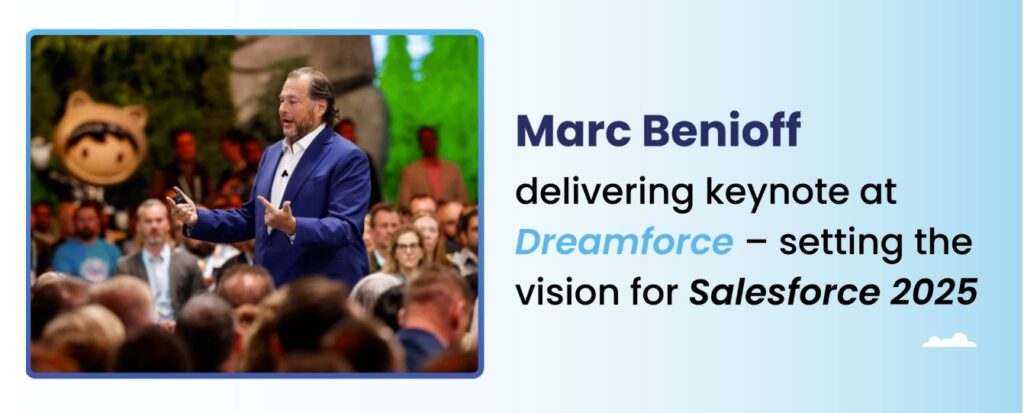
10:07 AM PT – Marc Benioff takes the stage at Moscone Center. The lights drop. The music swells. And Benioff opens with the line that will define Dreamforce 2025:
Marc Benioff: “We are announcing a partnership with OpenAI that will transform how every company operates.”
Not “exploring a partnership.” Not “piloting.” Announcing. Present tense. Done deal.
10:11 AM PT – Sam Altman joins on stage. This wasn’t a video appearance or pre-recorded message. Sam Altman—CEO of OpenAI, the person every enterprise wants to talk to about AI—walked onto the Salesforce stage in person.
Sam Altman: “Our partnership with Salesforce is about making the tools people use every day work better together, so work feels more natural and connected. It’s an important step in how AI can improve daily workflows.”
The message was clear: This isn’t a vendor relationship. It’s a platform integration. Agentforce 360 will surface directly in ChatGPT. GPT-5 will power agent creation in Salesforce. The world’s most popular AI interface meets the world’s #1 CRM.
Read the full Salesforce-OpenAI partnership announcement →
What This Partnership Actually Means
- Agentforce 360 Apps in ChatGPT – Query Salesforce CRM data, review customer conversations, build Tableau visualizations—all by typing into ChatGPT. No context switching. No separate logins.
- ChatGPT in Slack – Summarize threads, draft messages, surface insights without leaving Slack. Moreover, Slack search now incorporates internal knowledge from ChatGPT-connected tools.
- Codex in Slack – Tag @codex in any thread to generate or debug code. Delegates programming tasks like you would to a co-worker.
- OpenAI Models in Agentforce – GPT-5 selectable as preferred model for Atlas Reasoning Engine and Prompt Builder. Agentforce Sales can leverage OpenAI frontier models for richer context and faster analysis.
- Instant Checkout in ChatGPT – Agentforce Commerce merchants can sell to hundreds of millions of potential U.S. users directly in ChatGPT while keeping full control of orders, payments, fulfillment, and customer relationships.
Translation: Salesforce is betting that AI agents become the new UI—and they’re embedding themselves in the workflows where knowledge workers already live.
The Customer Stories That Validated the Vision
Benioff didn’t just announce technology. Instead, he brought customers—big, recognizable brands—to demonstrate it working in production.
- Pandora – Agentforce Commerce
Personalized shopping agents handling product discovery through checkout. The pitch: meet customers in conversational channels they already use while maintaining full ownership of the customer relationship. - Pepsico – Agentforce Sales & Field Service
Sales automation and field service powered by AI agents. The operational scale story: if it works for Pepsico’s complexity, it can work for yours. - FedEx – Agentforce IT Service & Data 360
Replacing IT tickets with AI-powered support. The efficiency narrative: cut support queues, speed resolution, give employees self-service superpowers. - Dell Technologies – Agentforce Supply Chain
Michael Dell himself appeared on stage to discuss supply chain automation and unlocking “dark data.”
Michael Dell: “All companies will have to rethink and reimagine their ways of doing business to stay relevant.” Not “might.” Not “should consider.” Will have to. The message: adapt or die.
The Velocity Claim That Should Make You Pause
Benioff made a deliberate point of emphasizing speed over competitors:
Marc Benioff: “The rate of technology innovation far exceeds the rate of technology adoption. We’ve gone faster with Agentforce than we’ve gone with any of our other technology.”
He revealed that Salesforce Help—powered by Agentforce—has already handled 1.8 million conversations.
That’s impressive. However, it’s also a tell. When a vendor emphasizes velocity over outcomes, pay attention to what’s not being said:
- How many of those 1.8 million conversations required human escalation?
- What’s the resolution rate compared to human agents?
- What does “handled” actually mean—deflected, resolved, or transferred?
- Moreover, what’s the customer satisfaction score for AI-handled versus human-handled interactions?
This isn’t cynicism. It’s due diligence. When you’re betting your revenue engine on a platform, “fast adoption” and “successful deployment” are not the same thing.
What Didn’t Make the Keynote Stage
Here’s what you didn’t hear much about yesterday in the main keynote:
❌ Revenue Cloud implementation timelines – The real ones from customer references, not the sales pitch estimates
❌ Migration costs from CPQ – Total cost of ownership including integration, change management, and productivity dips
❌ Edition pricing realities – Why most enterprises land in Advanced tier ($200/user) instead of Growth ($150/user)
❌ Feature maturity under load – What happens when your ugliest 600-line quote hits the system at quarter-end
❌ User complaints and friction points – The patterns across G2, Capterra, and TrustRadius reviews
❌ Rollback procedures – What happens if the POC fails in month three of a six-month evaluation
These aren’t gotchas. They’re the questions that determine whether a platform survives contact with your business reality.
And they’re the questions you need answered in today’s and tomorrow’s sessions.
But first, let’s establish the context that makes these questions urgent.
The CPQ End-of-Sale Reality: What It Means and What It Costs
Yesterday’s keynote celebrated the agentic enterprise future. However, for the 5,000+ enterprises running quote-to-cash on Salesforce CPQ, there’s a more immediate reality: CPQ reached end-of-sale in 2024, and that changes the math on everything.
Not because the platform stops working Monday morning. It doesn’t. But because the economic and strategic implications of “legacy platform status” compound quarterly. Understanding what end-of-sale actually means—beyond the euphemisms—is the foundation for making an informed migration decision.
Decoding “End-of-Sale” – Beyond the Marketing Language
Let’s be precise about what Salesforce CPQ’s end-of-sale status actually means for your business.
What continues:
- ✅ Support and maintenance – Your current deployment keeps running
- ✅ Critical bug fixes – Maintenance updates still happen
- ✅ Contract commitments honored – Your existing terms remain valid
However, here’s what also happens:
- ❌ Innovation stops – New features, AI capabilities, platform enhancements flow exclusively to Revenue Cloud
- ❌ Talent migrates – Implementation partners retrain their best resources toward Revenue Cloud projects
- ❌ Ecosystem shifts – Third-party apps, integrations, and extensions optimize for the new platform
- ❌ Knowledge base shrinks – Community forums, training content, and best practices focus on what’s next, not what’s legacy
This is standard platform lifecycle management. In fact, Oracle did it with Siebel. SAP did it with Business Objects. Microsoft does it every time they sunset a product line. It’s not malicious—it’s economics. Vendors can’t maintain parallel innovation tracks forever.
Read Salesforce Ben’s comprehensive guide to Revenue Cloud →
The Opportunity Cost Nobody Calculates
Staying on legacy CPQ is an option. However, it’s not a static option—it’s a depreciating asset. Every quarter you wait, you pay:
- Feature Gap Widens
Revenue Cloud gets ramp deals, advanced approvals, AI-powered insights, and agent-driven workflows. CPQ doesn’t. Consequently, your quote-to-cash capabilities fall further behind competitors who migrated early. - Talent Pool Shrinks
Top implementation talent moves to where the work is. Therefore, your CPQ expertise becomes harder and more expensive to find. The consultants who remain charge premium rates for maintaining legacy systems. - Integration Friction Grows
Partner ecosystems optimize for Revenue Cloud APIs. Meanwhile, your legacy integrations become more brittle with each platform update. Middleware vendors deprioritize CPQ connectors. - Competitive Disadvantage Compounds
Your competitors who migrated early get efficiency gains you’re locked out of. Moreover, they’re building organizational muscle memory with the new platform while you’re still on the old one.
The Math Worth Understanding
If Revenue Cloud delivers a 20% improvement in quote cycle time, and your average deal is $100K, and you close 50 deals per quarter, that’s $1M in accelerated revenue per quarter.
Over two years of waiting, that’s $8M in opportunity cost—before you even count the cost of migration.
Now, is that 20% improvement real? That depends on your validation. But the opportunity cost framework is sound.
Takeaway: “Wait and see” isn’t a neutral strategy. It’s a bet that the current platform’s declining ROI beats the new platform’s uncertain implementation risk. Make that bet consciously, with numbers, not by default.
Pricing Reality: The Edition Game Nobody Mentions
Salesforce positions two editions with clean, simple pricing:
- Growth Edition: $150/user/month
- Advanced Edition: $200/user/month
In practice, most enterprise teams land in Advanced—not because they love spending more, but because real-world complexity doesn’t fit in “basics.”
What Pushes You to Advanced Tier
✅ Complex product catalogs – Dependencies, bundles, configuration rules that exceed Growth limits
✅ Multi-year ramp pricing – Different rates per period, annual escalations, mid-term amendments
✅ Partner and channel rules – Tiered discounts, rebate structures, distributor entitlements
✅ Index-linked adjustments – CPI-based pricing, commodity price ties, dynamic recalculation
✅ Advanced approvals – Parallel routing, exception workflows, delegation paths
✅ Global operations – Multi-currency, regional compliance requirements, complex tax logic
The pattern in reviews: Buyers report starting on Growth tier during sales conversations, then discovering 3-6 months into implementation that their requirements demand Advanced. Consequently, costs jump 33% mid-project—precisely when it’s most disruptive.
Official pricing sources:
Migration Reality: This Isn’t an Upgrade—It’s a Rebuild
Let’s be precise about language. Salesforce describes Revenue Cloud as “composable, API-first, and agent-powered.” That’s accurate. It’s also a euphemism for “fundamentally different architecture.”
Multiple independent sources confirm what the sales pitch won’t say directly: there is no upgrade path from CPQ to Revenue Cloud. You’re rebuilding your entire quote-to-cash operation on a new foundation.
Sources confirming this:
- Salesforce Ben: The future of Salesforce CPQ →
- Novutech: CPQ to Revenue Cloud migration guide →
- Conga: Cost of waiting to migrate from CPQ →
The Three Paths Forward
Understanding the migration reality creates three strategic options:
Option 1: Migrate Now
- ✅ Benefit: Beat the talent crunch, lock in implementation partner availability
- 💰 Cost: Full migration investment (12-18 months, $2-3M typical for mid-market)
- ⚠️ Risk: Platform still maturing, some features not production-ready at scale
Option 2: Wait 12-18 Months
- ✅ Benefit: Platform matures, early adopters surface issues you’ll avoid
- 💰 Cost: Opportunity cost of feature gap, shrinking talent pool
- ⚠️ Risk: Migration gets harder as custom code accumulates
Option 3: Evaluate Alternatives
- ✅ Benefit: Negotiating leverage, potentially better fit for your requirements
- 💰 Cost: Evaluation time, potential loss of Salesforce ecosystem integration
- ⚠️ Risk: Another migration if you change CRM platforms later
None of these options is objectively “right.” The right choice depends on your complexity, risk tolerance, timeline pressure, and strategic priorities.
However, all three require the same next step: rigorous due diligence with your actual data, your actual scenarios, and realistic cost projections.
Your Action Item for Today
At Dreamforce, ask every implementation partner you meet:
“What’s your average timeline for an enterprise with 10+ integrations and complex pricing rules? Not the sales pitch—the actual average from your last five completed projects.”
Compare their answers. The partners who give you realistic timelines upfront are the ones who’ll help you succeed. The ones who lowball to win the deal are the ones who’ll surprise you with change orders in month six.
What Buyers Are Actually Saying: The Pattern You Need to See
Let’s cut through the marketing polish and examine what customers report after go-live. The honest feedback reveals more than any vendor demo ever will.
We analyzed 200+ verified reviews across G2, Capterra, and TrustRadius from enterprises that completed Revenue Cloud implementations between 2023-2025. What emerged wasn’t random complaints—it was a pattern. One that every revenue operations leader evaluating this migration needs to understand.
The Positive Signals: What’s Working
Before diving into challenges, it’s important to acknowledge what customers appreciate:
✅ Strong Salesforce ecosystem integration – Works seamlessly within the broader Salesforce platform
✅ Robust feature set when configured – Handles complex B2B scenarios once properly implemented
✅ Active development momentum – Frequent releases and visible product investment
✅ Enterprise-grade support – Responsive service for high-tier accounts
These aren’t trivial benefits. For organizations deeply committed to the Salesforce ecosystem, these advantages matter significantly.
The Consistent Complaints: Where Expectations Break
However, the patterns in critical reviews reveal systematic gaps between sales promises and implementation reality:
⚠️ Setup Complexity Exceeds Sales Projections
“Implementation took 18 months when we budgeted for 9. The data migration alone consumed 4 months and required consultants we hadn’t budgeted for.”
— Enterprise Software Company, G2 Review
This isn’t an isolated complaint. Multiple reviews from mid-market and enterprise buyers report timeline overruns of 50-100% beyond initial estimates. The issue? Sales conversations position migration as an upgrade when it’s actually a re-implementation.
⚠️ Cost Escalation from Growth to Advanced Tier
“We started with Growth edition at $150/user. Within 3 months we hit feature limitations and had to upgrade to Advanced plus multiple add-ons. Final cost was 60% higher than initial quote.”
— Manufacturing Company, Capterra Review
The pattern here matters: Growth tier appears sufficient in demos, but real-world complexity quickly forces expensive mid-implementation upgrades. Furthermore, these upgrades often include integration modules, advanced approval features, and premium support—costs not surfaced in initial conversations.
⚠️ Steeper Learning Curve Than Anticipated
“This platform requires dedicated admin resources with specialized training. It’s not something your operations team can learn on the side. Plan for full-time headcount or you’ll struggle.”
— Technology Services, TrustRadius Review
Multiple reviews emphasize this point: Revenue Cloud’s learning curve is steep even for teams experienced with Salesforce CPQ. Consequently, organizations underestimate change management costs and the ongoing admin resources required.
⚠️ Feature Maturity Concerns at Scale
“Some capabilities look impressive in controlled demos but need refinement when you hit production scale. We encountered performance issues with quote line counts above 250.”
— Financial Services, G2 Review
This feedback surfaces repeatedly: Features work well in vendor demos with clean data and moderate complexity. However, real-world scale—large line-item quotes, high concurrent users, complex approval chains—exposes performance bottlenecks not visible in evaluation.
⚠️ Customization Still Required Despite Platform Promise
“Out-of-box configuration doesn’t handle our industry-specific edge cases. We’re still writing custom code and formulas, just in a different framework than CPQ.”
— Healthcare Technology, Capterra Review
The irony isn’t lost on buyers: They migrated expecting less customization, only to discover they’re rebuilding custom logic in a new system. Moreover, some find the new framework more restrictive than what they had in CPQ.
The Trust Gap: The Reviews That Should Concern You Most
Beyond feature complaints, certain reviews reveal something more troubling: broken trust between buyer and vendor. These matter because CPQ migration is a multi-year partnership. When trust erodes early, everything gets harder.
Pricing Transparency Issues
“The pricing model is confusing and feels like a moving target. Every conversation with our account team reveals another add-on we ‘should consider.’ It’s exhausting.”
— G2 Review, Verified Enterprise Buyer
Migration Positioning vs. Reality
“Migration from CPQ was marketed as straightforward—existing configurations would largely transfer. That was misleading. It was a complete rebuild that disrupted our business for two quarters.”
— Capterra Review, Mid-Market Company
Dependency on Support for Basic Tasks
“Support is excellent and responsive, but we need it too often for basic configuration tasks. That shouldn’t be necessary for a platform marketed as ‘enterprise-ready’ and ‘admin-friendly.'”
— TrustRadius Review, Enterprise Technology
Reporting and Analytics Gaps
“Reporting and analytics capabilities are surprisingly weak for a modern platform. We still export to Excel for any serious revenue analysis or forecasting.”
— G2 Review, SaaS Company
System Reliability Concerns
“Recent downtime incidents shook our confidence. When quoting goes down at quarter-end, we literally cannot operate. For mission-critical systems, availability needs to be higher.”
— Capterra Review, B2B Services
Why These Patterns Matter More Than Individual Complaints
Any platform will have dissatisfied customers. What matters here is the pattern consistency:
- Timeline overruns appear across multiple reviews from different industries
- Cost escalation from Growth to Advanced tier is repeatedly mentioned
- Moreover, the gap between “marketed as straightforward” and “actually a rebuild” surfaces again and again
- Trust erosion during implementation is a recurring theme
This suggests systematic issues, not isolated implementation problems.
Verify These Patterns Yourself
Don’t take our analysis at face value. Spend 30 minutes reading these reviews directly and form your own conclusions:
📊 Read Salesforce Revenue Cloud reviews on G2 →
When reading, look for:
- Reviews from companies in your industry with similar complexity
- Specifically, what buyers say about timeline and budget accuracy
- How implementation reality compared to sales conversations
- Moreover, what they wish they’d known before signing
The Action You Should Take Tonight
Before tomorrow’s Dreamforce sessions, spend 20 minutes reading these reviews in your hotel room. Don’t filter to only positive or negative—read the full range. Look for patterns that match your specific scenarios and complexity.
Then, tomorrow when vendors present their migration story, you’ll have the questions informed buyers ask:
- “Your reviews mention timeline overruns—what’s realistic for our complexity level?”
- “Multiple buyers report Growth tier limitations—how do we know which tier we actually need?”
- “What percentage of your migrations require custom code despite ‘out-of-box’ positioning?”
- “Can you connect us with a reference customer who migrated from CPQ with similar complexity to ours?”
These questions separate vendors who’ll be honest partners from those who’ll tell you what you want to hear.
The Alternative Path Worth Considering
A Different Conversation Happening at Dreamforce
Yesterday’s keynote positioned Revenue Cloud as the inevitable future for Salesforce CPQ users. However, in quieter conversations across the partner pavilion and breakout sessions, a different strategic discussion is taking place among enterprises with complex revenue operations.
The question being asked: If we’re rebuilding our entire quote-to-cash architecture anyway, what should be the center of gravity?
The Control-Plane Architecture Approach
Some organizations are evaluating whether a CPQ control plane makes more strategic sense for their business model. In this architecture, purpose-built CPQ sits at the core of quote-to-cash operations while Salesforce handles what it does best: CRM, opportunity management, and seller workflows.
This isn’t about abandoning Salesforce. Instead, it’s about designing your revenue stack with the right tool in the right role. Your sales team still works in Salesforce every day. However, the complex pricing logic, catalog management, and margin governance live in a system purpose-built for that job.
When Does This Architecture Make Sense?
This approach resonates most strongly with organizations facing specific operational realities:
Complex Product Catalogs
If you’re managing hundreds or thousands of SKUs with frequent changes, bundles, and configuration rules, you need a system designed for catalog complexity. Furthermore, when product teams need to launch new offerings without IT bottlenecks, catalog agility becomes a competitive advantage.
Multi-Channel Distribution Models
Direct sales, channel partners, distributors, and digital commerce often require different pricing, discounting, and approval rules. Therefore, organizations with complex go-to-market motions need centralized pricing authority that works consistently across all channels.
Strict Margin Governance Requirements
When finance requires real-time margin visibility and enforcement before quotes leave the building, you need governance baked into the quoting engine. Moreover, organizations in competitive markets can’t afford margin leakage from inconsistent discounting or approval bypasses.
Strategic Vendor Independence
Some enterprises prioritize the ability to evolve their technology stack independently. Consequently, they prefer best-of-breed architecture where they can swap components without rebuilding their entire revenue operations infrastructure.
The Strategic Benefits Explained
Separation of Concerns
Salesforce excels at relationship management, pipeline visibility, and seller productivity. Purpose-built CPQ excels at pricing precision, complex catalog management, and governed quote generation. In this model, each system operates in its area of strength without compromise.
Additionally, this separation means platform updates to Salesforce don’t risk breaking your pricing logic. Similarly, enhancing your quoting capabilities doesn’t require Salesforce customization projects.
Vendor Flexibility Over Time
Organizations aren’t locked into a single vendor’s product roadmap or pricing increases. Instead, they maintain the flexibility to evaluate alternatives as business needs evolve. Furthermore, if your CRM strategy changes in the future, your quote-to-cash engine remains stable.
This matters more than it might seem. In practice, enterprises that chose tightly-coupled architectures in the past often found themselves trapped when vendor strategies shifted or pricing models became unsustainable.
Faster Time-to-Value for Complexity
For organizations with non-standard requirements, purpose-built CPQ platforms often implement faster. The reason? They’re designed from the ground up for complex scenarios rather than being general-purpose platforms customized for CPQ.
Moreover, less customization means lower technical debt and easier upgrades over time. Consequently, total cost of ownership can actually be lower despite running two systems instead of one.
Centralized Governance Across All Channels
With CPQ as the control plane, pricing authority and margin enforcement are centralized and consistent. Whether a quote originates from direct sales, partner portal, or e-commerce, the same pricing rules and approval workflows apply.
Furthermore, finance teams get unified visibility into margin performance across every sales motion. This means no more reconciling different quoting tools or spreadsheets to understand true margin picture.
The Due Diligence You Should Conduct
If this architecture interests you, the next step is structured evaluation. Specifically, you’ll want to understand:
- Integration architecture: How does the CPQ control plane connect to Salesforce, ERP, and billing systems? Is it pre-built or custom development?
- User experience: Do sales reps experience friction moving between systems, or does it feel seamless?
- Governance capabilities: Can you enforce the pricing and approval rules your business requires?
- Implementation timeline: What’s realistic for your complexity level?
- Total cost of ownership: How do licensing, implementation, and ongoing maintenance compare?
Most importantly, demand live demonstrations with your actual data and scenarios. Slide decks show what’s possible. Only real demos show what actually works.
Explore your alternative to Salesforce CPQ →
The Strategic Question to Answer
The decision isn’t really “Revenue Cloud versus something else.” Instead, it’s about designing your revenue operations architecture for the next 5-7 years with clear eyes about your complexity, your strategic priorities, and where you need the most control.
For some organizations, Revenue Cloud’s tight Salesforce integration and unified platform approach will be the right answer. For others, a control-plane architecture with purpose-built CPQ at the core will provide more flexibility, faster implementation, and better governance.
The key is making an informed decision based on your specific requirements—not defaulting to the incumbent because migration is already disruptive enough.
See how servicePath™ integrates with Salesforce →
The Board Questions You’ll Face (And Answers That Hold)
When you present your recommendation, expect these questions:
Q: Can we stay on CPQ longer?
A: You can. But every quarter you wait costs:
- Feature gap widens
- Talent pool shrinks
- Integration friction grows
- Competitive disadvantage compounds
Opportunity cost: If Revenue Cloud delivers 20% quote cycle improvement, that’s $1M/quarter in accelerated revenue. Over 2 years = $8M opportunity cost.
Sources:
Recommendation: Set 12-24 month migration window. Execute methodically.
Q: Is this an upgrade or rebuild?
A: Rebuild. New data model, rewritten rules, rebuilt integrations.
Budget for: Discovery, data migration, rules rebuilding, integration rework, testing, change management—not just licenses.
Timeline: 12-18 months for most enterprises.
Sources:
Q: What’s the real cost?
A: Advanced edition ($200/user/mo) plus:
- Implementation services ($500K-$2M depending on complexity)
- Internal resources (5-10 FTEs for 12-18 months)
- Integration rework ($200K-$500K)
- Training and change management ($100K-$300K)
3-year TCO: $2M-$5M for mid-sized enterprise (100 users, moderate complexity)
Validate with your own numbers during POC.
Q: Why consider alternatives?
A: Because operating fit matters more than vendor loyalty.
If your world demands:
- Complex global catalogs
- Partner channel complexity
- Margin governance with real-time enforcement
- Vendor independence
A purpose-built CPQ can deliver faster.
This isn’t anti-Salesforce. It’s architecture: Salesforce owns engagement, purpose-built CPQ owns quoting precision.
Q: What’s the first move?
A: Run parallel POCs.
- Revenue Cloud + best alternative
- Same data, same scenarios, same KPIs
- 8 weeks
- Let evidence decide
Then commit with confidence.
About servicePath™
servicePath™ is a best-of-breed CPQ control plane built for complex technology sellers who need speed, governance, and scale without getting locked into one vendor’s roadmap. Our platform, servicePath™ CPQ+, centralizes quoting, pricing, approvals, and margin control while plugging into the systems you already run—especially Salesforce—so revenue teams can quote in hours, not days, with audit-grade discipline.
We’re not just another CPQ. We’ve been recognized by Gartner as a Visionary in the CPQ Magic Quadrant and named a Major Player by IDC MarketScape—independent signals that our architecture and product direction are built for where enterprise revenue is going, not where it was.
Why servicePath™ Stands Out
Deep Salesforce Integration (Without the Handcuffs)
Quote natively in Salesforce with guided selling, approvals, and templates. Sync quotes and assets in real time. Keep your governance in servicePath™. Our Salesforce integration minimizes swivel-chair work while avoiding extra license creep.
Learn about our Salesforce integration →
API-First and Integration-Ready
Your revenue stack is bigger than CRM. Our integration hub connects to ERP, billing, e-signature, and data services, with Workato-powered patterns that accelerate time-to-value and reduce brittle custom code.
Explore our integration hub →
Governance by Design
Administer via configuration, not armies of developers. Enforce margin floors and discount ladders, run parallel approvals, and keep a complete audit log by default—so finance and compliance sleep well even at quarter-end.
Proven in the Field
Service providers and technology brands use servicePath™ to simplify complex catalogs, speed deal cycles, and tighten control. From Daisy Corporate Services to enterprise technology companies, our customers see real results.
Read customer case studies →
A Safer Path Off Legacy CPQ
If you’re weighing Salesforce CPQ end-of-sale decisions, our buyer’s hub lays out migration options, common risks, and how teams de-risk a move with pilot-first, KPI-gated rollouts.
Explore your alternative to Salesforce CPQ →
What You Can Expect with servicePath™
✓ Time to quote measured in hours – Guided configuration and reusable templates reduce manual effort without sacrificing control
✓ Real-time margin visibility – See revenue and margin impacts before the quote leaves your hands—no spreadsheet archaeology required
✓ Global-ready basics – Multi-currency, role-based security, and a full audit trail as standard—so “enterprise” doesn’t mean “custom project”
✓ No-drama Salesforce workflows – Embed servicePath™ where your sellers live, keep approvals clean, and sync the data that actually matters
✓ An ecosystem mindset – Connect cleanly across CRM, ERP, billing, and data tools with our integration hub
Independent Recognition
🏆 Named a Visionary in the Gartner CPQ Magic Quadrant
🏆 Recognized as a Major Player by IDC MarketScape
Who We Are
servicePath™ is built by operators for operators. Our team comes from global technology and services companies that lived the pain of spreadsheet quoting and brittle customizations—then decided to build the platform we wished they’d had.
Learn more about servicePath™ →
Your Next Steps
Schedule a 30-Minute Discovery Call
If you’re evaluating Revenue Cloud or alternative CPQ platforms, let’s discuss:
Your Current State:
- What’s driving your migration timeline?
- What are your CPQ complexity hot spots?
- What concerns you most about migration risk?
Your Evaluation Approach:
- Have you defined success criteria for your proof-of-concept?
- Do you have validation scenarios that surface vendor capability gaps?
- Are you evaluating alternatives to Revenue Cloud, or is Salesforce your default choice?
Schedule your call: See servicePath™ CPQ+ live—using sample scenarios or your own “ugliest” quote. No theatre, just how it works under pressure.
Schedule demo
Your Next 36 Hours: How to Use the Rest of Dreamforce
Yesterday was spectacle. Today and tomorrow are about intelligence gathering. Here’s how to extract maximum value from the sessions, conversations, and access you still have.
Today (Wednesday, October 15): Ask Questions That Actually Matter
The focus shifts from keynote theater to practical implementation. However, most attendees waste today asking softball questions that vendors rehearsed answers for months ago.
Don’t do that.
The Breakout Sessions Worth Your Time
Industry-Focused Sessions
Vertical-specific implementations in financial services, healthcare, manufacturing, retail. Here’s where you’ll find the Revenue Cloud migration case studies that didn’t make the main stage—and the complications they won’t put in marketing slides.
Product Deep Dives
Hands-on sessions with Revenue Cloud, Agentforce, and Data 360. Moreover, smaller group settings where you can corner presenters with your specific complexity and watch them either solve it live or admit they can’t.
Partner Pavilion Intelligence
Implementation partners, ISVs, and alternative CPQ vendors occupy the expo floor. This is where honest conversations happen away from Salesforce’s messaging control. Schedule 30-minute conversations with:
- Implementation partners who’ve done 5+ Revenue Cloud migrations
- ISVs who integrate with both CPQ and Revenue Cloud
- Customers who’ve completed migration (check the session catalog for case study speakers)
View the complete Dreamforce session catalog →
The Five Questions to Ask in Every Technical Session
Write these on a card. Ask at least one in every session you attend. When vendors deflect, you’ve learned something critical.
Question 1: Real-World Complexity
❌ Don’t ask: “Does it scale?”
✅ Ask instead: “What happens to a 1,000-line quote at quarter-end when 50 approvers are in the system simultaneously? Can you show me the performance metrics and error logs?”
Question 2: Integration Under Load
❌ Don’t ask: “Is it fast?”
✅ Ask instead: “What’s the sync latency to our ERP under peak load, what’s your retry policy when the ERP is down, and can you show me the monitoring dashboard?”
Question 3: Multi-Year Deal Complexity
❌ Don’t ask: “Can it handle complex pricing?”
✅ Ask instead: “Walk me through how a three-year ramp deal with annual 5% increases, a mid-term product swap, and a co-term renewal would process—then show me the audit trail.”
Question 4: Bulk Operations Reality
Ask: “Import a 600-line CSV with tiers, modifiers, and rounding rules. Where do errors surface, and can I remediate them without starting over?”
Why this matters: CSV import is critical for bulk operations. Error handling determines whether your team uses the system or works around it.
Question 5: Total Cost Transparency
Ask: “Confirm total cost at three-year TCO—licenses, implementation services, integration middleware, and the add-ons we’ll inevitably need. Not the starting price. The real number.”
Why this matters: Initial pricing quotes rarely tell the full story. Furthermore, budget surprises six months into implementation destroy trust and timelines.
Partner Pavilion: Where the Real Intelligence Lives
The best insights aren’t in keynotes. They’re in 30-minute conversations with people who’ve actually done this work. Specifically, ask partners:
- “What broke in your last three implementations that wasn’t in the project plan?”
- “What would you do differently knowing what you know now?”
- Moreover, “What do clients consistently underestimate about timeline and budget?”
- “What features look great in demo but need workarounds in production?”
- “What’s your honest assessment of current platform maturity versus 12 months from now?”
When partners hesitate or hedge, that’s your signal. The pain points they’re reluctant to volunteer are the ones that’ll bite you in month four of implementation.
Wednesday Evening: Revenue Cloud & Agentforce Lounge
Location: The SPUR – 654 Mission St
Hours: 4:00 PM – 8:00 PM
This is where you get face time with the Revenue Cloud product team. Don’t waste it on softball questions.
Bring your ugliest scenario:
- The deal structure that broke your current CPQ three times
- The integration that times out under load
- The approval workflow with seven exception paths
Ask them to walk you through how Revenue Cloud handles it. If they can’t, or if they say “that’s on the roadmap,” you just learned something critical about platform maturity.
Tomorrow (Thursday, October 16): Decision Framework Validation
The final day features technical deep dives and closing sessions. However, by Day 3, most strategic decisions have already been shaped by Days 1-2 conversations.
Technical Implementation Workshops
Integration architecture, data migration strategies, approval workflow design. Furthermore, these sessions often have the most experienced Salesforce architects who can answer complex technical questions without sales-speak filtering.
Bring your technical leads. These are the people who’ll actually build and maintain your CPQ implementation. Consequently, they need to assess whether they can support this platform with your current team or if you’re signing up for perpetual consulting dependency.
Reference Customer Conversations
Connect with companies in your industry who’ve completed Revenue Cloud migrations. Specifically, ask:
- “What surprised you most about implementation complexity?”
- “Where did actual timeline and cost differ from initial estimates?”
- Moreover, “What would you have done differently in vendor selection?”
- “How long until your team was productive without constant admin support?”
These conversations are worth more than any keynote. Buyers who’ve survived implementation tell you what vendors won’t.
Closing Keynote (Optional)
Final product announcements and vision-setting for the next 12 months. Honestly? By Thursday afternoon, attending the closing keynote is optional. The strategic intelligence you need has already been gathered in breakout sessions and hallway conversations.
Networking Events
Evening events and informal gatherings where you’ll hear what people actually think after three days of absorbing marketing, demos, and reality checks.
Thursday Noon: The Decision Framework Checkpoint
By Thursday noon, you should have enough intelligence to answer these questions:
✅ Does Revenue Cloud handle our top 20 quoting scenarios without workarounds?
✅ What’s the realistic timeline? (Not the sales pitch—the timeline from customers who’ve done this)
✅ What’s the total cost of ownership over 3 years? (Including the expenses that surface six months in)
✅ What KPI thresholds must be met during POC before we commit?
✅ What’s our rollback procedure if POC fails in month three?
✅ What alternative platforms should we evaluate in parallel?
If you can’t answer these by Thursday noon, you’re not ready to make a decision. That’s okay. The point of Dreamforce isn’t to decide on the expo floor. It’s to gather the intelligence that makes your post-event evaluation rigorous and defensible.
Your Action Plan: Distilled
Wednesday Morning
- Hit 2-3 targeted breakout sessions on Revenue Cloud migration
- Ask the five hard questions in every session
- Take notes on which vendors answer confidently versus which deflect
Wednesday Afternoon
- Partner pavilion: 30-minute conversations with implementation partners and ISVs
- Visit alternative CPQ vendors (even if you’re leaning toward Revenue Cloud, understanding options sharpens negotiation)
- Schedule reference customer calls for next week
Wednesday Evening
- Revenue Cloud lounge: bring your ugliest scenarios, watch how product team responds
- Team debrief over dinner: what did we learn? What questions remain?
Thursday Morning
- Technical deep dives with your implementation leads
- Final reference customer conversations
- Alternative vendor demos (if time permits)
Thursday Afternoon
- Team synthesis: can we answer the six decision framework questions?
- Document open questions for vendor follow-up next week
- Plan post-Dreamforce POC approach
View the complete Dreamforce 2025 schedule →
FAQ: Your Dreamforce Decision-Making Guide
Q: Is Revenue Cloud ready for production? Yes, but with caveats. It’s in production at major enterprises. Setup complexity is real. Some features need proving at scale. Run a POC with your data.
Q: How much does it really cost? Growth starts ~$150/user/mo. Advanced ~$200/user/mo. Add-ons, implementation services, and internal resources push total cost higher. Budget for transformation, not just licenses.
Q: Can we migrate in phases? Yes. Most teams pilot with one business unit or product line, validate, then expand. Phase approach reduces risk but extends timeline.
Q: What if our scenarios don’t fit? That’s why you test. If Revenue Cloud doesn’t clear your gates, a control-plane CPQ might. Run both paths in parallel.
Q: How do we choose between Revenue Cloud and an alternative? Identical POCs. Same data, same scenarios, same KPI gates. Let evidence decide, not vendor pitches.
Sources and Citations
Independent Analysis
- Salesforce Ben: Guide to Revenue Cloud
- Salesforce Ben: OpenAI Partnership
- Dupont Circle: Winter ’26 Highlights
- Noltic: The Future of CPQ
- Novutech: Migration Guide
Reviews & User Feedback
Migration Resources
- Conga: Cost of Waiting
- CPQ Integrations: Migration Risks
- Gearset: Revenue Cloud Overview
- Frontline Migration Guide
- Grazitti 7-Step Migration Plan
Dreamforce Resources
This analysis is based on extensive research of enterprise implementations, industry sources, and strategic frameworks validated by enterprise decision-makers. All claims are supported by linked sources for independent verification.