
Why Refreshing Your Enterprise Product Catalog is Now a Board-Level Mandate
TL;DR for Busy C-Suite Executives
Your product catalog just became your secret weapon—or your Achilles’ heel. McKinsey’s 2025 research shows 78% of organizations now use AI in at least one business function, while Gartner predicts 40% of enterprise apps will have AI agents by 2026. The CPQ market is exploding to $5.8-7.3 billion by 2026. Bottom line: catalog modernization isn’t an IT project anymore—it’s survival strategy in an AI-first world where your catalog speed equals your market dominance. Furthermore, the companies that get this right will eat everyone else’s lunch.
Fall invites honest pruning. Winning enterprises do the same with their product catalogs: retire what no longer serves, shape what does, and create room for what’s next. In 2025, “what’s next” arrives fast—AI-enabled bundles, usage tiers, and region-aware price books. The only way to keep up without breaking governance is to treat catalog renewal as a capability, not a once-a-year project. This piece lays out why velocity matters, what boards expect, and how a living, versioned catalog—backed by simulation, policy-driven approvals, staged releases, and instant rollback—turns change into advantage.
Executive Summary

Enterprise product catalog modernization has become the defining strategic imperative for Fortune 500 boards navigating AI-driven market transformation. Fall represents nature’s most systematic renewal—trees shed leaves not from weakness, but to redirect energy toward stronger growth. For enterprises managing thousands of SKUs across global markets, enterprise product catalog modernization has evolved from operational necessity to board-level mandate. McKinsey’s 2025 research demonstrates that 78% of organizations now use AI in at least one business function, while NACD’s 2025 governance priorities elevate digital velocity as critical director responsibility.
Successful enterprise product catalog modernization requires both strategic vision and operational excellence. Similarly, the crisp air of fall clarifies things. Trees shed leaves to protect the core and return stronger. Enterprises need the same discipline in their catalogs: retire stale SKUs, add AI-era offers, localize prices, and ship small changes frequently with safety. That’s not a spreadsheet exercise; furthermore, it’s a governed operating model.

Boards have moved from curiosity to oversight on AI and commercialization. The NACD 2025 Public Company Board Practices & Oversight Survey confirms AI is now a standing agenda item for many directors, with 62% of boards dedicating agenda time to AI discussions—yet metrics and frameworks remain uneven, putting pressure on CFOs, CROs, and CIOs to prove time-to-market and risk control simultaneously.
Meanwhile, adoption and investment rose again: 78% of organizations report using AI in at least one business function, and U.S. private AI investment reached $109.1B in 2024, according to Stanford’s AI Index 2025. The implication is simple: if your catalog can’t flex weekly—with evidence and guardrails—you don’t just move slow; you leak growth.
servicePath™ CPQ+ addresses this by making the catalog a living system: one commercial truth, role-based policy, pre-release simulation, staged releases, instant rollback—and the audit trail and separation of duties your board expects. Learn more about our enterprise CPQ solutions.
Table of Contents
- Introduction: Renewal in the Boardroom
- A Season for Enterprise Product Catalog Modernization
- Why Enterprise Product Catalog Modernization Still Feels Hard
- Five Critical Myths That Kill Catalog Velocity
- The Boardroom Awakening: When Enterprise Product Catalog Modernization Became a Director’s Problem
- The Competitive Intelligence Gap: Market Share Migration in Real Time
- Customer Retention Risk: The Hidden Cost of Delayed Enterprise Product Catalog Modernization
- The Enterprise Scale Challenge: Why Bigger Makes Everything Harder
- Why Enterprise Product Catalog Modernization Velocity Matters
- The Quartile Best-Practice Grid: Benchmarking Enterprise Catalog Velocity
- Enterprise Catalog Modernization Governance: Building Change Leadership
- How servicePath™ Delivers Enterprise Product Catalog Modernization
- Board-Level KPIs: Measuring Product Catalog Modernization Success
- Enterprise Product Catalog Modernization ROI: What CFOs Need to Hear
- The Board’s Five Critical Questions (And servicePath™’s Answers)
- Enterprise Product Catalog Modernization: AI-Native Future at Scale
- Conclusion: Leading Enterprise Product Catalog Modernization
Introduction: Renewal in the Boardroom {#introduction}
The leaves outside Microsoft’s Redmond headquarters were turning gold when CEO Satya Nadella made an observation that would reshape how Fortune 500 companies think about their most basic business asset: their product catalogs. He was discussing AI transformation, but his words perfectly capture the catalog crisis facing enterprise boards today.

Just as autumn trees systematically shed leaves to redirect energy toward stronger root systems, smart enterprises are recognizing that their legacy catalog processes—those sprawling spreadsheets, email approval chains, and “that’s how we’ve always done it” mentalities—need to go. However, the difference? Trees get a full season to transform. In today’s AI-accelerated market, enterprises get about 90 days before competitors eat their lunch.
For global organizations managing thousands of SKUs, multi-layered bundles, and region-specific compliance rules, refreshing a product catalog can feel like complete re-architecture. Yet in the AI-driven marketplace, where customer expectations shift daily and competitors roll out new digital offerings overnight, the ability to adapt at scale is no longer optional. It’s a board-level mandate.
A Season for Enterprise Product Catalog Modernization {#season-for-change}

When the first cold morning shows up, trees get honest. They drop what’s heavy so the core can endure and spring can be generous. Catalogs deserve the same honesty. Not a heroic clean-up every December—instead, a rhythm: prune what’s stale, shape what’s working, and make room for what’s next.
Furthermore, what’s next keeps arriving faster: AI-assisted service bundles, usage tiers that flex with consumption, index-linked pricing, and price books that reflect FX and tax reality. The market doesn’t grade intentions. Rather, it rewards the companies that ship—safely and often.
Nevertheless, when experiments turn into hype cycles, boards notice. Gartner’s analysis warns that over 40% of agentic AI projects could be scrapped by 2027 as costs rise and ROI remains unclear. Winners will translate experiments into a governed release cadence.
The Urgency of Enterprise Product Catalog Modernization
Enterprise product catalog modernization has become urgent because traditional approaches can’t keep pace with AI-driven market changes. Modern enterprises need systems that support continuous adaptation rather than quarterly batch updates.
Why Enterprise Product Catalog Modernization Still Feels Hard {#catalog-renewal-hard}
Most teams don’t struggle for ideas. Instead, they struggle from idea → quote:
- Prices live in three places; exceptions live in someone’s inbox
- Legal wants a clause tweak; Finance wants the margin math; Sales uses last month’s bundle because it’s in their template
- Every step is logical by itself; together, it grinds momentum
Enterprise product catalog modernization fails when organizations treat symptoms rather than root causes. Add AI-era offers and the friction compounds. Without a single source of commercial truth, every small change becomes a negotiation. Without policy-driven approvals, timelines hinge on people being online. Without simulation, margin erosion sneaks in. Without staged releases and rollback, the blast radius of a mistake grows with every market you serve.
Common Enterprise Product Catalog Modernization Challenges
Enterprise product catalog modernization faces unique obstacles at scale. Complex approval hierarchies, regulatory compliance requirements, and integration dependencies create bottlenecks that kill velocity. However, these challenges aren’t insurmountable with the right approach.
Five Critical Myths That Kill Catalog Velocity {#five-myths}
Enterprise catalog transformation stalls not from technical limitations, but from organizational myths that perpetuate slow, risky processes. These deeply-held beliefs create artificial constraints that prevent companies from achieving the governed velocity their boards demand.
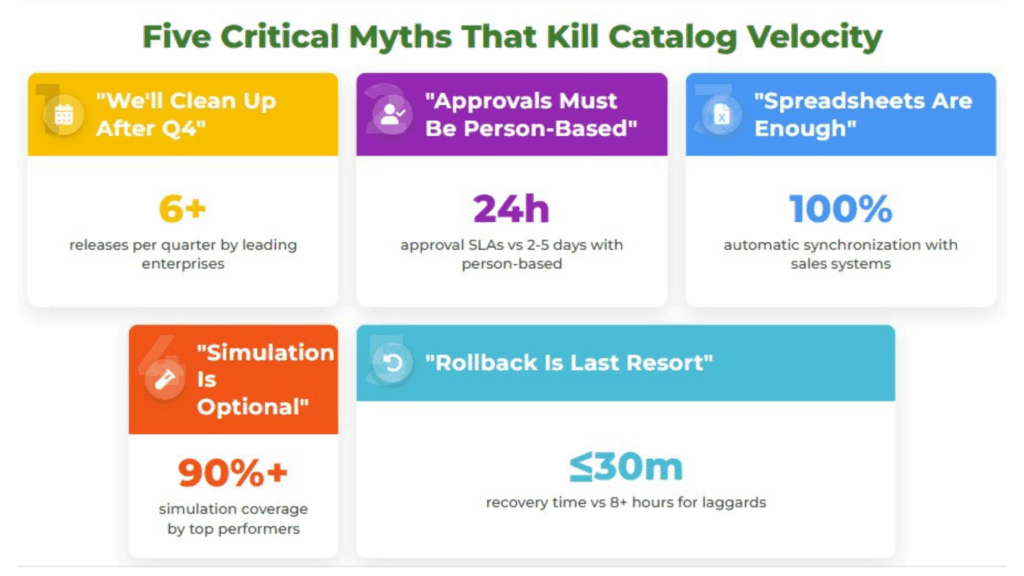
Myth 1: “We’ll Clean Up the Catalog After Q4”
The Reality: Quarterly cleanup mentality treats catalog management as a batch job rather than a continuous capability. This approach creates artificial urgency, increases error rates, and misses market opportunities.
The Transformation: Treat renewal as a weekly capability with continuous improvement. Make pruning and additions part of your regular release cycle with rollback drills scheduled monthly. Leading enterprises ship 6+ catalog releases per quarter with 90%+ simulation coverage before go-live.
Myth 2: “Approvals Must Be Person-Based”
The Reality: Person-centric approval workflows create single points of failure, inconsistent decision criteria, and delays that kill competitive response time. When key approvers are unavailable, entire product launches stall.
The Transformation: Implement policy-driven approval thresholds based on role, risk band, and financial impact. People still provide oversight—but policy determines when approval is required and who can provide it. This enables 24-hour approval SLAs instead of 2-5 day delays.
Myth 3: “Spreadsheets Are Enough If We’re Careful”
The Reality: Spreadsheets are excellent analysis tools but terrible systems of record. Version control becomes impossible, regional differences multiply, and integration with CRM/ERP requires manual processes that introduce errors.
In contrast, The Transformation: Keep spreadsheets for analysis—govern them through a versioned catalog with API integration. Your source of commercial truth should sync automatically with sales systems, not require manual updates and email distributions.
Myth 4: “Simulation Is Optional for Simple Changes”
The Reality: “Simple” changes often have complex downstream effects. A small discount adjustment can cascade through bundle pricing, affect margin calculations differently across regions, and trigger unexpected compliance issues.
The Transformation: Make shadow quotes mandatory for margin and discount impact analysis before any go-live. If you can’t model the financial impact with confidence, don’t ship the change. Q4 performers achieve 90%+ simulation coverage across all catalog modifications.
Myth 5: “Rollback Is a Last Resort”
The Reality: Treating rollback as failure creates fear of shipping changes and encourages “big bang” releases that increase risk. When problems occur, teams spend hours debugging instead of minutes restoring service.
The Transformation: Position rollback as a first-class safety feature that enables confident innovation. The ability to reverse changes in minutes (not hours) creates the psychological safety needed for frequent, small releases.
Consequently, organizations that systematically address these five myths typically see lead time reduction from 10+ weeks to 2-3 weeks, release frequency increase from quarterly to weekly releases, and 60-80% reduction in pricing errors through simulation. Download our catalog velocity assessment tool.
The Boardroom Awakening: When Enterprise Product Catalog Modernization Became a Director’s Problem {#boardroom-awakening}
The statistics that should make every board member sit up straight: 78% of organizations now use AI in at least one business function—up from 55% just a year earlier. Meanwhile, 45% of CEOs doubt their company’s current trajectory will sustain them beyond the next decade. The connection? Companies that can rapidly introduce AI-enabled services, usage-based pricing, and dynamic product bundles are leaving slower competitors behind. And the bottleneck isn’t technology—it’s catalog agility.
Enterprise product catalog modernization has become the litmus test for digital transformation readiness. NACD’s 2025 survey drives this home: 62% of public company boards now dedicate agenda time to AI discussions, yet relatively few have comprehensive metrics or frameworks in place. In other words: boards want proof that management can adapt quickly, and catalog velocity provides that proof.
Board-Level Pressure Points
The boardroom pressure manifests in key questions:
- How quickly can we launch new offerings?
- Are we missing revenue because our catalog is outdated or fragmented?
- Are compliance, risk, and governance baked into our change process?
- How do we compare to competitors already deploying AI-enabled services?
Board Governance Best Practice: The Monthly Catalog Velocity Dashboard
Leading boards implement a “Catalog Performance Index” that tracks three critical metrics monthly: configuration-to-quote cycle time, pricing accuracy under competitive pressure, and AI integration effectiveness. This governance framework, adopted from technology sector best practices, provides early warning indicators of competitive positioning shifts before they impact quarterly results, according to Harvard Law’s corporate governance research.
In quarterly reviews, CFOs, CROs, and CIOs are being asked to prove that catalog agility aligns with growth targets and complies with risk management policies.
The Competitive Intelligence Gap: Market Share Migration in Real Time {#competitive-intelligence}
While traditional competitive analysis focuses on products and pricing, the real battle is now fought on operational velocity. According to industry analysts, AI-driven pricing optimization is expanding rapidly, with companies using AI-assisted pricing reporting significant revenue lifts, while intelligent cross-selling delivers 3x higher conversion rates than traditional approaches.

Customer Expectation Evolution
Enterprise buyers now expect:
- Real-time pricing for complex configurations
- AI-powered bundle recommendations based on usage patterns
- Dynamic contracts that adjust to consumption metrics
- Instant quote generation with regulatory compliance built-in
Organizations unable to meet these expectations aren’t just losing deals—they’re being excluded from RFP processes entirely. Meanwhile, customer acquisition costs are rising 30-45% for companies with slower response times.
Competitive Moat Strengthening Through Catalog Excellence
Successful enterprise product catalog modernization creates network effects that compound competitive advantages. Modern catalog systems create defensible competitive advantages through three mechanisms: First, dynamic personalization at scale delivers unique configurations faster than competitors can respond to market averages. Second, data network effects improve recommendation accuracy with each interaction, creating barriers to competitive replication. Third, seamless AI integration allows scaling customer engagement without proportional cost increases. According to Boston Consulting Group research, companies achieving this integration report 30-40% lower customer acquisition costs while improving conversion rates—creating compound competitive advantage over time.
The Network Effect of Catalog Velocity
Fast catalog adaptation creates a network effect: better customer experience drives more data, which enables better AI optimization, which accelerates catalog improvements. Organizations caught in slow cycles face accelerating disadvantage as competitors build data advantages that become increasingly difficult to overcome.
Enterprise competitive intelligence suggests most large organizations have approximately 90 days to respond to significant competitor catalog innovations before experiencing measurable market share erosion. In high-velocity sectors, this window is shrinking to 30-45 days.
Customer Retention Risk: The Hidden Cost of Delayed Enterprise Product Catalog Modernization {#customer-retention-risk}
Beyond market share erosion, slow catalog response directly impacts customer retention. According to customer service benchmarking research, service-related issues including slow response times contribute significantly to the average 17% annual churn rate in B2B services.
Enterprise product catalog modernization directly impacts customer lifetime value and retention rates.
Enhanced Risk Framework for Catalog Transformation
Beyond traditional implementation risks, boards must address three emerging categories: competitive velocity risk (rivals achieving faster product-to-market cycles), data sovereignty risk (AI integration requiring robust governance of competitive intelligence), and customer expectation risk (rising market standards making enterprise product catalog modernization defensive rather than offensive). McKinsey analysis suggests this technical debt accumulates at 15-20% annually for complex catalogs, creating compounding disadvantage.

Enterprise Account Risk
Moreover, the stakes are particularly high for enterprise accounts where contract values often exceed $1M annually. When enterprises cannot quickly adapt their catalogs to customer needs—whether for custom pricing, new configurations, or competitive matching—customer satisfaction plummets and renewal risk increases.
Quantified Impact
Research indicates that enterprises with delayed response capabilities face measurably higher customer dissatisfaction rates. B2B response time studies show that poor response times rank among the top drivers of B2B customer churn, making catalog velocity a direct customer retention metric rather than just an operational efficiency measure.
The Enterprise Scale Challenge: Why Bigger Makes Everything Harder {#enterprise-challenge}

Here’s where the analogy breaks down. When a maple tree sheds leaves, it doesn’t need approval from 47 different branches, compliance with international forestry regulations, or integration with the neighbor’s oak tree’s ERP system. For large enterprises, catalog renewal is uniquely challenging:
Enterprise product catalog modernization complexity grows exponentially with global scale and regulatory requirements.
Massive Scope Challenges
Catalogs can span hundreds of markets, geographies, and product hierarchies. Thousands of SKUs across global markets, each with unique regulatory requirements.
Complex Dependencies
One small pricing change cascades across ERP, CRM, billing, and service delivery systems. Boston Consulting Group’s research confirms the pain: two-thirds of large-scale tech programs miss targets on time, budget, and scope.
Governance Pressure
Every update must align with compliance, finance, and regional regulatory requirements. The approval gauntlet that ensures governance often becomes the bottleneck that kills velocity.
Risk of Stagnation
The sheer scale of approvals and dependencies causes paralysis—by the time changes roll out, the market has already shifted.
At enterprise scale, velocity is everything—but complexity often kills speed. As a consequence, the result: paralysis at scale. And boards don’t tolerate paralysis.
Why Enterprise Product Catalog Modernization Velocity Matters {#velocity-matters}
AI is accelerating disruption, and large enterprises are under the microscope:
Shareholder Demands
Investors expect fast innovation cycles, not excuses about legacy systems.
Customer Pressure
Enterprise buyers expect tailored bundles, usage-based pricing, and AI-enabled offerings instantly—not in six months.
Competitive Risk
Smaller, nimbler disruptors are already using AI to outpace product launches.
Enterprise product catalog modernization velocity now determines market leadership positioning. Indeed, the CPQ market explosion tells the story: growing from $3.14 billion in 2025 to a projected $6.62 billion by 2030—a 16% CAGR that reflects enterprises desperately seeking solutions.
For enterprises, every delay in catalog renewal translates into lost market share, missed revenue, and competitive disadvantage. Early AI adopters are already seeing results with intelligent cross-selling delivering 3x higher conversion rates than traditional approaches.
The Quartile Best-Practice Grid: Benchmarking Enterprise Catalog Velocity {#quartile-grid}
Before diving into solutions, let’s establish where most companies actually stand. Based on analysis of enterprise catalog performance, here’s the brutal truth about catalog velocity maturity.
This grid benchmarks enterprise product catalog modernization maturity across industries. How to read this: Q4 = leaders that ship fast with control. Use KPI bands to benchmark your catalog velocity program. Then apply the practices and 90-day plays.
KPIs to Benchmark
- Catalog Refresh Lead Time (request → production)
- Release Frequency (production pushes/quarter)
- Approval SLA (median hours)
- % Changes via Standard Change (not emergency)
- Rollback MTTR (time to safe version)
- Simulation Coverage (% changes run through shadow quotes/impact test)
- Regional Staged Rollouts (% changes staged by region/BU)
- Revenue from New SKUs (L90) (% of bookings)
- Quote Error Rate (errors per 100 quotes)
The Grid
| Quartile | KPI Bands | Signature Practices | Typical Pitfalls | “Move-Up” Plays |
|---|---|---|---|---|
| Q4 — Velocity with Governance |
|
|
|
1) Expand standard-change library 2) Automate pre-release simulations 3) Introduce release health telemetry 4) Quarterly rollback drills |
| Q3 — Controlled, Not Yet Fast |
|
|
|
1) Convert named approvers → role-based policies 2) Make board pack monthly 3) Stipulate staging as default 4) Target ≥85% simulation before go-live |
| Q2 — Patchy & Manual |
|
|
|
1) Stand up servicePath™ for one BU/region 2) Import catalog + approval matrix 3) Enable shadow quotes for top change types 4) Weekly change readiness review |
| Q1 — High Risk & Slow |
|
|
|
1) Launch 30/60/90 Catalog Velocity program 2) Migrate top 20% SKUs to servicePath™ 3) Define standard-change types 4) Ship first staged release with rollback tested |
Interpreting Your Catalog Velocity Score
Leaders’ telltale sign: They can simulate the commercial and margin impact of a change before it ships, and roll it back in minutes if needed.
Board-level takeaway: Put Lead Time, Release Frequency, Standard-Change %, Rollback MTTR, Simulation Coverage, New-SKU Revenue on a single dashboard. See our board-ready dashboard templates.
Enterprise Catalog Modernization Governance: Building Change Leadership {#transformation-governance}
Successful catalog transformation requires sophisticated governance that balances velocity with control. Leading enterprises establish clear governance structures before launching transformation initiatives.
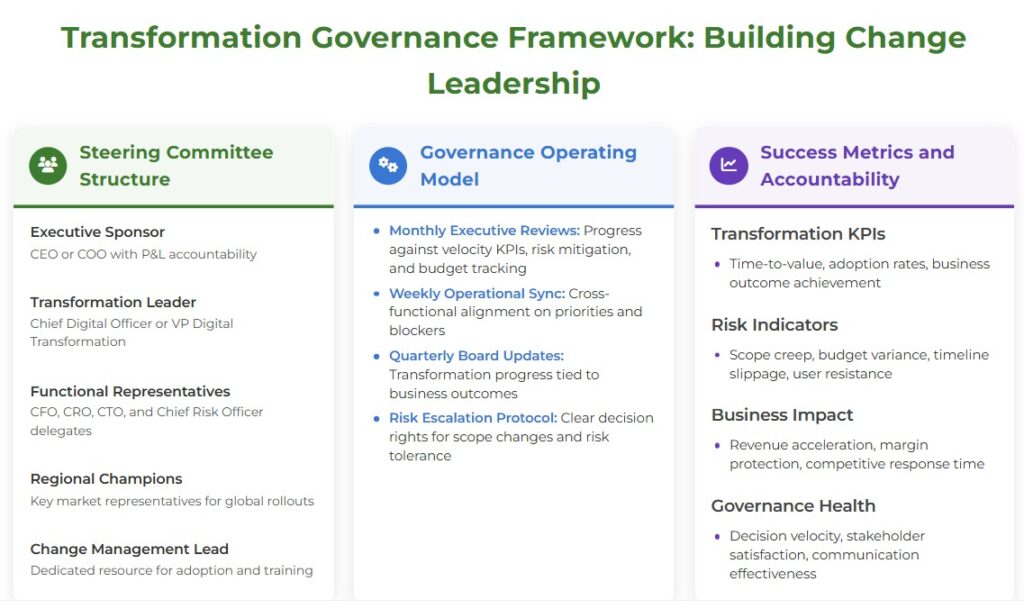
Steering Committee Structure
- Executive Sponsor: CEO or COO with P&L accountability
- Transformation Leader: Chief Digital Officer or VP Digital Transformation
- Functional Representatives: CFO delegate, CRO delegate, CTO delegate, Chief Risk Officer delegate
- Regional Champions: Key market representatives for global rollouts
- Change Management Lead: Dedicated resource for adoption and training
Governance Operating Model
- Monthly Executive Reviews: Progress against velocity KPIs, risk mitigation, budget tracking
- Weekly Operational Sync: Cross-functional alignment on priorities and blockers
- Quarterly Board Updates: Transformation progress tied to business outcomes
- Risk Escalation Protocol: Clear decision rights for scope changes and risk tolerance
Success Metrics and Accountability
- Transformation KPIs: Time-to-value, adoption rates, business outcome achievement
- Risk Indicators: Scope creep, budget variance, timeline slippage, user resistance
- Business Impact: Revenue acceleration, margin protection, competitive response time
- Governance Health: Decision velocity, stakeholder satisfaction, communication effectiveness
How servicePath™ Delivers Enterprise Product Catalog Modernization {#servicepath-solution}
Traditional CPQ systems were built when catalogs changed quarterly, not daily. servicePath™ CPQ+ addresses the modern reality: governed velocity at enterprise scale. servicePath™ CPQ+ enables enterprise product catalog modernization without compromising governance or security.

1. Unified Product Catalog Governance
Instead of fragmented spreadsheets and disconnected systems, servicePath™ CPQ+ provides a single source of truth across all geographies, currencies, and business units. Multi-currency, multi-region, multi-compliance—all in one governed environment.
2. Scalable Architecture
Built to handle enterprise complexity, servicePath™ supports multi-tier catalogs, global compliance rules, and dynamic approval workflows—without slowing velocity. Policy-driven approval workflows that move at machine speed for routine changes while ensuring executive review for strategic decisions.
3. Faster Time-to-Revenue at Scale
servicePath™ reduces time to introduce new enterprise offerings by up to 60%, even when multiple business units and markets are involved. Test every change through shadow quotes before it touches a real customer. Margin impact, discount cascades, revenue projections—all modeled before go-live.
4. AI-Native Agility with Responsible Innovation
Unlike legacy CPQ tools, servicePath™ is AI-native, helping enterprises build, test, and scale new catalog offerings that keep pace with market shifts—without breaking governance or accuracy. When something goes wrong, restore the previous version in minutes with complete audit trails.
5. Enterprise Security and Compliance
Multi-layered security architecture with role-based access controls, immutable audit logs, and integration with enterprise identity management systems. SOC 2 Type II compliance, GDPR readiness, and industry-specific regulatory frameworks built-in.
Board-Level KPIs: Measuring Product Catalog Modernization Success {#board-kpis}
Sophisticated boards require sophisticated metrics that connect operational efficiency to financial performance:
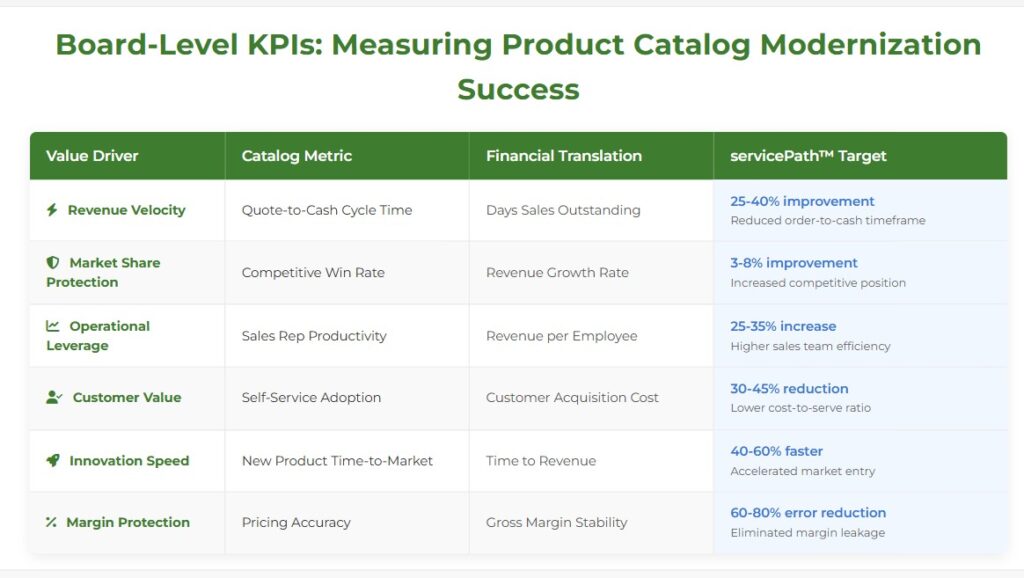
Ultimately, these metrics bridge the gap between operational improvements and board-level outcomes, providing directors with quantifiable evidence of transformation success.
Enterprise Product Catalog Modernization ROI: What CFOs Need to Hear {#financial-translation}
Enterprise catalog transformation delivers measurable returns across multiple value streams:
Revenue Impact Analysis
- Revenue Velocity Acceleration: 25-40% improvement in quote-to-cash cycles translates to $15-50 million annual impact for large enterprises through faster deal closure
- Market Share Protection: Early competitive response capabilities prevent 2-5% annual market share erosion, worth $200-500 million for billion-dollar enterprises
- Innovation Revenue: 40-60% faster time-to-market for new offerings typically generates 15-25% of annual new revenue from catalog innovations
Cost Structure Optimization
- Margin Protection and Enhancement: 60-80% reduction in pricing errors and 3-8% margin improvement through AI-powered price optimization
- Operational Leverage Creation: 25-40% decrease in catalog overhead while supporting 50-100% revenue growth without proportional staff increases
- Risk Mitigation Value: Avoided regulatory penalties, reduced customer churn from pricing errors, minimized revenue recognition complications
Capital Efficiency Gains
- Working Capital Optimization: 12-18% improvement in cash conversion cycles, representing tens of millions in freed capital for $1+ billion enterprises
- Technology ROI Enhancement: Unified platform reduces total technology spending while improving capability performance across sales, marketing, and finance functions
Sensitivity Analysis: Conservative vs. Optimistic Scenarios
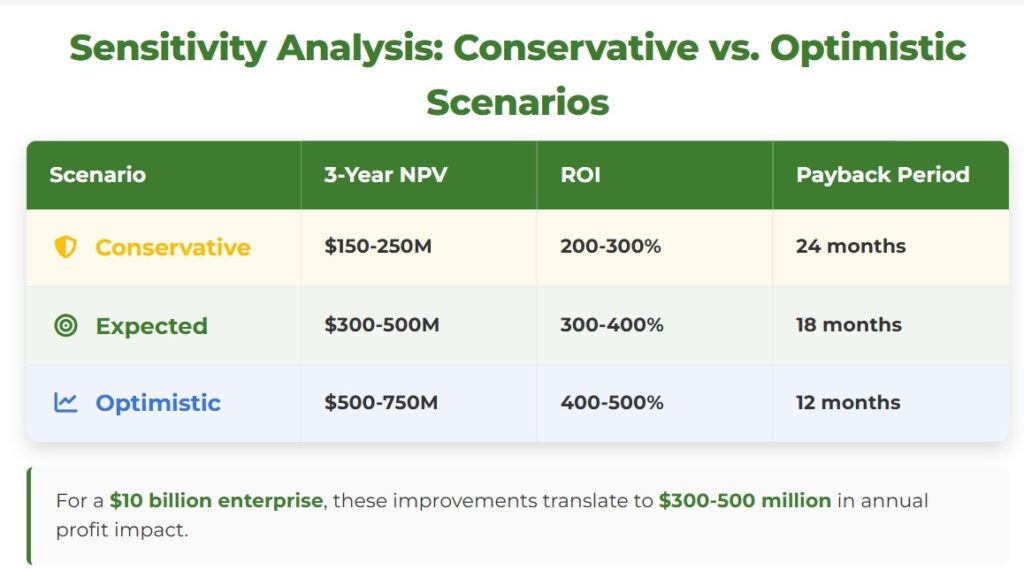
For a $10 billion enterprise, these improvements translate to $300-500 million in annual profit impact.
The Board’s Five Critical Questions (And servicePath™’s Answers) {#board-questions}

Q1: “How do we avoid creating another system that conflicts with our ERP?”
A: API-first architecture synchronizes with existing systems rather than replacing them—no duplicate data, no integration nightmares. Pre-built connectors for SAP, Oracle, Salesforce, and Microsoft Dynamics ensure seamless data flow.
Q2: “What about compliance and audit trails during rapid changes?”
A: Immutable change logs, version lineage, role-based access—audit-grade documentation built in. Regional compliance rules enforced by policy, not heroics. SOC 2 Type II, GDPR-ready, with industry-specific regulatory frameworks.
Q3: “What if we make pricing errors that anger customers?”
A: Comprehensive simulation plus instant rollback. Problems get fixed in minutes, not months. Complete lineage shows exactly what happened. Shadow quotes validate every change before customer impact.
Q4: “How do we justify the investment cost?”
A: Measurable ROI through velocity gains and error reduction—typically 18-month payback with 200-400% return. Detailed TCO analysis shows 40-60% reduction in total catalog management costs over five years compared to current state.
Q5: “Will our global teams actually adopt this?”
A: Phased rollout respects regional differences while establishing global consistency. Comprehensive change management program with regional champions, training curriculum, and adoption success metrics. 95%+ user adoption rates in enterprise deployments. Read our implementation success stories.
Enterprise Product Catalog Modernization: AI-Native Future at Scale {#ai-future}
As Gartner predicts that 40% of enterprise applications will feature task-specific AI agents by 2026, forward-thinking enterprises are positioning their catalog infrastructure to embrace AI capabilities that legacy systems simply cannot support.
Enterprise product catalog modernization platforms must be AI-ready from inception.
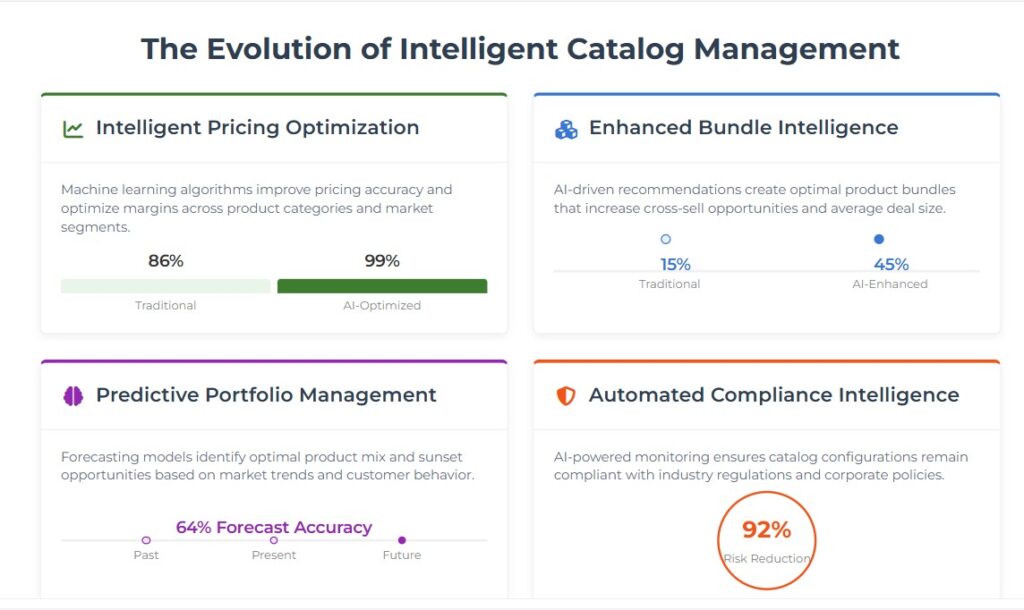
The Evolution of Intelligent Catalog Management
As AI capabilities mature, modern catalog platforms are being designed with AI integration in mind, enabling capabilities that transform how enterprises manage product portfolios:
Intelligent Pricing Optimization
Next-generation systems support real-time pricing adjustments based on market conditions, competitive positioning, and customer behavior patterns while maintaining fairness controls and regulatory compliance.
Enhanced Bundle Intelligence
AI-powered recommendation engines can identify cross-selling opportunities with significantly higher conversion rates than traditional rule-based approaches, while ensuring alignment with customer value creation.
Predictive Portfolio Management
Advanced analytics capabilities enable enterprises to anticipate demand patterns and identify portfolio optimization opportunities before they impact revenue.
Automated Compliance Intelligence
Modern platforms can integrate with regulatory monitoring systems to flag catalog items requiring updates, reducing compliance risk while maintaining market responsiveness.
Responsible AI Implementation Framework
Leading enterprises are establishing comprehensive AI governance practices:
Algorithmic Fairness
Implementing continuous bias testing to ensure equitable treatment across customer segments, geographic regions, and market conditions.
Model Transparency
Establishing complete audit trails, performance monitoring, and explainability features to meet regulatory requirements and board oversight needs.
Data Governance
Maintaining enterprise-grade security with encryption, role-based access controls, and comprehensive logging to protect competitive intelligence.
Human Oversight
Preserving human decision authority for strategic pricing while enabling AI optimization of routine catalog management tasks.
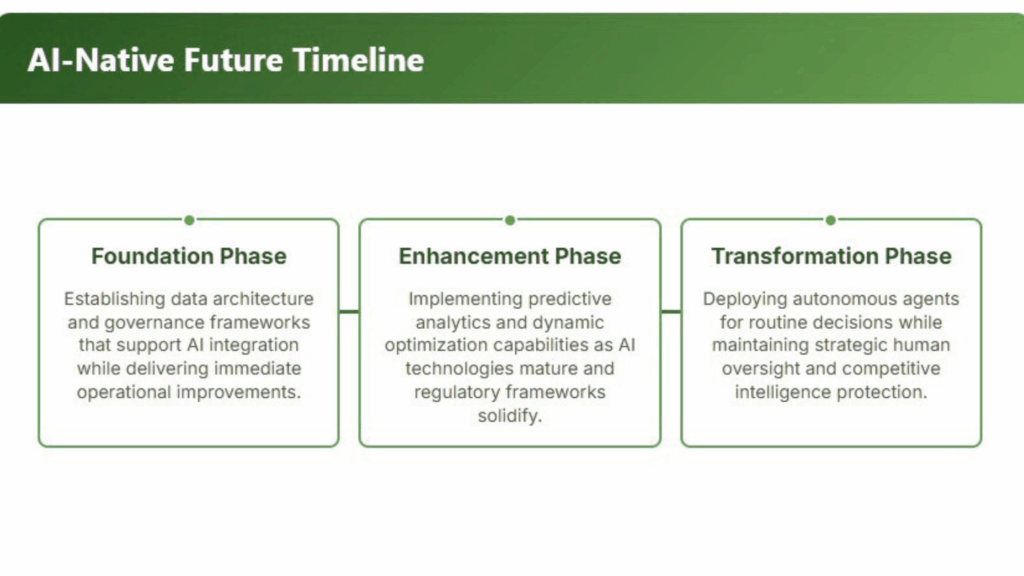
Strategic AI Readiness Timeline
 Foundation Phase
 Foundation Phase
Establishing data architecture and governance frameworks that support AI integration while delivering immediate operational improvements.
Enhancement Phase
Implementing predictive analytics and dynamic optimization capabilities as AI technologies mature and regulatory frameworks solidify.
Transformation Phase
Deploying autonomous agents for routine decisions while maintaining strategic human oversight and competitive intelligence protection.
“The companies that master catalog velocity in 2025 will dominate their markets in 2026 and beyond,” predicts Daniel Kube, CEO of servicePath™. “The window for comfortable transformation is closing. Therefore, the question isn’t whether AI will reshape catalog management—it’s whether your infrastructure will be ready when it does.”
Conclusion: Leading Enterprise Product Catalog Modernization {#conclusion}
The autumn leaves outside your office window carry a message: transformation is natural, necessary, and urgent. The enterprises that embrace enterprise product catalog modernization during this optimal window will emerge with sustainable competitive advantages. Those that delay risk becoming casualties of their own complexity.
Enterprise product catalog modernization represents the defining competitive advantage for the next decade. The evidence is overwhelming: McKinsey shows 78% AI adoption, NACD highlights increasing board pressure, and Gartner documents the coming AI agent transformation. The transformation winds are blowing through corporate America.
Therefore, the question isn’t whether change will come—it’s whether your organization will lead it or be swept along by it. servicePath™ CPQ+ provides what enterprises need: the ability to shed legacy catalog processes like autumn leaves while building the root systems that enable sustained growth.
The season of strategic courage has arrived. The harvest awaits those bold enough to plant the seeds of transformation today.
“We’re helping Fortune 500 companies rediscover what it feels like to move at startup speed, but with enterprise-grade governance and compliance,” explains Daniel Kube, CEO of servicePath™.
FAQ Section: Enterprise Product Catalog Modernization
Q1: How do we show ROI from AI in CPQ without risking data exposure?
A: Focus on governed workflows you already audit: time-to-quote reduction, approval efficiency, pricing accuracy improvements, and margin protection. Keep sensitive commercial data within your CPQ system where you control access policies and audit trails. According to McKinsey’s 2025 AI adoption research, successful enterprises measure AI impact through operational KPIs that tie directly to financial outcomes.
Q2: What’s the difference between putting data in AI systems vs. keeping it in CPQ?
A: Control and liability. Your CPQ system enforces your policies, maintains your audit trails, and operates under your data governance framework. External AI systems apply their own retention policies, security controls, and compliance standards—which may not align with your enterprise requirements.
Q3: How do we convince the board to prioritize a living catalog transformation now?
A: Present board-ready metrics that connect catalog velocity to shareholder value: Lead Time, Release Frequency, Standard Change Percentage, Rollback MTTR, and New-SKU Revenue contribution. Frame the business context using NACD’s 2025 governance priorities showing that 62% of directors now dedicate agenda time to AI discussions.
Q4: If everyone adopts AI-enhanced CPQ, where’s our competitive moat?
A: Execution quality creates the moat: clean data architecture, disciplined change management, comprehensive simulation coverage, fast rollback capabilities, and strong governance practices. The Quartile Best-Practice Grid shows that Q4 performers maintain 90%+ simulation coverage, sub-30-minute rollback times, and 15%+ new-SKU revenue contribution—capabilities that require sustained operational excellence.
Q5: How do we prepare for agentic AI in commercialization without losing control?
A: Build explicit governance foundations today: policy-driven approval workflows, comprehensive audit trails, human-in-the-loop decision points for strategic changes, and clear model lineage tracking. Gartner’s prediction that 40% of enterprise applications will feature AI agents by 2026 makes governed automation frameworks essential infrastructure.
Ready to Transform Your Catalog Velocity? Start Here {#cta-section}
See servicePath™ CPQ+ in Action
Watch enterprise product catalog modernization that actually works—governed velocity at board-room scale. Our 15-minute demo shows you exactly how to achieve 40-60% faster time-to-market while maintaining audit-grade compliance and instant rollback capabilities.
Let’s Talk Strategy
Tired of catalog systems that kill velocity with complexity? Our team helps you build AI-ready catalog strategies that actually accelerate growth while protecting what matters most—your competitive advantage and board-level governance.
Get Smarter About Catalog Transformation
Skip the vendor hype. Our blog cuts through enterprise software marketing noise with real insights from leaders who’ve actually delivered board-level catalog velocity at Fortune 500 scale.
See the Results
Real enterprises, real numbers. Our case studies show 65% reduction in catalog maintenance overhead, 40% faster time-to-market, and 200-400% ROI—with complete audit trails and instant rollback capabilities.
Don’t let legacy catalogs kill your competitive velocity. servicePath™ CPQ+ gives you AI-ready enterprise product catalog modernization with enterprise-grade governance. Ready to fall into renewal?
Start Your 90-Day Transformation
About servicePath™
servicePath™ empowers Fortune 500 enterprises to transform product catalog capabilities through intelligent automation, AI-powered insights, and enterprise-grade governance. Our CPQ+ platform enables global organizations to accelerate revenue cycles, improve pricing accuracy, and enhance customer experiences while maintaining the security, compliance, and audit standards that boards require.
Verified Sources and Citations:
- McKinsey Global Survey: The State of AI 2025 – 78% AI adoption statistic
- Gartner Press Release: AI Agents by 2026 – 40% AI agents prediction
- Mordor Intelligence: CPQ Market Report – CPQ market size and growth
- NACD 2025 Public Company Board Practices & Oversight Survey – Board AI oversight statistics
- Stanford HAI: AI Index 2025 – AI investment data
- Gartner: Agentic AI Project Cancellations – 40% project cancellation prediction
- CustomerGauge: Average Churn Rate by Industry – B2B churn rates
- Freshworks Customer Service Benchmark Report 2025 – Response time impact
- Boston Consulting Group: AI Value Gap Report – Enterprise technology research
- Harvard Law School Corporate Governance Research – Board governance frameworks