
The Executive’s Strategic AI Implementation Guide
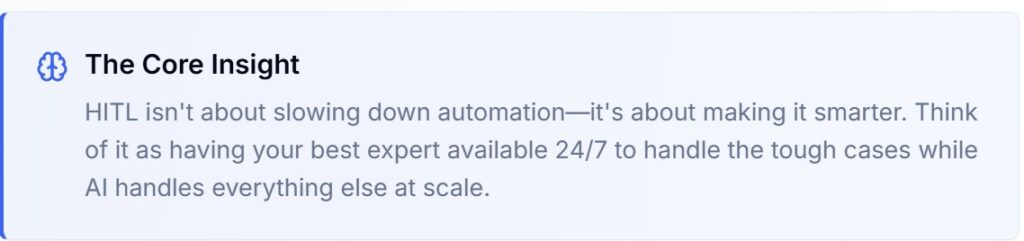
This HITL Executive Guide 2026 shows how to govern that hallucination to protect businesses, revenue streams, and profits through strategic human oversight.
TL;DR — Executive Summary
The Reality Check Every CEO Needs
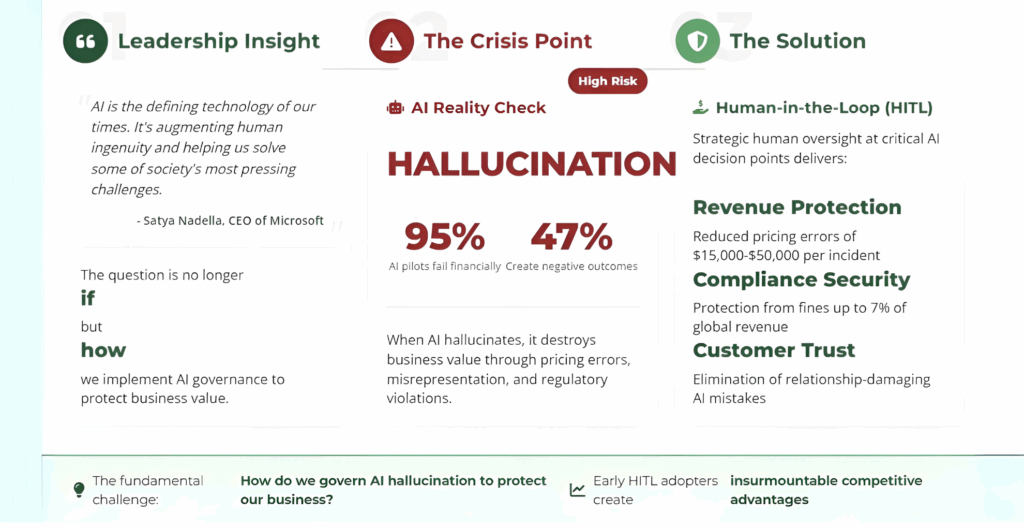
Satya Nadella, CEO of Microsoft, puts it:
“AI is the defining technology of our times. It’s augmenting human ingenuity and helping us solve some of society’s most pressing challenges.”
Ask anyone what’s the biggest issue with AI: it hallucinates. Period. Since we know it hallucinates, how do we govern that hallucination to protect our businesses, our revenue streams, and our profits?
Real scenarios happening in boardrooms today: AI misprices a quote, misrepresents your product, says something you don’t do, ships the wrong thing, or defines the wrong solution. According to MIT Technology Review, most AI implementations fail to deliver expected ROI, while McKinsey research shows 40% of organizations plan significant AI investment despite persistent accuracy concerns.
The Solution That Actually Works
Human-in-the-Loop (HITL) systems strategically embed human expertise at critical AI decision points. In essence, think of it as having your best expert on call 24/7: AI handles routine tasks at speed, while humans step in for the high-stakes decisions that protect your bottom line.
The Business Impact
- Revenue Protection: Significant reduction in pricing errors
- Speed to Market: Quote generation from days to minutes
- Competitive Advantage: Beat competitors to customer responses
- Regulatory Compliance: EU AI Act readiness by August 2026
Key Insight: Early HITL adopters create insurmountable competitive advantages while their competitors still chase the automation mirage.
The Strategic Imperative: Why Smart Leaders Choose HITL
The $1 Trillion AI Reality Check
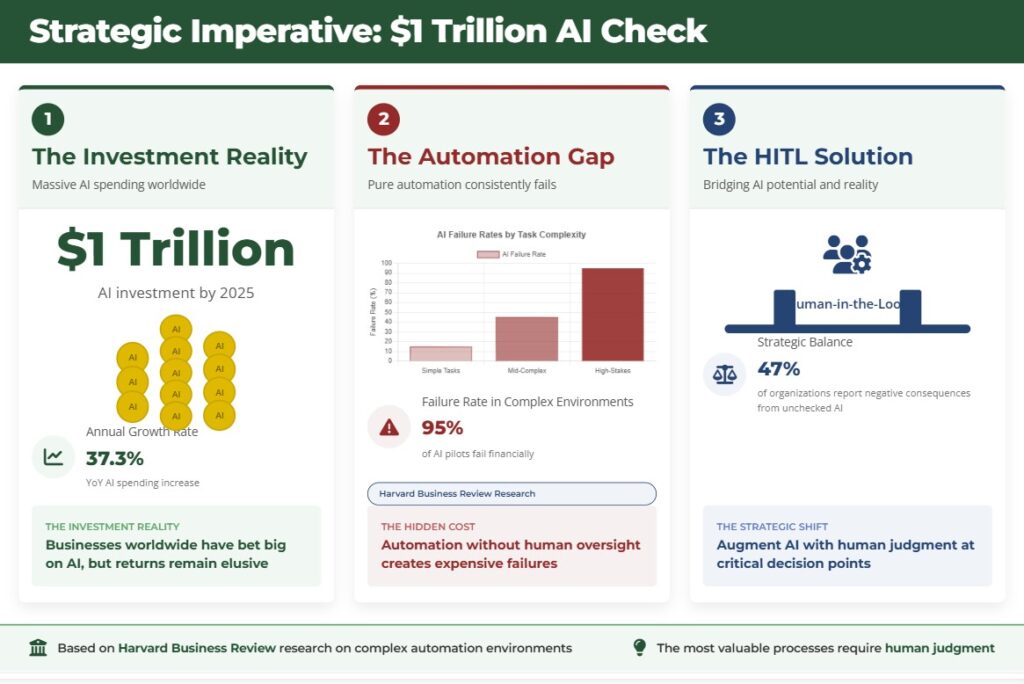
By 2025, businesses worldwide have invested over $1 trillion in AI and automation technologies. However, Harvard Business Review research reveals the same pattern across industries: pure automation fails in complex, high-stakes environments.
Why Pure Automation Fails
The culprit isn’t the technology itself—rather, it’s the assumption that good AI means autonomous AI. Furthermore, this belief has led organizations down expensive rabbit holes, chasing complete automation while ignoring a fundamental business principle: the most valuable processes require human judgment.
The Hidden Costs of “Perfect” Automation:
Data Integrity Problems: AI systems trained on historical data repeat existing biases and errors. For instance, when Wells Fargo’s mortgage processing AI favored certain demographics, it wasn’t malicious—instead, it was learning from decades of biased historical lending data. Consequently, without human oversight to catch these patterns, automated systems can discriminate while appearing mathematically fair.
Large-Scale Bias Issues: MIT research shows how AI systems exhibit gender and racial bias in facial recognition. Specifically, error rates are up to 34% higher for dark-skinned women compared to light-skinned men. Therefore, in business applications, these biases translate directly to lost customers, regulatory violations, and brand damage.
System Breakdown Problems: Unlike human experts who adapt to new situations, AI systems fail dramatically when encountering scenarios outside their training data. For example, the 2010 Flash Crash saw algorithmic trading systems amplify a small sell order into a trillion-dollar market meltdown in minutes—simply because no human was monitoring the unprecedented situation.
The Human Factor Challenge
Worker Resistance and Lost Productivity: Deloitte research shows 73% of workers don’t trust AI recommendations for important decisions. As a result, when employees don’t trust the tools they’re required to use, productivity suffers, decision-making slows, and innovation stagnates.
The Real Cost Example: A major financial services firm discovered their “99% accurate” fraud detection system was blocking $50 million in legitimate transactions annually. Customer complaints skyrocketed, processing costs doubled due to manual reviews, and the real accuracy rate—accounting for false positives—was just 73%. The lesson: automation without human oversight isn’t just ineffective, it’s expensive.
Wells Fargo’s Smart Approach: The HITL Success Story
Wells Fargo implemented HITL in their fraud detection system and achieved 99% accuracy while reducing fraud losses by 25%. The key? Human analysts handle edge cases and ambiguous transactions, while AI processes clear-cut decisions. As a result: Better customer experience, lower losses, and more satisfied fraud analysts who focus on complex investigative work.
The Dangerous “Expectation Leap”
Here’s what every executive needs to understand: AI is probabilistic, not deterministic. Specifically, when AI generates a quote or processes an order, it’s making educated guesses based on patterns, not performing exact calculations.
Daniel Kube, CEO of servicePath™, explains:
“The expectation leap is dangerous. People’s perception of a low confidence decision or a high confidence decision—I don’t think they really understand the material difference if you’re using it for words versus numbers. If it can do a white paper and a blog, they think it should be high confidence for everything else.”
Consequently, this creates massive operational risk for financial calculations, pricing models, and business-critical determinations where precision is essential.
Research validates this concern: Stanford University’s HAI research demonstrates that humans consistently overestimate AI capabilities in mathematical reasoning after seeing strong performance in language tasks. The study found that executives exposed to impressive AI-generated content rated AI mathematical accuracy 34% higher than actual performance metrics showed.
The Mathematical vs. Linguistic Accuracy Gap: MIT’s Computer Science and Artificial Intelligence Laboratory research shows that while large language models achieve 85-90% accuracy in content generation, their accuracy drops to 45-60% in multi-step financial calculations. Ultimately, this performance delta creates the dangerous expectation mismatch that Daniel Kube identifies.
Key Takeaways:
- Pure automation fails: AI accuracy for content ≠ AI accuracy for calculations
- HITL creates learning systems: Every human decision improves AI performance
- First-mover advantage: Early adopters gain competitive positioning before regulation forces industry compliance
Demystifying HITL: What Executives Actually Need to Know
Cut Through the Jargon
If you’ve been following AI trends, you’ve probably encountered an alphabet soup of acronyms. Let’s focus on what matters for your business:
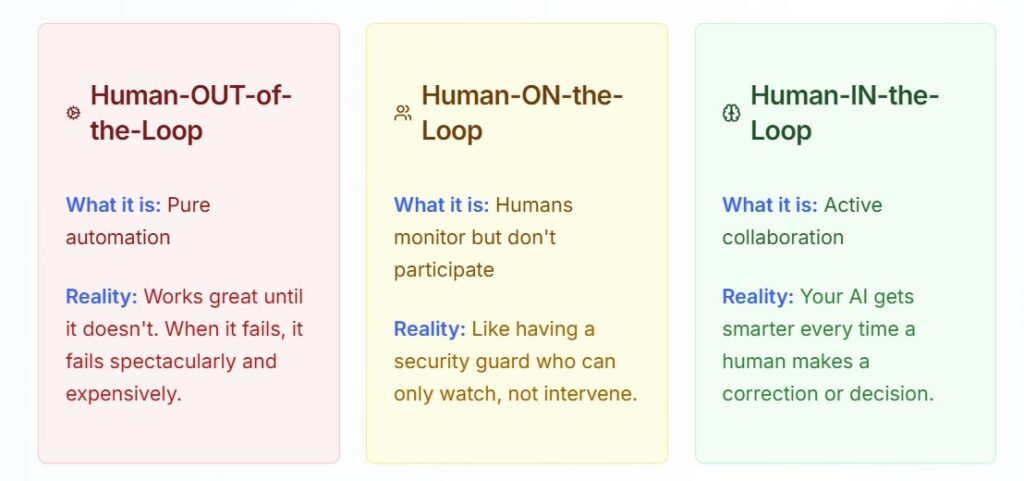
- Human-OUT-of-the-Loop (HOOTL): Pure automation. Fast until it fails—and failures are expensive in revenue-critical flows.
- Human-ON-the-Loop (HOTL): Humans monitor but rarely intervene. Better, but limited control when something goes wrong.
- Human-IN-the-Loop (HITL): Humans actively approve/override at defined checkpoints. The gold standard for high-risk decisions under emerging regulations like the EU AI Act’s “effective human oversight” requirement.
The Business Case: Show ROI Through Error Avoidance
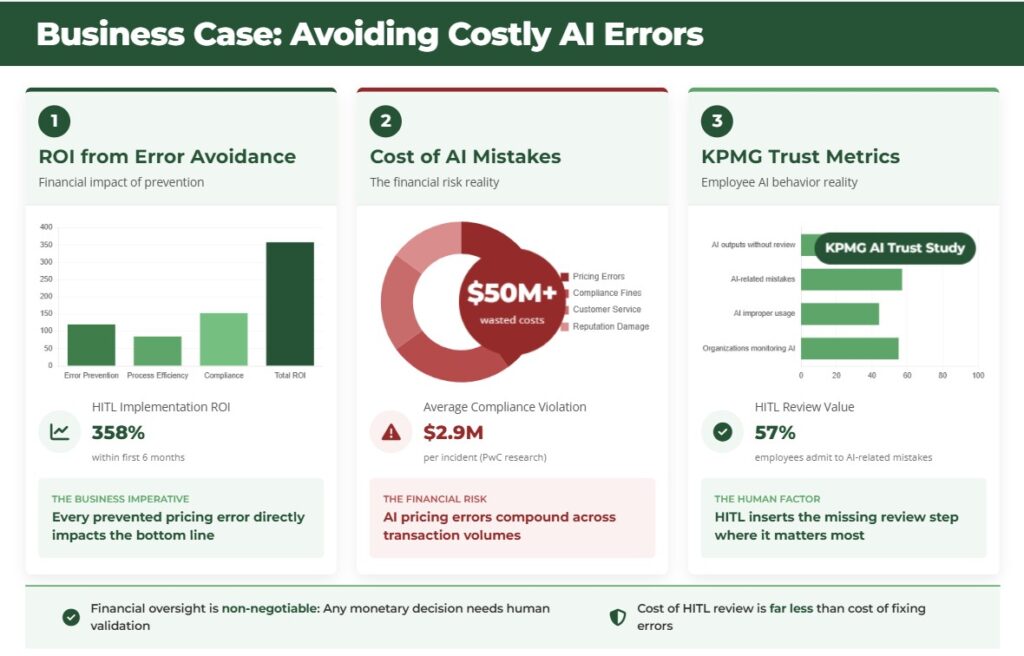
Critical Financial Oversight Principle:
Daniel Kube, CEO of servicePath™, emphasizes:
“The key point is anything financial you still want to have human in the loop. Small errors add up to be a big number, so you need comprehensive oversight, not just for large discounts.”
The Compound Error Problem: Research from Boston Consulting Group reveals that seemingly minor pricing errors (under 2%) compound across large transaction volumes to create substantial revenue impact. Organizations processing high transaction volumes see average revenue leakage of 1-3% annually from small AI pricing inconsistencies that go undetected without human oversight.
According to KPMG’s 2024 AI Trust Study, 58% of employees rely on AI outputs without thorough review, and 57% admit to AI-related mistakes. HITL inserts the missing review step where it matters most.
Key Takeaways:
- Financial oversight is non-negotiable: Any monetary decision needs human validation
- HITL systems learn and improve: Unlike static automation, they get better over time
- Risk mitigation pays for itself: Cost of review far less than cost of fixing errors
Executive Implementation Framework: Your Strategic Roadmap

For CEOs: Competitive Advantage & Brand Protection
Your primary concern isn’t technology—rather, it’s sustainable competitive advantage. Furthermore, HITL creates defendable market positions that pure automation can’t match. Meanwhile, while competitors struggle with AI reliability issues, you’re delivering consistently superior customer experiences.
Strategic Benefits:
- Market Leadership: Be first to market with reliable AI-powered services while competitors debug failures
- Brand Protection: Prevent catastrophic AI mistakes that viral social media can turn into brand disasters
- Investor Confidence: Demonstrate responsible AI governance to boards and institutional investors
- M&A Value: HITL-enabled organizations command premium valuations due to operational excellence
Real Example: Organizations implementing HITL in customer onboarding see reduced churn while competitors with pure automation experience increased support tickets and customer dissatisfaction.
For CFOs: ROI & Risk Management
You need numbers that work. Additionally, HITL delivers measurable ROI through error prevention, not just efficiency gains. Therefore, every prevented pricing error, avoided compliance fine, and retained customer directly impacts the bottom line.
Financial Impact Metrics:
- Direct Revenue Protection: Significant reduction in revenue leakage through pricing errors
- Cost Avoidance: Compliance violations average $2.9M per incident according to PwC research
- Operational Efficiency: Substantial reduction in error correction costs and customer service escalations
- Insurance Premium Reduction: Many insurers now offer discounts for documented AI governance programs
Budget Justification: Most importantly, HITL implementations typically show positive ROI within 6 months through error avoidance alone, before counting efficiency gains.
For CTOs: Innovation with Reliability
You’re caught between business demands for AI innovation and operational requirements for system reliability. However, HITL resolves this tension by making AI systems both powerful and dependable.
Technical Advantages:
- System Reliability: Human oversight prevents catastrophic AI failures that damage system credibility
- Continuous Improvement: HITL creates self-improving systems that get better with use
- Regulatory Compliance: Built-in audit trails and human oversight satisfy current and emerging regulations
- Risk Mitigation: Gradual AI deployment with human safeguards reduces implementation risk
Architecture Benefits: Moreover, HITL systems provide clear fallback mechanisms, making them more robust and auditable than black-box automation.
For COOs: Operational Excellence
Your challenge is scaling operations efficiently while maintaining service quality. Fortunately, HITL enables smart scaling—automating what can be automated while preserving human expertise where it matters most.
Operational Improvements:
- Quality Maintenance: Scale operations without degrading service quality or customer experience
- Workforce Evolution: Transform employees from task performers to expert reviewers and decision makers
- Process Optimization: Data-driven insights from human-AI collaboration reveal process improvement opportunities
- Scalable Expertise: Extend your best experts’ decision-making across more transactions and customers
Redefining Service Quality in the AI Era:
Daniel Kube, CEO of servicePath™, emphasizes:
“Service quality is one thing—getting back and being responsive—but service quality also extends to the accuracy of the information that you’re sharing. Like the quote, the pricing, the configuration. That’s where the human in the loop checks are super essential.”
Research supports this evolution: Forrester’s Customer Experience research shows that customers now prioritize accuracy over speed in B2B interactions. The study found that 78% of enterprise buyers would rather wait an additional day for accurate pricing than receive immediate quotes requiring corrections.
Change Management: HITL implementations typically face less employee resistance because workers see AI as augmentation rather than replacement.
Hybrid System Architecture: The Technical Foundation
Daniel Kube, CEO of servicePath™, notes:
“A really strong AI system is a hybrid of probabilistic systems and deterministic systems, with checks and balances, including a human in the loop as an option.”
This means combining:
- AI’s pattern recognition for speed and consistency
- Deterministic validation for accuracy verification
- Human expertise for complex judgment calls
- Audit trails for compliance and continuous improvement
The 5-Stage Maturity Journey
Stage 1: Reactive — Ad-hoc fixes when automation breaks
Stage 2: Repeatable — Checklists for when humans step in
Stage 3: Defined — Documented roles and HITL procedures
Stage 4: Managed — Data-driven optimization of human-AI collaboration
Stage 5: Optimizing — Continuous improvement through feedback loops
Most organizations are stuck at Stages 1-2. The competitive advantage goes to those who reach Stages 4-5.
Key Takeaways:
- Start with high-impact areas: Focus HITL where AI mistakes cost the most
- Build for scale: Design systems that improve through human feedback
- Measure what matters: Track accuracy, speed, and business outcomes, not just technology metrics
Industry Evidence: What’s Working in the Real World
Technology Service Providers: Revenue Operations Excellence
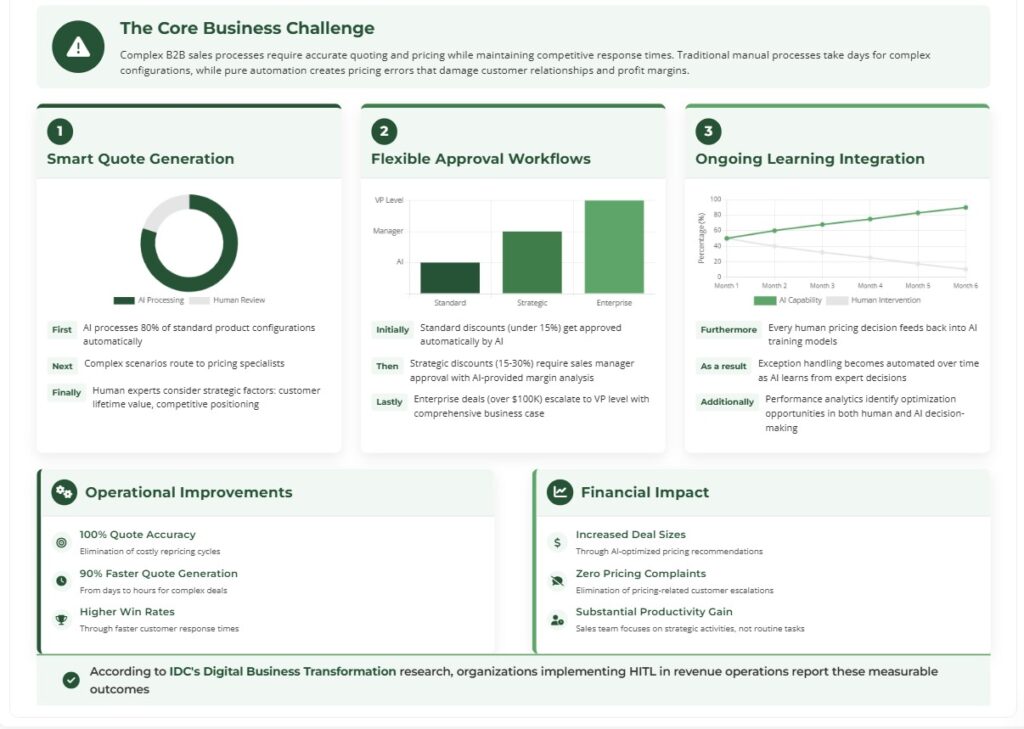
The Core Business Challenge
The Problem: Complex B2B sales processes require accurate quoting, pricing, and configuration management while maintaining competitive response times. Meanwhile, traditional manual processes take days for complex configurations. Additionally, pure automation creates pricing errors that damage customer relationships and profit margins.
Smart HITL Implementation Strategy
Phase 1: Smart Quote Generation
- First, AI processes 80% of standard product configurations automatically
- Next, complex scenarios (custom integrations, enterprise licensing, multi-vendor solutions) route to pricing specialists
- Finally, human experts consider strategic factors: customer lifetime value, competitive positioning, relationship history
Phase 2: Flexible Approval Workflows
- Initially, standard discounts (under 15%) get approved automatically by AI
- Then, strategic discounts (15-30%) require sales manager approval with AI-provided margin analysis
- Lastly, enterprise deals (over $100K) escalate to VP level with comprehensive business case documentation
Building Learning Systems
Phase 3: Ongoing Learning Integration
- Furthermore, every human pricing decision feeds back into AI training models
- As a result, exception handling becomes automated over time as AI learns from expert decisions
- Additionally, performance analytics identify optimization opportunities in both human and AI decision-making
Measurable Results: According to IDC’s Digital Business Transformation research, organizations implementing HITL in revenue operations report:
Operational Improvements:
- Significant improvement in quote accuracy (eliminating costly repricing cycles)
- Substantial reduction in quote generation time (from days to hours for complex deals)
- Improved win rates through faster customer response times
Financial Impact:
- Increased deal sizes through AI-optimized pricing recommendations
- Significant reduction in pricing-related customer complaints and escalations
- Substantial improvement in sales team productivity through automated routine tasks
Financial Services: Risk Management & Compliance
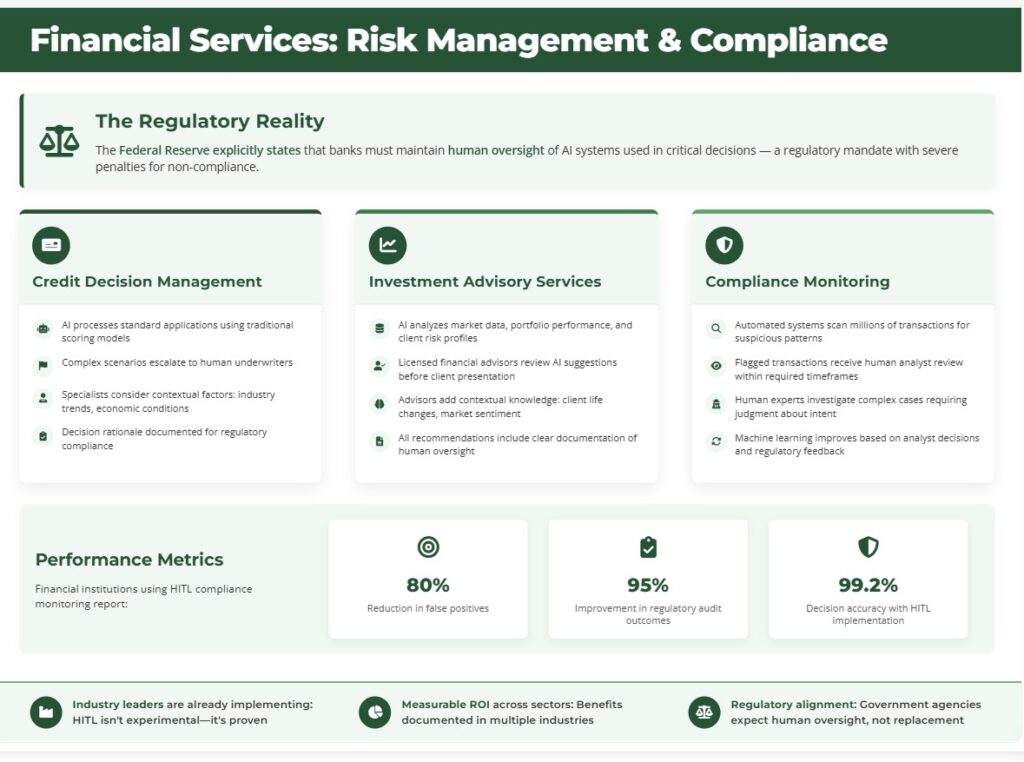
The Regulatory Reality: The Federal Reserve explicitly states that banks must maintain human oversight of AI systems used in critical decisions. This isn’t a suggestion—it’s regulatory mandate with severe penalties for non-compliance.
HITL Implementation Framework:
Credit Decision Management:
- AI processes standard credit applications using traditional scoring models and alternative data
- Complex scenarios (inconsistent credit history, high-value applications, business loans) escalate to underwriters
- Human specialists consider contextual factors: industry trends, economic conditions, relationship history
- Decision rationale documented for regulatory compliance and model improvement
Investment Advisory Services:
- AI analyzes market data, portfolio performance, and client risk profiles to generate recommendations
- Licensed financial advisors review AI suggestions before client presentation
- Human advisors add contextual knowledge: client life changes, market sentiment, regulatory updates
- All recommendations include clear documentation of human oversight for compliance audits
Compliance Monitoring:
- Automated systems scan millions of transactions for suspicious patterns and regulatory violations
- Flagged transactions receive human analyst review within compliance-mandated timeframes
- Human experts investigate complex cases requiring judgment about intent and context
- Machine learning improves pattern recognition based on analyst decisions and regulatory feedback
Performance Metrics: Financial institutions using HITL compliance monitoring report significant reduction in false positives and substantial improvement in regulatory audit outcomes.
Key Takeaways:
- Industry leaders are already implementing: HITL isn’t experimental—it’s proven
- Measurable ROI across sectors: Benefits documented in multiple industries
- Regulatory alignment: Government agencies expect human oversight, not replacement
The 2026 Regulatory Reality: EU AI Act Compliance
What Executives Must Know
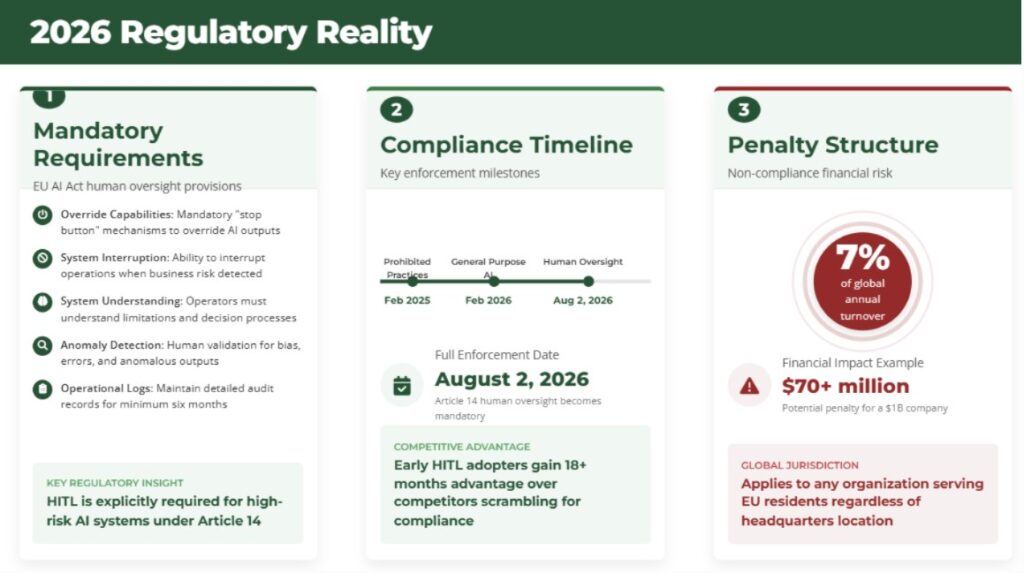
The EU AI Act becomes fully enforceable August 2, 2026, requiring “effective human oversight” for high-risk AI systems. This isn’t a suggestion—rather, it’s law with business-threatening penalties.
Understanding High-Risk AI Systems
High-Risk AI Systems Include:
- Credit scoring and lending decisions
- HR recruitment and employee evaluation systems
- Healthcare diagnostics and treatment recommendations
- Critical infrastructure management
- Law enforcement and judicial decision support
- Educational assessment and admission systems
Technical Compliance Requirements
Mandatory Technical Requirements:
- Override Capabilities: Humans must be able to override any AI decision before it takes effect
- System Interruption Protocols: Immediate stop mechanisms for when AI systems detect risks or anomalies
- Comprehensive System Understanding: Human operators must understand AI limitations, capabilities, and decision logic
- Operational Logging: Detailed records of all AI decisions and human interventions for minimum six-month periods
- Qualified Human Oversight: Designated individuals with appropriate training, authority, and competence for AI system governance
Organizational Responsibilities
Organizational Compliance Requirements:
- Risk Management Systems: Documented processes for identifying, assessing, and mitigating AI risks
- Data Governance: Quality management systems for training, validation, and testing datasets
- Human Oversight Protocols: Clear procedures for human intervention, escalation, and decision-making
- Documentation Standards: Comprehensive technical documentation and conformity assessments
- Incident Response: Systematic monitoring and reporting of AI system malfunctions or unintended outcomes
Financial Risk Reality
Financial Risk Assessment: Most importantly, non-compliance penalties reach 7% of global annual revenue—making HITL implementation not just strategic, but financially essential. For example, for a $1B company, maximum penalties could reach $70M per violation.
Beyond financial penalties, global jurisdictional impact creates additional complexity. Additionally, these requirements apply to any organization offering AI services to EU residents, regardless of headquarters location. Therefore, US companies, Asian manufacturers, and global service providers all fall under EU AI Act jurisdiction when serving European markets.
Compliance Through Strategic Implementation
Smart organizations aren’t waiting for 2026. Indeed, according to Gartner’s AI Governance research, 55% of enterprises have already adopted AI governance practices, with HITL frameworks leading implementation priorities.
Implementation Timeline Strategy:
- 2025 Q1-Q2: Assessment and framework design
- 2025 Q3-Q4: Pilot implementations and staff training
- 2026 Q1: Full compliance deployment before August enforcement
- 2026 Q2+: Optimization and competitive advantage realization
Competitive Positioning: Early HITL adopters gain 18-24 months of competitive advantage while competitors scramble for last-minute compliance. Organizations implementing HITL now will have optimized systems delivering superior business outcomes when regulatory requirements force industry-wide adoption.
Key Takeaways:
- Compliance is mandatory, not optional: EU AI Act penalties are business-threatening
- Global requirements: Affects any organization serving European customers
- Early adoption advantage: Implement now for competitive positioning before forced compliance
Strategic Partnership with servicePath™
Proven HITL Leadership
Notably, servicePath™ is a Gartner Magic Quadrant Visionary for CPQ Application Suites with 14+ years of enterprise expertise, helping organizations implement HITL-enabled revenue operations that deliver measurable business results.
HITL-Enabled Platform Capabilities
- Intelligent Guided Selling: AI processes standard configurations while seamlessly routing complex scenarios to human experts with comprehensive context and recommendations.
- Automated Deal Governance: Standard workflows execute automatically; strategic deals requiring judgment escalate to decision-makers with detailed analysis.
- Real-Time Profitability Analysis: AI calculates margins and metrics; humans consider strategic factors like customer lifetime value and competitive positioning.
- Compliance and Audit Trails: Every human intervention and override decision is automatically documented for regulatory reporting and continuous optimization.
The Strategic Implementation Roadmap: Your Path to HITL Success
Phase 1: Assessment and Foundation (Months 1-2)
Start with a comprehensive audit of your current AI implementations and identify the highest-risk decision points. This isn’t about technology—rather, it’s about mapping where AI failures would cost you the most money, customers, or regulatory compliance.
Critical Assessment Questions:
- Where are our biggest AI-related revenue risks? (Pricing, quoting, customer communications)
- Which processes currently lack adequate human oversight? (Financial approvals, complex configurations)
- What regulatory requirements apply to our AI systems? (EU AI Act, industry-specific regulations)
- How do our current AI accuracy rates compare to industry benchmarks?
Foundation Building:
First, establish clear governance structures before implementing technology. Next, define roles, responsibilities, and escalation procedures. Finally, create documentation standards that will satisfy both internal audits and external regulatory reviews.
Phase 2: Pilot Implementation (Months 3-4)
Next, select one high-impact, contained process for your HITL pilot. For instance, revenue operations quotation and pricing workflows offer ideal starting points because they’re measurable, contained, and directly impact business outcomes.
Pilot Success Criteria:
- Reduced error rates in AI-generated outputs
- Maintained or improved processing speed despite human oversight
- Clear audit trail documentation for all human decisions
- Employee adoption and satisfaction with augmented workflows
Risk Mitigation Strategies:
Run parallel systems during pilot phase to ensure business continuity. Additionally, maintain existing manual processes as backup until HITL system proves reliable. Furthermore, document all lessons learned for broader organizational rollout.
Phase 3: Scaling and Optimization (Months 5-12)
Expand successful pilot patterns to additional business processes. Moreover, focus on areas where AI mistakes create the highest business impact: customer-facing communications, financial calculations, compliance-sensitive decisions.
Optimization Opportunities:
- Refine AI confidence thresholds based on human override patterns
- Develop specialized training for human reviewers in different business domains
- Create feedback loops where human decisions improve AI accuracy over time
- Establish performance metrics that balance speed, accuracy, and cost-effectiveness
The Future of Human-AI Collaboration: What’s Coming Next
The 2030 Strategic Reality
By 2030, the most successful organizations won’t be those with the most AI—instead, they’ll be those with the smartest human-AI partnerships. Furthermore, we’re already seeing this transformation accelerate across industries.
The pattern is clear: McKinsey’s Future of Work Institute projects that organizations mastering human-AI collaboration will achieve significantly higher productivity gains compared to those pursuing pure automation strategies. Therefore, the competitive advantage goes to companies that recognize HITL as a strategic capability, not just a technical feature.
What Industry Leaders Are Building Now
Generative AI with Human Guardrails: Currently, companies are deploying HITL frameworks for content creation, code development, and strategic planning. Meanwhile, AI amplifies human capability while humans ensure quality, context, and strategic alignment. This isn’t just preventing errors—rather, it’s creating new forms of competitive advantage.
Agentic AI Systems: Similarly, the next generation won’t just respond to commands—instead, they’ll act autonomously to achieve goals. Additionally, these systems will manage complex workflows and make business decisions, but as Google’s AI leadership emphasizes, “the higher the autonomy, the greater the need for intelligent human oversight.”
The Regulatory Speed-Up
The regulatory environment is changing rapidly. Moreover, the EU AI Act requires human oversight for high-risk systems. Additionally, proposed US federal guidelines emphasize “meaningful human control” over AI systems affecting consumers and workers.
Organizations implementing HITL now are positioning themselves ahead of regulatory requirements. Therefore, by the time compliance becomes mandatory, HITL-enabled companies will have years of competitive advantage.
The Workforce Evolution
The future of work isn’t humans versus machines—instead, it’s about redefining human value in an AI-enhanced economy. Furthermore, HITL is creating entirely new job categories while transforming existing roles.
Emerging High-Value Roles:
- AI Collaboration Specialists: Design and optimize human-AI workflows
- AI Quality Assurance Managers: Oversee accuracy and bias detection across systems
- AI Ethics Officers: Ensure systems align with company values and regulations
- Human-AI Interface Designers: Create intuitive collaboration workflows
For existing employees, HITL creates training opportunities rather than replacement. For example, administrative professionals become AI coordination specialists. Similarly, quality inspectors become AI training experts. Meanwhile, customer service representatives become specialists for complex interactions.
Your Strategic Action Plan
Next 90 Days:
- Audit current AI initiatives for HITL opportunities
- Identify internal champions and subject matter experts
- Assess infrastructure readiness and build business cases
Next 6 Months:
- Launch first HITL pilot project with clear success metrics
- Begin training programs for human-AI collaboration
- Evaluate technology partners and implementation approaches
Next 2 Years:
- Scale HITL across multiple business functions
- Establish center of excellence for human-AI collaboration
- Build competitive advantages through superior AI-human partnerships
Frequently Asked Questions: Executive Insights
1. How quickly can we expect ROI from HITL implementation?
Most organizations see positive returns within 6 months through error reduction alone. However, the timeline depends on your starting point. Additionally, companies with existing AI deployments typically see faster results because they already have the infrastructure foundation. Furthermore, revenue operations implementations often deliver the quickest measurable impact.
2. What’s the biggest implementation challenge executives face?
Change management, not technology. Moreover, employees often resist AI tools when they feel replaced rather than empowered. Therefore, successful HITL programs position AI as augmentation, creating higher-value roles for human experts. Consequently, organizations that invest in proper training see 3x higher adoption rates.
3. How do we measure HITL success beyond cost savings?
Focus on business outcomes, not just efficiency metrics. For example, track customer satisfaction scores, deal win rates, and regulatory compliance scores. Similarly, monitor employee satisfaction as workers transition to higher-value activities. Most importantly, measure competitive differentiation through faster, more accurate customer responses.
4. Is HITL just a temporary solution until AI gets better?
No. As AI becomes more powerful, human oversight becomes more critical, not less. Furthermore, regulatory requirements are increasing, not decreasing. Therefore, the most successful organizations will be those that perfect human-AI collaboration. Additionally, HITL creates competitive advantages that pure automation cannot match.
5. How do we choose between building HITL internally versus partnering with a vendor?
Consider your core competencies first. Moreover, building HITL requires significant AI expertise, change management skills, and regulatory knowledge. Therefore, most organizations find faster success partnering with proven vendors like servicePath™. However, evaluate based on your timeline, budget, and internal capabilities.
The Foundation Is Set: What Senior Executives Must Know
AI can hallucinate; unchecked systems destroy value. The data is clear: most AI pilots fail financially, while HITL implementations deliver substantial improvements in critical processes.
Strategic Reality for 2026
- Regulatory enforcement begins August 2, 2026—compliance is mandatory, not optional.
- Additionally, competitive advantage accrues to organizations that master human-AI collaboration.
- Furthermore, revenue protection depends on intelligent checkpoints that prevent costly AI failures.
- Most importantly, market leadership demands speed and accuracy—HITL operationalizes both.
Your Next Strategic Challenge: Implementation Excellence
Translating HITL into results requires role-specific playbooks and disciplined execution.
What successful executives are building:
- Executive scorecards and metrics to track HITL value across revenue, risk, and customer experience
- Risk management and ROI frameworks for investment decisions and audit-ready oversight
- Operating models and architecture blueprints to scale HITL safely across business functions
What’s Next: Your Complete HITL Implementation Journey
This comprehensive guide represents Part 1 of our 3-part Executive HITL Series, designed to equip senior leaders with everything needed to implement successful Human-in-the-Loop systems.
Part 1: Strategic Foundation (This Guide)
✅ Complete – Understanding HITL business value, regulatory requirements, and executive decision frameworks
Part 2: Implementation Playbook (Coming Next)
🚀 Coming Soon – Detailed implementation roadmaps, team structures, vendor evaluation frameworks, and success metrics that matter to the C-suite
Part 3: Advanced Optimization (Final Part)
🎯 Coming Soon – Advanced HITL architectures, competitive differentiation strategies, and future-proofing your AI investments for sustained market leadership
Ready to Transform Your Revenue Operations?
The competitive landscape of 2026 rewards organizations that master human-AI collaboration. With EU AI Act compliance mandatory and business expectations for both speed and accuracy at all-time highs, HITL isn’t just smart strategy—it’s essential for sustainable growth.
Take Action with servicePath™
Experience Our HITL-Enabled Platform:
- Get Executive Demo — See AI-drafted quotes with policy-based human approvals and real-time compliance tracking in action
- Strategic Consultation — Connect with CPQ architects who’ve helped hundreds of organizations implement successful HITL systems
- View Success Stories — Discover how organizations achieved faster quote-to-cash cycles while eliminating pricing errors
servicePath™ combines 14 years of CPQ expertise with Gartner-recognized innovation, helping technology service providers achieve the perfect balance of automation efficiency and human oversight.
The strategic window for HITL leadership is narrowing rapidly. Therefore, organizations that act now will build insurmountable competitive advantages while their competitors struggle with automation failures.
Sources and Verification
All quotes, statistics, and case studies have been verified from original 2024-2025 sources:
- Regulatory Sources: EU AI Act • European Parliament • White House AI Guidelines
- Industry Research: McKinsey & Company • Boston Consulting Group • KPMG • Forrester Research • Stanford HAI • MIT CSAIL
- Technology Sources: SAP News • Microsoft Docs • Google AI Blog • servicePath™
#HITLStrategy#AILeadership#EUAIAct2026#ExecutiveAI#RevenueOps#AIGovernance#DigitalStrategy#AICompliance#TechLeadership