
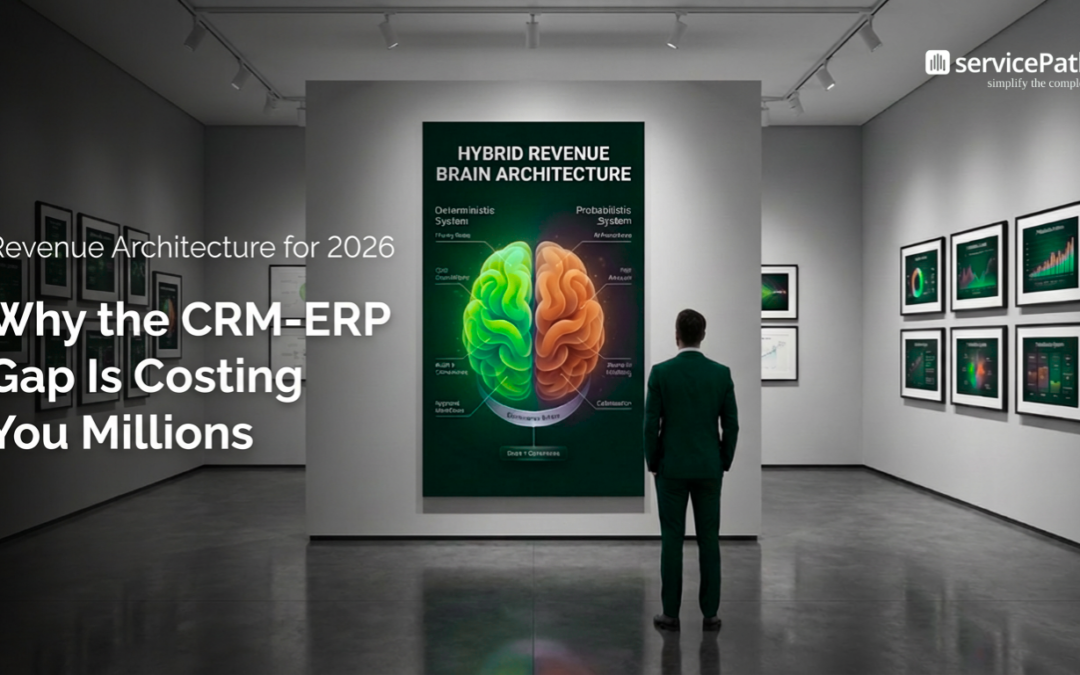
Revenue Brain, the governed intelligence layer enterprises are missing
As CEO of servicePath™, I live in the space where revenue architecture breaks down. The space between where deals get made and where they get recorded. And I can tell you with certainty: that space is a graveyard.
It’s where margin dies quietly. Where audit findings breed. Where billion-dollar enterprises still run their most consequential financial logic in spreadsheets that live on someone’s laptop. The pricing. The bundling. The cost-to-serve math. The revenue allocation. All of it, ungoverned.
We call it the Shadow Stack. Not because it’s sinister, but because it’s invisible. It doesn’t show up in your IT architecture diagram. It doesn’t appear in your software audit.
But it’s there. In every offline Excel file that a deal desk analyst maintains because your CPQ can’t handle the complexity. In every revenue recognition workaround your controller builds because the quoting system doesn’t tag performance obligations.
In every pricing exception that gets approved over Slack because there’s no governed workflow to route it through.
At servicePath™, we exist to kill the Shadow Stack.
Not by replacing your CRM or your ERP. They do what they do. Instead, we provide the governed revenue architecture layer that should have existed between them all along: the intelligence that transforms commercial intent into clean financial outcomes across the entire quote-to-cash lifecycle.
I call it the Revenue Brain.
That’s not an industry term. It’s ours. The industry doesn’t have a name for this layer, and the absence of a name is part of the problem.
What Is a Revenue Brain in Revenue Architecture?
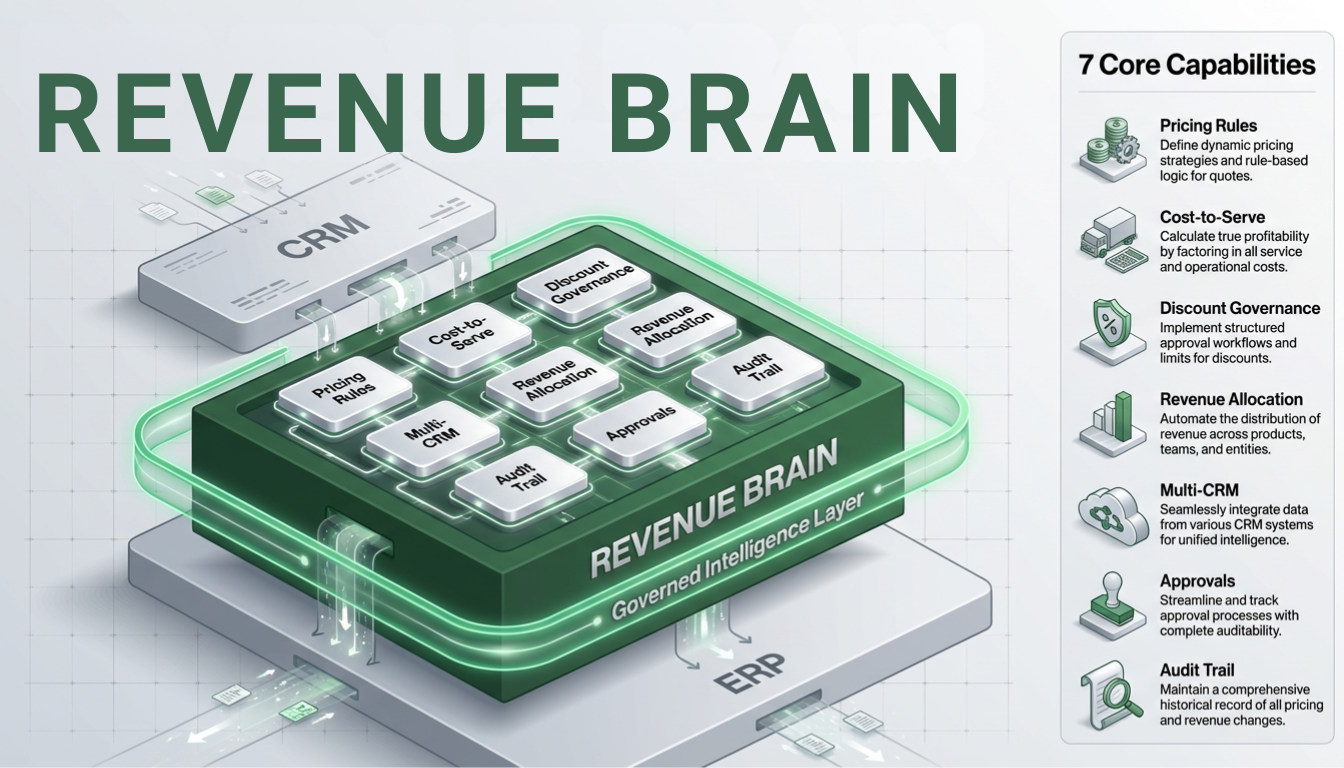
A Revenue Brain is the centralized, governed intelligence layer between CRM and ERP. It ensures every deal is priced correctly, margin-validated, ASC 606-aware, and audit-ready before it reaches the ledger.
It is not just another CPQ tool. Likewise, it is not a billing module or an ERP extension. Instead, it governs the logic that connects them all.
The pricing rules, cost-to-serve calculations, discount governance, revenue allocation, and multi-CRM propagation that enterprises currently manage in disconnected spreadsheets.
That includes:
- pricing rules
- cost-to-serve calculations
- discount governance
- revenue allocation
- multi-CRM propagation
- approval workflows
- auditability
In most enterprises, those processes are fragmented. Worse, they are often maintained in spreadsheets by high-performing operators who are compensating for architectural gaps.
So while the people are capable, the system is fragile.
That is why naming this layer matters.
Without governed revenue architecture, enterprises keep pushing critical deal logic into spreadsheets and manual workarounds.
Defining the Language of Modern Revenue Architecture: New Concepts for Managing Risk, Control, and Complexity
To understand the Revenue Brain, it helps to define the language around it.
Shadow Stack
The hidden layer of offline spreadsheets, manual workarounds, and tribal knowledge used to manage complex revenue logic outside CRM and ERP systems.
Innovation Debt
The lag between designing a new pricing or monetization model and making it operational across quoting, billing, and revenue recognition. In weak architectures, that lag can stretch for months.
Preemptive Governance
The practice of validating margin, compliance, and audit-readiness at the point of deal creation rather than discovering issues later.
Immutable Audit Trail
A tamper-resistant record of every quote version, discount approval, margin decision, and revenue allocation event.
Aggregated Community
servicePath™’s customer-driven innovation ecosystem, where users help shape platform enhancements through shared input and feedback.
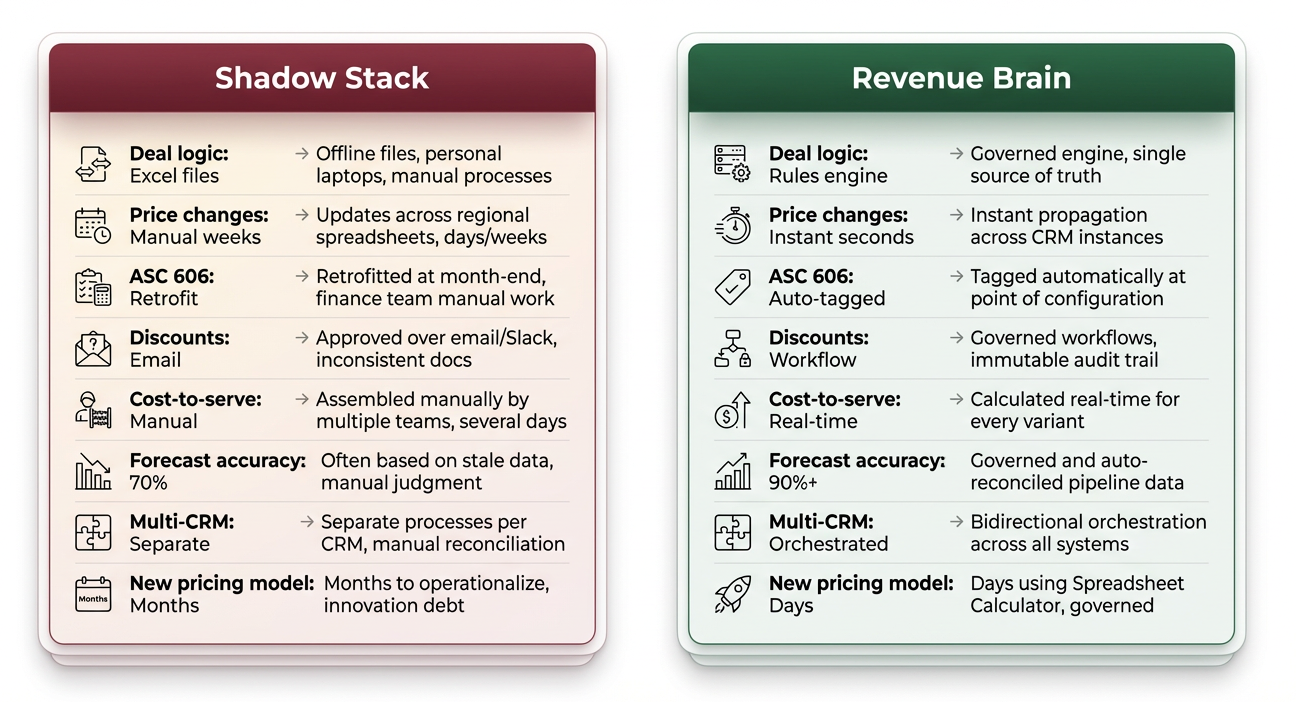
Revenue Brain vs. Shadow Stack
The difference between a Shadow Stack and a Revenue Brain becomes much clearer when you compare how each model handles the operational realities of enterprise revenue.
The Enterprise Revenue Crisis: Why It Matters Now
The enterprise revenue problem is no longer theoretical. It is measurable, visible, and increasingly expensive.
- 61% of invoices contain at least one error and billing errors account for 60% of late payments (Tesorio, 2025)
- Only 36% of U.S. invoices are paid on time, with more than half paid after their due date (DocuClipper / Atradius, 2025)
- Only 8% of finance teams are fully automated in 2026, while 60 to 64% remain dependent on manual processes (Parseur, 2025)
- 49% of revenue operations leaders say processes aren’t flexible enough to respond when market conditions change (Forrester, 2024)
- 87% of CFOs rate AI as extremely or very important to finance operations in 2026, with technology transformation now the #1 CFO priority (Deloitte Q4 2025 CFO Signals)
Think about that contrast. 87% saying AI is critical, while only 8% of finance teams are fully automated. That’s not a technology gap. That’s a chasm between aspiration and architecture.
“The Shadow Stack persists not because it’s cheap, but because its cost is distributed invisibly across the organization.”
These aren’t statistics about small businesses. These are enterprise-scale failures happening inside companies that have spent tens of millions on their technology stack. They persist because the Shadow Stack fills a genuine need.
It handles complex logic that CRM and ERP were never designed for.
But it also creates risks that compound invisibly until something breaks. An audit finding. A restatement. Revenue leakage that nobody saw coming because nobody could see the full picture.
Score Yourself: Five Questions That Reveal Your Revenue Architecture Maturity
Take a minute and ask your team these five questions: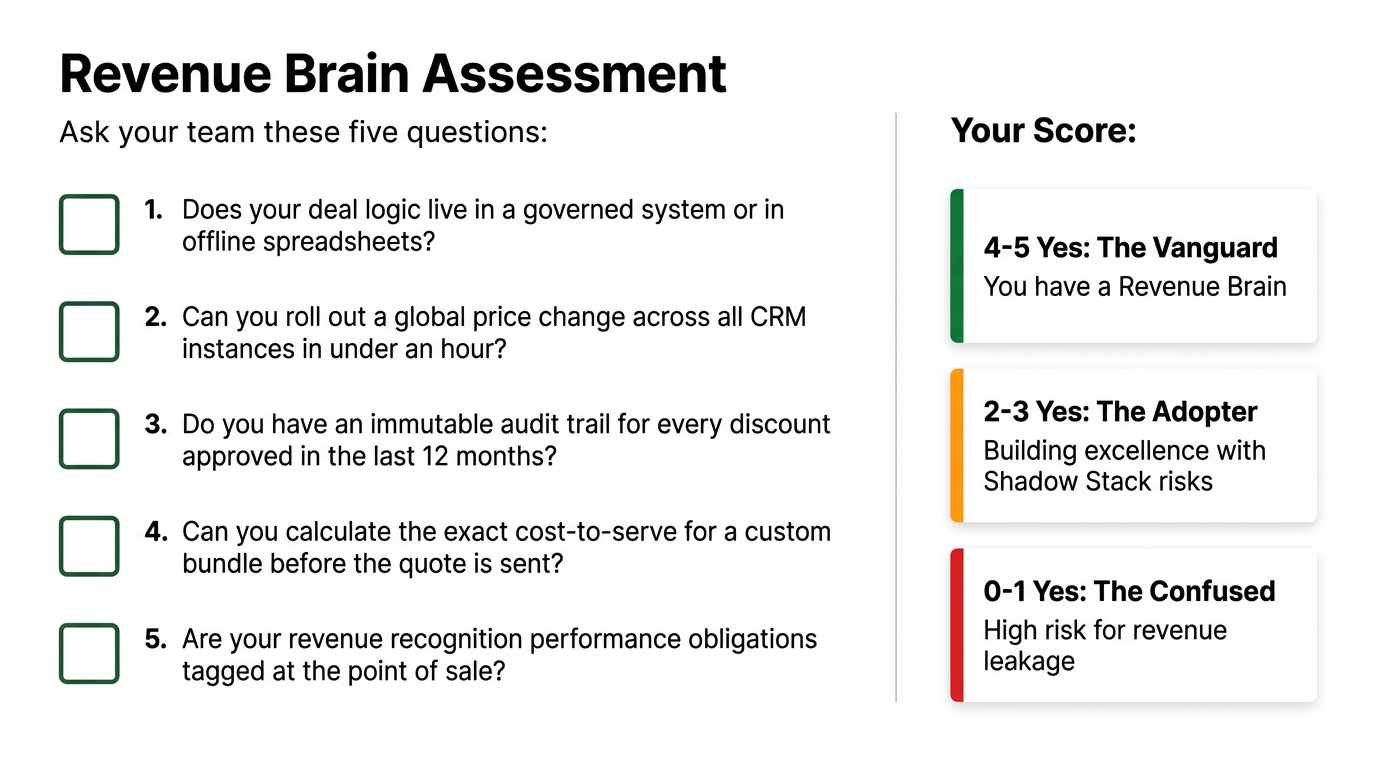
If you scored 0 to 2, keep reading. What follows is the revenue architecture that closes the gap.
The Revenue Architecture Continuum
Your diagnostic score maps to a maturity model. Organizations move through three stages, from operational confusion to autonomous innovation. Knowing where you are determines what you should build next.
Stage 1: The Confused Organization (Score: 0 to 1)
This is the Shadow Stack at full strength. Deal logic lives in offline spreadsheets. Pricing decisions depend on tribal knowledge.
Revenue recognition is retrofitted at month-end. Legacy systems were never built for real-time decision-making, and the result is decision latency that kills margins.
When a vendor price changes, it takes days or weeks to propagate. When a deal needs cost validation, three teams assemble data manually. Integration between systems is brittle, manual, and constantly breaking.
The cost is real: margin leakage, audit exposure, and a finance team spending its best hours on reconciliation instead of strategy.
Stage 2: The Adopter Organization (Score: 2 to 3)
Adopters are transitioning from order-centric to contract-centric models. They’ve invested in CPQ, CRM, and some automation. They’re building commercial excellence. But the Shadow Stack still fills the gaps that their tools can’t cover.
This is the stage where organizations start to see what governed revenue architecture could look like.
Bain’s research shows commercial excellence contributes 2 to 3x growth by enabling firms to rethink pricing architecture and remove unjustified discounts.
McKinsey’s work with Reckitt on Revenue Growth Management demonstrated what happens when an enterprise leapfrogs reactive silos with an AI-enabled tool suite across 35 markets.
The principle is the same: governed intelligence replacing disconnected spreadsheets.
The risk at this stage is stalling. Adopters have enough automation to feel comfortable, but not enough governance to be audit-ready, margin-protected, or agent-ready. The Shadow Stack is smaller, but it’s still there.
Stage 3: The Vanguard Organization (Score: 4 to 5)
Vanguards have a Revenue Brain. Their deal logic is governed. Their pricing propagates in seconds. Their ASC 606 tagging happens at the point of configuration, not at month-end. Their audit trail is immutable.
This is the stage where agentic AI becomes possible.
Gartner predicts that by the end of 2026, 40% of enterprise applications will feature task-specific AI agents, driving a shift from assistants to collaborators.
But agents only work when the foundation underneath them is governed.
Vanguard organizations align with the NIST Cybersecurity Framework 2.0 “Govern” function, treating governance not as a technical hurdle but as a leadership mandate.
The Vanguard doesn’t just use AI. It uses AI safely, on a deterministic foundation that delivers five-nines accuracy, with safe harbor caveats on every probabilistic recommendation.
That’s the architecture the market is moving toward. The question is whether you’ll build it or buy it, and how fast.
The Revenue Architecture Landscape Is Consolidating
The market isn’t waiting.
In February 2026, Conga completed its acquisition of PROS’s B2B business. Forrester called it “a defining moment for CPQ.” Meanwhile, Salesforce is re-platforming Revenue Cloud.
The entire category is consolidating around a single premise: companies need to stop stitching together point solutions.
They’re right about the diagnosis. However, here’s what most platforms still get wrong: they optimize individual steps without governing the logic that connects them.
You get better quoting. Better pricing. But not a brain. Not a single system ensuring every deal is margin-validated, ASC 606-compliant, and audit-ready before it touches your ERP.
That’s why servicePath™ has been positioned as the sole Visionary in Gartner’s Magic Quadrant for CPQ for four consecutive years. The revenue architecture is fundamentally different. For enterprises navigating M&A with multiple CRMs, the problem multiplies. (Revenue-IT Architecture Convergence for 2026 M&A.)
Meanwhile, Gartner predicts 90% of B2B buying will be AI-agent intermediated by 2028, pushing $15 trillion through autonomous exchanges. Think about what that means for your pricing.
If an AI agent queries your pricing in real time, and your pricing logic lives in a spreadsheet that someone updates on Thursdays, you’re not in the game.
Your pricing needs to be governed, API-accessible, and defensible at machine speed.
In addition, Gartner predicts 40% of enterprise applications will integrate task-specific AI agents by end of 2026, up from less than 5% in 2025. As the numbers above show, Bain’s research confirms that companies executing commercial excellence deliver 2x the revenue growth of their peers.
Broader Bain research shows commercial excellence contributes 2 to 3x growth through smarter pricing architecture and tighter discount governance.
Deloitte’s Q4 2025 CFO Signals survey confirms the C-suite is ready. 86% of CFOs say pricing will become more important to their organizations over the next year.
The bottom line: pricing, governance, and AI are colliding. Companies without governed revenue architecture will be the casualties.
Why servicePath™ Is The Leader For Revenue Architecture
Every enterprise we talk to has invested millions in CRM and ERP. They have CPQ tools. They have billing platforms.
But between those systems, in the space where a deal gets priced, validated, margin-tested, and made audit-ready, there is nothing but Excel. Brilliant, fragile, ungovernable Excel.
The Missing System Between CRM and ERP
Across enterprises, the pattern is always the same. The gap between CRM and ERP is filled with spreadsheets.
Those spreadsheets carry pricing logic, margin models, cost-to-serve calculations, and discount histories that should live in a governed system.
When a vendor price changes, it doesn’t propagate. When a deal needs cost validation, three teams assemble data manually.
And when audit season arrives, the finance team scrambles to reconcile what was quoted against what was recognized. No single system governed the journey from deal to ledger.
“The Shadow Stack isn’t a people problem. It’s an architecture problem.”
The people building those spreadsheets are often the most capable operators in the company. They’re compensating for a system that doesn’t exist.
The conviction behind servicePath™ is simple: give them the system, and they’ll do extraordinary things with it. Take the intelligence that’s trapped in their heads and their spreadsheets, and put it in a governed engine that the whole enterprise can trust.
Where Traditional CPQ Breaks Down
However, traditional CPQ handles product configuration and basic quoting only up to a point.
It breaks down when vendor pricing shifts weekly, when you are operating across multiple CRM instances after M&A, when you launch outcome-based pricing models, or when you need real-time cost-to-serve before a quote is sent.
When CPQ cannot handle that complexity, teams fall back on spreadsheets.
That is when the Shadow Stack grows. servicePath™ governs the complex deal logic that traditional CPQ was never designed to manage.
That is the logic that drives margin, compliance, and win rate.
More importantly, quoting accuracy was only the entry point. The governed intelligence layer between CRM and ERP was the real product: configuration, pricing, cost-to-serve, revenue allocation, margin governance, and audit trail.
All of it is governed in one place and propagated to every CRM instance in real time through servicePath™’s Integration Hub.
That is the Revenue Brain, and it is what the market is now racing to build.
Ultimately, we have learned that the technology is the easier half. Adopting a Revenue Brain means retiring spreadsheets that people have built their workflows around, and sometimes their careers around.
The deployments that succeed are the ones where the CFO and CRO are jointly committed, where master data cleanup is treated as a prerequisite rather than a parallel workstream, and where someone has the authority to retire the old spreadsheets instead of letting them run alongside the new system.
By contrast, the deployments that struggle are the ones treated as IT projects rather than executive mandates.
Three Pressure Moments That Define the Revenue Brain
Enterprise revenue doesn’t happen in dashboards. It happens in pressure moments. These scenarios are illustrative of patterns across our customer base.
The CFO: The Discount That Almost Cost $1.8M
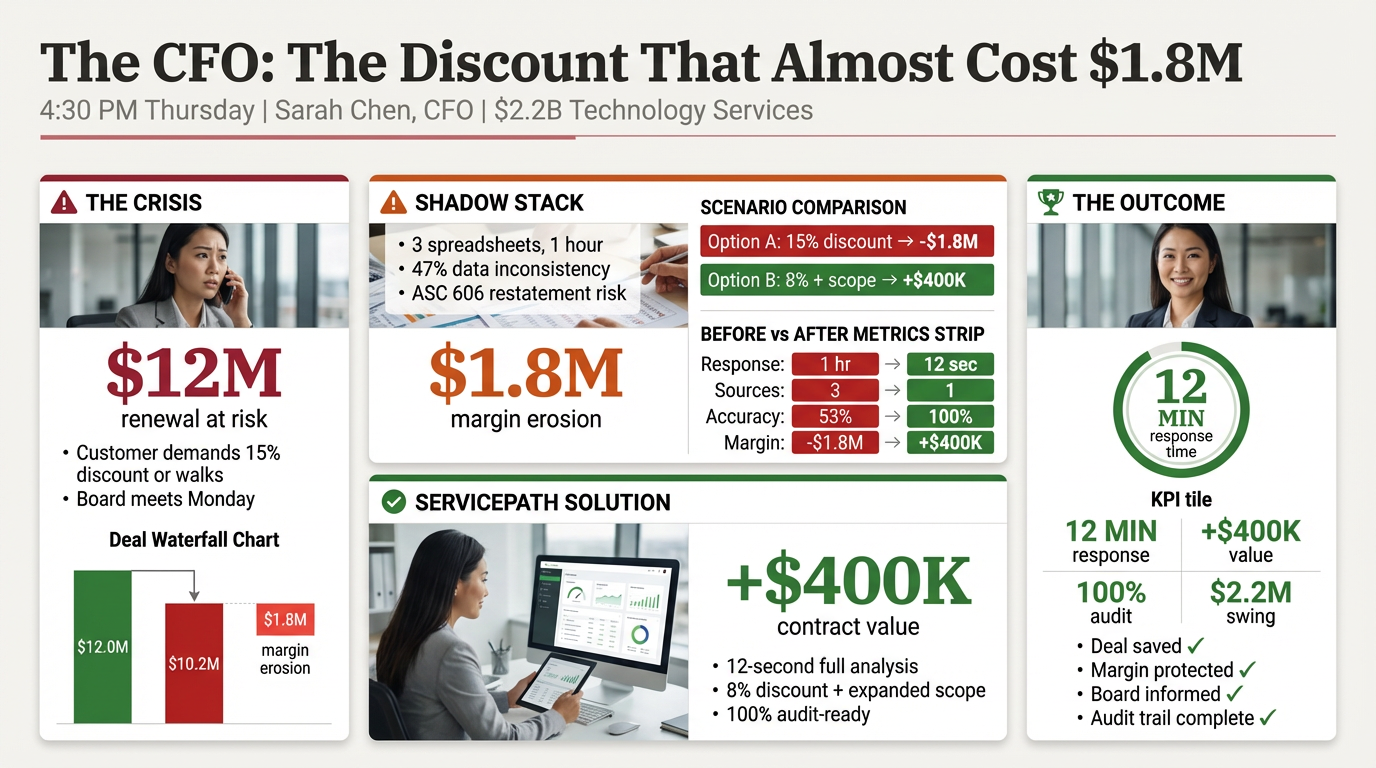
4:30 PM, Thursday. Sarah, CFO of a $2.2B technology services company, gets a call. A $12M renewal is at risk. The customer’s procurement team, backed by an AI negotiation tool, is demanding 15% off or they walk. The board meets Monday.
In the Shadow Stack world, CFOs approve discounts they shouldn’t. The deal desk pulls data from one spreadsheet, finance from another, the CRM from a third. An hour of conflicting numbers, and the path of least resistance wins.
Sarah pulls the customer’s full profile in servicePath™. Seconds. Customer lifetime value. Total contract value. Blended margin. Cost-to-serve by deliverable.
Standalone selling price reallocation under ASC 606. Net revenue retention impact. Full discount history on the account. The full 15% shows $1.8M in margin erosion and a restatement flag. An 8% discount with expanded scope increases TCV by $400K while improving blended margin and protecting NRR.
She tries to approve the 8% counter-proposal. But because of the gravity of the discount on a deal this size, servicePath™ automatically routes it to the CEO and board for approval. Not as an email with a spreadsheet attached.
As a full Deal Dashboard: lifetime value, cost-to-serve breakdown, blended margin, TCV, NRR impact, ASC 606 reallocation, payback timeline, and complete discount history.
The board can analyze it, discuss it, and make an informed decision with complete visibility. Nobody built the dashboard. Nobody chased the data. Governance was built into the workflow from the moment the deal was configured.
Counter-proposal delivered in minutes. Deal saved. Margin protected. Board informed. Audit trail complete. That’s Preemptive Governance.
The Product Manager: The Launch That Didn’t Die in a Spreadsheet
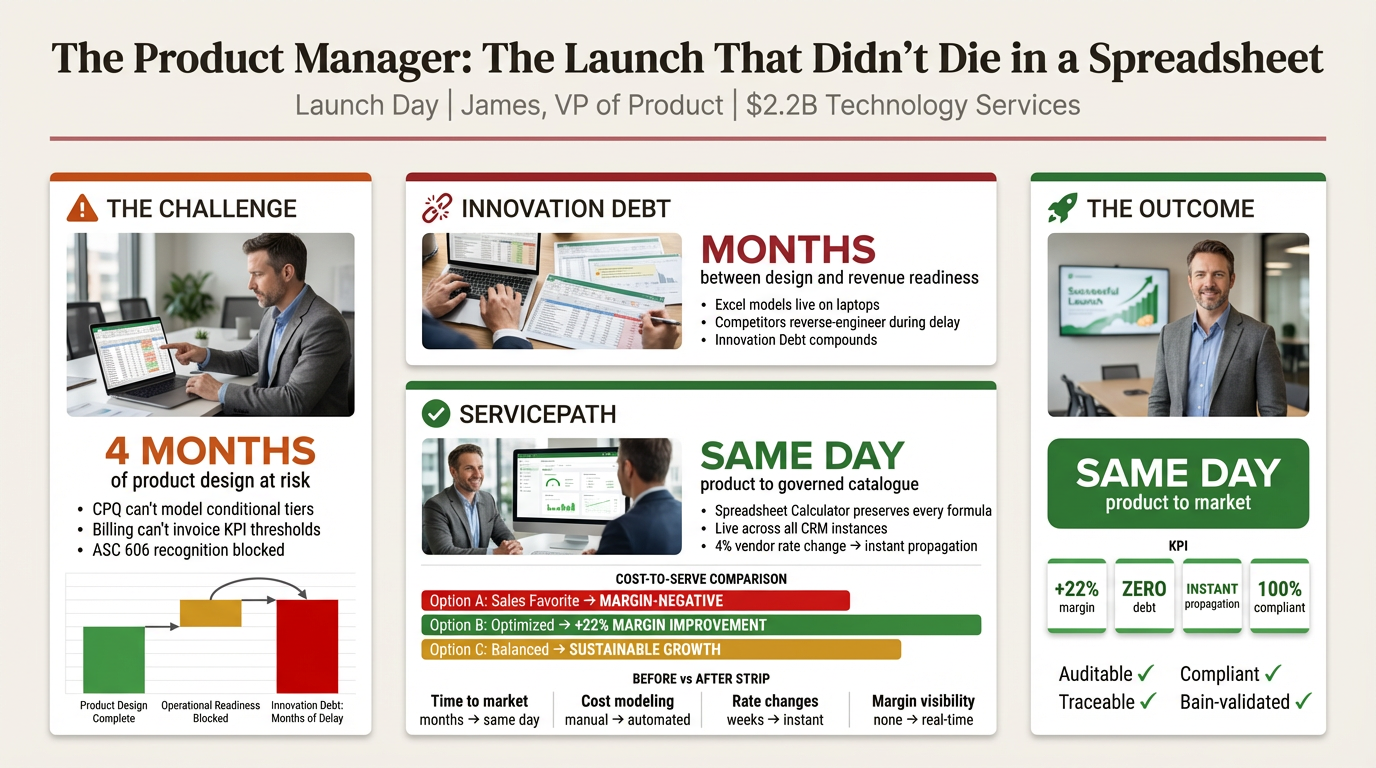
Launch day. James, VP of Product, has spent four months designing an outcome-based bundle that ties fees to customer-achieved KPIs. Uptime targets, adoption thresholds, delivery milestones. The board approved it. Sales is excited. The competitive differentiation is real.
In most enterprises, this is the moment where innovation dies. Not from competitive pressure, but from operational paralysis.
The CPQ can’t model conditional tiers. Billing can’t invoice against KPI thresholds. Finance can’t recognize the revenue under ASC 606 when performance obligations depend on outcomes that won’t be measured for six months. So the product team builds a spreadsheet.
Then another. Innovation Debt compounds. Months between product design and full revenue readiness. Months where competitors can reverse-engineer your model and launch it on a platform that actually works.
James uploads his Excel model into servicePath™’s Spreadsheet Calculator. Every formula preserved. Every conditional intact. But now it lives in a governed rules engine, not on a laptop. The product is live. It’s in servicePath™’s governed catalogue, available to every sales team across every CRM instance.
Auditable. Traceable. Compliant. Brought to market in a system, not in a spreadsheet.
The Cost-to-Serve engine models three packaging options.
One delivers 22% margin improvement without changing the customer-facing price. A second, the one the sales team liked best, turns out to be margin-negative after fully loaded costs. A trap that would have taken weeks to discover in a spreadsheet process. Or might never have been discovered at all.
Mid-afternoon, a vendor raises labor rates 4% globally. In a legacy environment, that means weeks of manual updates, every quote carrying wrong cost assumptions. In servicePath™: one adjustment. Every CRM instance reflects correct costs instantly. Innovation Debt: zero.
This is the capability Bain identifies as critical for margin expansion.
The RevOps Leader: The Forecast She Didn’t Have to Apologize For
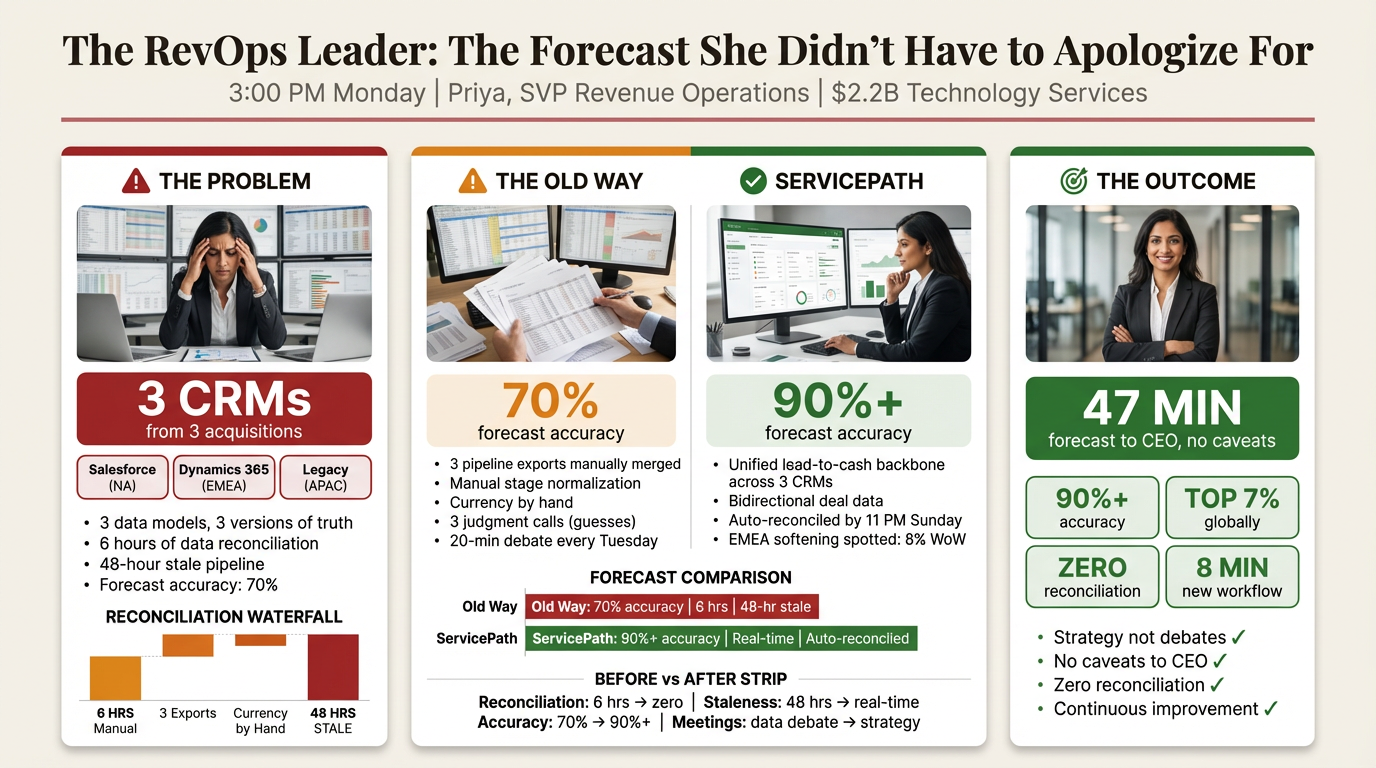
3:00 PM, Monday. Priya, SVP of Revenue Operations, is preparing the Tuesday forecast. She inherited three CRMs from three acquisitions. Salesforce in North America, Dynamics 365 in EMEA, a legacy CRM in Asia-Pacific. Three systems. Three data models. Three versions of the truth.
She knows exactly what this moment used to cost. Six hours of data reconciliation.
Three pipeline exports. Manual normalization of deal stages that used different naming conventions.
Currency adjustments done by hand. And at the end, a global pipeline number that was 48 hours stale.
It contained at least three judgment calls that were generous descriptions of guesses.
Every Tuesday meeting opened with a 20-minute debate about whether the number was real, instead of a strategic conversation about what to do with it. Forecast accuracy: 70% on a good quarter.
“The Tuesday meeting will be about strategy. Not data. That alone justifies the investment.”
Today, servicePath™ orchestrates across all three CRMs, creating a unified lead-to-cash backbone. Deal data flows bidirectionally. Configurations, pricing, approvals, revenue allocations governed in one place and synchronized to each system in the format it requires.
Pipeline current as of 11 PM Sunday, auto-reconciled, margin-validated. Priya doesn’t reconcile. She analyzes. She spots EMEA softening 8% week-over-week, drills into five deals, identifies two legitimate timing shifts and three real reductions, and flags them for the EMEA CRO before tomorrow’s meeting.
At 3:47 PM she sends the forecast to the CEO. No caveats. Accuracy: consistently above 90%, a threshold only about 7% of organizations reach.
Later this week, she’ll activate a new partner approval workflow from servicePath™’s Aggregated Community, live in her EMEA instance in eight minutes. That’s the kind of continuous improvement that compounds when your foundation is governed.
What Happens When an AI Agent Asks Your System for a Price
Gartner projects 40% of enterprise apps will have AI agents by end of 2026. So here’s where servicePath™ fits.
We’re building the governed foundation that AI agents operate on. This is what AI-native CPQ looks like in practice.
A buyer’s AI procurement agent requests a price on a custom 3-year managed services bundle across four geographies. servicePath™ responds with a governed, margin-validated, ASC 606-compliant answer in milliseconds. Full audit trail. Every parameter governed by rules your CFO approved.
Your internal sales agent draws on servicePath™’s pricing engine to model scenarios and flag margin risks, all within governance guardrails. When market conditions shift, whether a vendor raises rates, a currency fluctuates, or a regulatory change impacts cost structures, servicePath™ propagates the impact across every active quote in every CRM instance automatically. Agents don’t have to ask. The foundation stays current.
“Agents are only as good as the data they operate on.”
An AI agent negotiating with stale spreadsheet pricing will lose to one querying a governed engine with real-time cost-to-serve data. The key principle: don’t start with the agent. Start with the foundation. AI agents operating on ungoverned data will produce fast, confident, wrong answers at machine speed. Build governed revenue architecture first. Clean data. Auditable logic. Defensible pricing. Then let agents operate within guardrails that your CFO and auditor can inspect.
This aligns with the NIST Cybersecurity Framework 2.0 “Govern” function, which treats governance as an architectural requirement rather than an afterthought. And Gartner warns 40%+ of agentic AI projects will fail by 2027 due to inadequate controls. The projects that survive will be the ones built on governed foundations.
Five Nines: The Standard That Separates Architecture from Guesswork
The Revenue Brain operates at .99999 accuracy. Five nines. Every pricing rule, every cost-to-serve calculation, every margin validation, every ASC 606 tag is deterministic, auditable, and repeatable. No variance. No probability. When the output matters to your ledger, your audit, or your board, the Revenue Brain delivers governed certainty.
AI-powered capabilities, including scenario recommendations, pricing optimization suggestions, and risk flags, operate as an advisory layer on top of this foundation. These recommendations carry safe harbour caveats because they should.
They’re informed by data, surfaced by models, and designed to accelerate human decision-making. But they don’t execute. The governed core executes. The AI advises. A human or a governed rule authorizes the action.
Most vendors today are doing the opposite. They wrap probabilistic AI around ungoverned data and call it intelligent. The outputs look impressive in a demo. But when a CFO asks “can I audit this?” or “will this hold up under ASC 606 review?”, there’s no answer. Because there’s no deterministic foundation underneath.
servicePath™’s position is the inverse. The foundation is five nines. The AI enhances it. The governed core makes the AI safe. The AI makes the governed core smarter. But the core never depends on the AI for accuracy. That’s the line. And it’s the line that separates revenue architecture from revenue guesswork.
(Deeper dive: Revenue Architecture 2.0: The CPQ Control Plane for 2026.)
The Cost of Waiting, and the 90-Day Decision
Here’s the model we run with prospective customers to quantify the cost of ungoverned revenue architecture, using a $1.5B tech-enabled enterprise as the baseline:
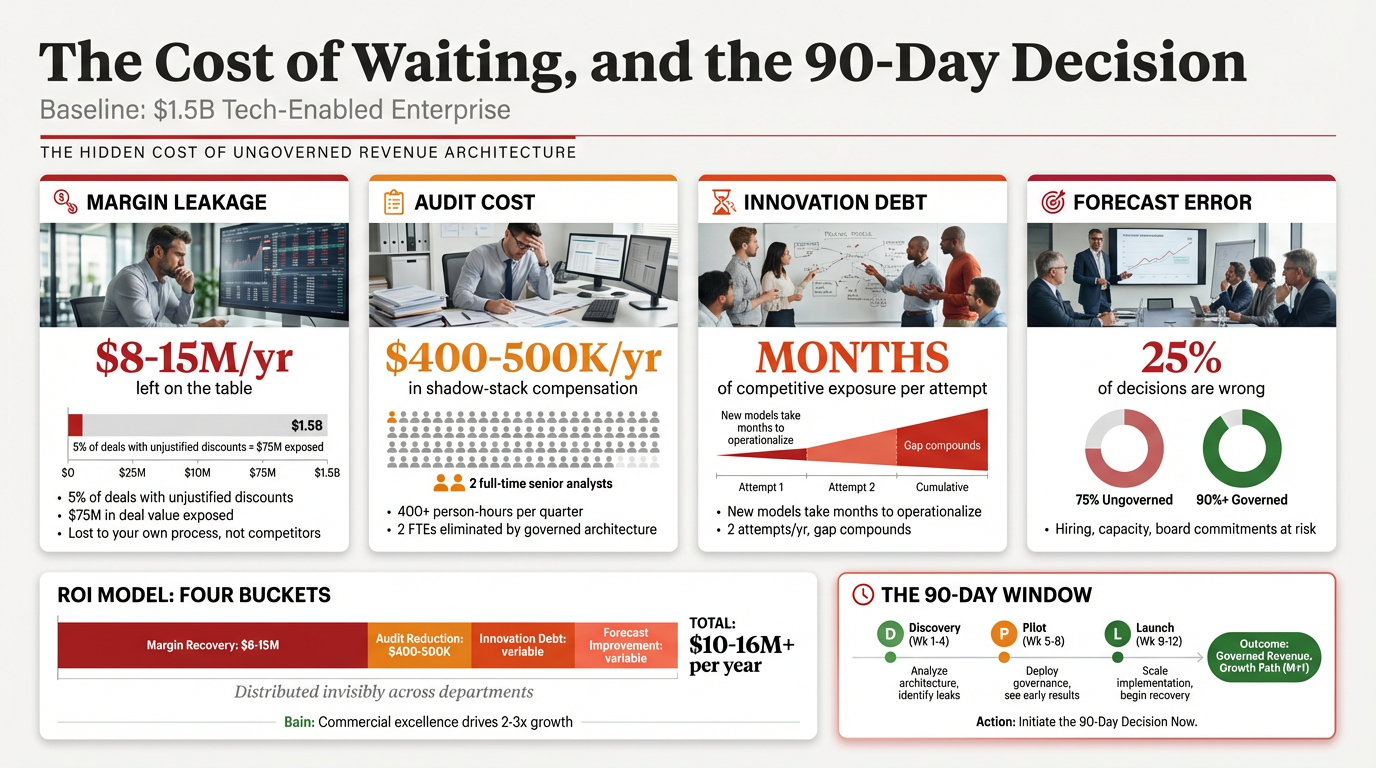
Margin leakage. 5% of deals with unjustified discounts means $75M in deal value exposed. At average enterprise margins, that’s $8 to $15M per year left on the table. Not lost to competitors. Lost to your own process.
Audit cost. 400+ person-hours per quarter on revenue recognition reconciliation and audit prep. That’s the equivalent of two full-time senior analysts whose entire jobs exist because of the Shadow Stack. $400 to $500K per year in compensation for work that governed architecture eliminates.
Innovation Debt. Every new pricing model that takes months to operationalize is months of competitive exposure. Multiply by two attempts per year, and the gap compounds.
Forecast error. 75% accuracy instead of 90%+ means hiring decisions, capacity investments, and board commitments based on numbers wrong 25% of the time.
“Nobody sums these numbers.”
The ROI model we see across deployments breaks into four buckets: margin recovery from eliminating unjustified discounts (typically the largest), audit cost reduction from governed revenue recognition, Innovation Debt elimination from faster monetization model operationalization, and forecast accuracy improvement from clean governed pipeline data.
Bain’s research shows commercial excellence drives 2 to 3x growth when done right. The prerequisite for “done right” is governed revenue architecture.
The Shadow Stack persists not because it’s cheap, but because its cost is distributed invisibly across departments that don’t share budgets or dashboards. A Revenue Brain makes the full cost visible, and then eliminates it.
The CPQ landscape is consolidating. Agentic buyers are coming. Every quarter you wait, Innovation Debt compounds and the gap widens.
The question isn’t whether you need a Revenue Brain. It’s whether you can build one before the market moves past you. The window is 90 days. Not to full deployment, but to the executive decision that revenue architecture governance matters more than speed, and architecture matters more than features.
About servicePath™
servicePath™ is an AI-native revenue operations platform that governs pricing, configuration, cost-to-serve, and revenue lifecycle management for high-complexity B2B enterprises.
The platform sits between CRM and ERP, orchestrating deal logic across Salesforce, Dynamics, HubSpot, and other systems via its Integration Hub, without requiring CRM migration or replacement.
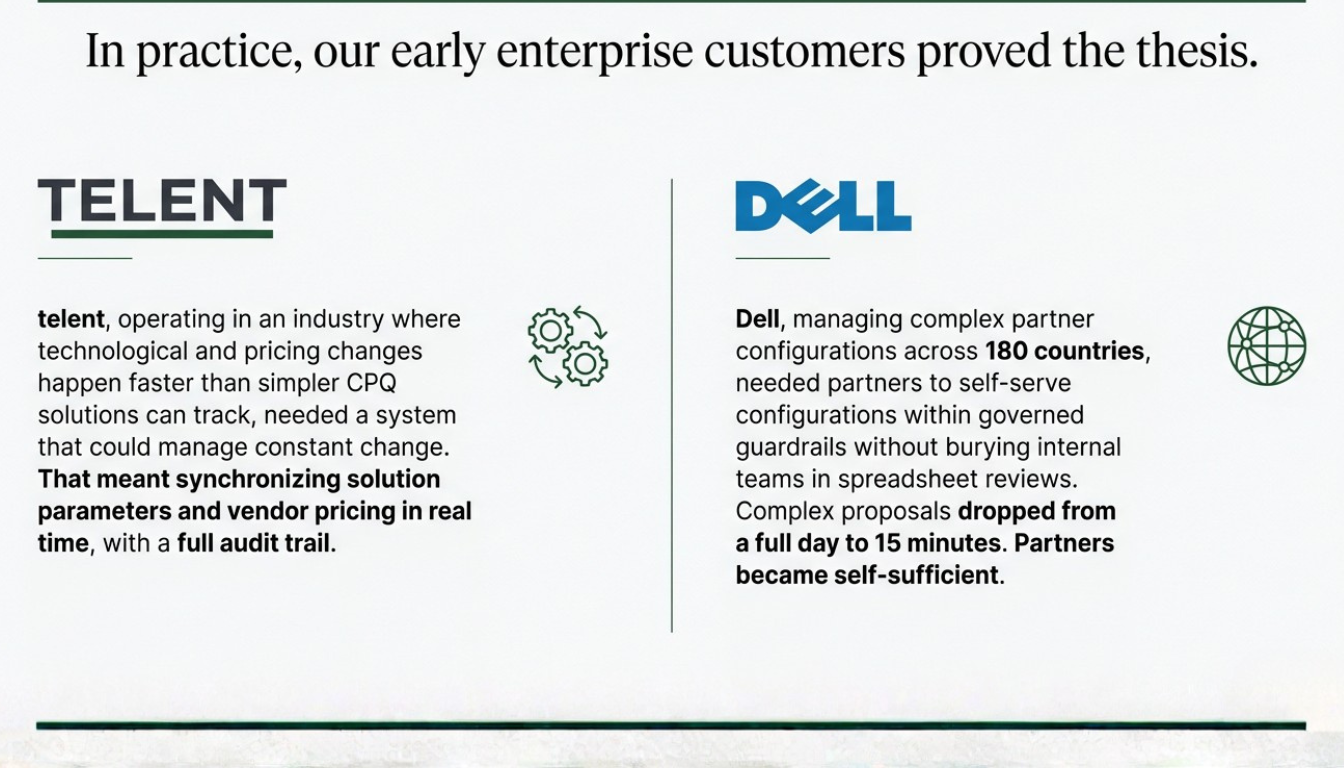
Recognized as the sole Visionary in Gartner’s Magic Quadrant for CPQ for four consecutive years and the 2025 CPQ Triple Crown winner (SoftwareReviews), servicePath™ is trusted by enterprises including Dell EMC, ATOS, DXC Technology, telent, TierPoint, Ensono, Daisy Group, and Park Place Technologies.
Ready to Kill the Shadow Stack?
See the Revenue Brain in action. Not a slideshow. A live demo with your complexity, your CRM environment, your pricing models
. servicePath™ is the sole Gartner MQ Visionary for CPQ and 2025 CPQ Triple Crown winner
Go deeper on the architecture. Revenue Architecture 2.0: The CPQ Control Plane for 2026 is the technical companion to this piece.
- Revenue Architecture 2.0: The CPQ Control Plane for 2026
- Gartner’s 2026 CIO Agenda and AI-Native CPQ
- Revenue-IT Architecture Convergence for M&A
- The Executive’s Guide to AI and CPQ
Or just email me. daniel.kube@servicepath.co. No pitch deck. No sales funnel. Just a straight conversation about your revenue architecture.
If these scenarios sound familiar, let’s talk about what this looks like for your business
Resources (servicepath.co): Glossary: Quote-to-Cash · Performance-Based Pricing · Standalone Selling Price · Revenue Engine · Bundled Services · Sales Configurators · AI-Native CPQ · Revenue Operations · Revenue Leakage
FAQs
“What is a Revenue Brain, and how is it different from CRM and ERP?” The governed intelligence layer between them. Your CRM captures opportunities, your ERP records revenue. servicePath™ governs what happens between: pricing, margin, cost-to-serve, ASC 606 tagging, discount governance, and multi-CRM propagation.
“We already have CPQ. Why another platform?” CPQ handles configuration and basic quoting. It breaks under the complexity that creates the Shadow Stack. servicePath™ governs the deal logic CPQ wasn’t designed for, and with Salesforce sunsetting its CPQ and Conga-PROS merging, the market is converging fast.
“How do we adopt agentic AI responsibly?” Start with the foundation, not the agent. Governed architecture first, then let agents operate within guardrails, consistent with NIST CSF 2.0‘s “Govern” principle.
“What ROI should I expect?” DellEMC compressed proposals from a full day to 15 minutes across 180 countries. The model: margin recovery, audit cost reduction, Innovation Debt elimination, and forecast accuracy improvement. Four buckets detailed in the Cost of Waiting section above.
Sources
- Gartner, “40% of Enterprise Apps Will Feature AI Agents by 2026” (Aug 2025)
- Gartner, “90% of B2B Buying AI Agent Intermediated by 2028” (Oct 2025)
- Gartner, “Over 40% of Agentic AI Projects Canceled by End 2027” (Jun 2025)
- McKinsey, “The State of AI in 2025” (Nov 2025)
- Bain, “The B2B Growth Divide” (Apr 2025)
- Bain, “Commercial Excellence: 2 to 3x Growth” (Jan 2026)
- Bain, “Expanding Profit Margin Through Intelligent Pricing” (Apr 2025)
- Deloitte, “CFO Expectations for 2026” (Jan 2026)
- Deloitte, Revenue Recognition Services (2025)
- Forrester, “2026 Budget Planning for Revenue Operations” (Aug 2025)
- Forrester, “A Defining Moment for CPQ” (Feb 2026)
- Conga, “Completes Acquisition of PROS B2B” (Feb 2026)
- NIST, Cybersecurity Framework 2.0 (2024)
- DocuClipper, “59 AP Statistics” (2025)
- Tesorio, “AR and AP Automation” (2025)
- Parseur, “Global Trends in AI Invoice Processing” (2025)
- Outreach, “Sales Forecasting Tools” (2026)