
Why Commercial Excellence and Revenue Architecture Are Redefining Enterprise Performance
Executive Summary
Missed forecasts are not a performance problem. They are an architecture problem.
The decade of growth-at-all-costs assumed stability. That assumption is gone. Volatile markets, AI-driven competition, and shifting customer expectations now demand something most revenue systems were never built to deliver — predictability as a system capability, not a reporting outcome.
Achieving it requires four conditions: Control, Awareness, Adaptability, and Agility — working together, without exception. Most enterprises have two or three. The gap between that and all four is where margin erodes, forecasts break, and boards lose confidence.
The organizations pulling ahead made one structural decision: they treated revenue architecture as a strategic asset. The ones that haven’t are falling behind at the pace the market is moving forward.
The Question Boards Are Actually Asking in 2026

For most of the past decade, enterprise growth was a speed game. Organizations invested in pipeline expansion, faster deal cycles, and aggressive automation. The implicit assumption was simple: a stable environment would let execution win.
That assumption no longer holds.
In a 2025 survey of more than 9,000 CFOs, The CFO Alliance found that 54% described their forecasts as worsening. Furthermore, 73% cited global volatility as a moderately to significantly negative force on their business. The CFO Alliance
These are not early warning signals. They reflect the operating environment enterprises must now treat as permanent.
As a result, the question boards are asking has fundamentally changed. It is no longer “How fast can we grow?” It is now “How predictable — and controllable — is our revenue?”
This shift is structural, not strategic. Therefore, it demands a structural answer. The organizations that understand this early will widen the competitive gap. The ones that don’t will spend the next several quarters explaining variance they could see coming — but were not architected to prevent.
Revenue Predictability Is Breaking — And It’s Not Your Team’s Fault
Picture a well-run enterprise. It has solid pipeline coverage, experienced leadership, and disciplined processes. Yet it still misses its forecast — two quarters in a row.
The board asks why. Inevitably, the answer is never clean. Because the real answer lives in the gap between systems that cannot talk to each other and market conditions that moved faster than the business could respond.
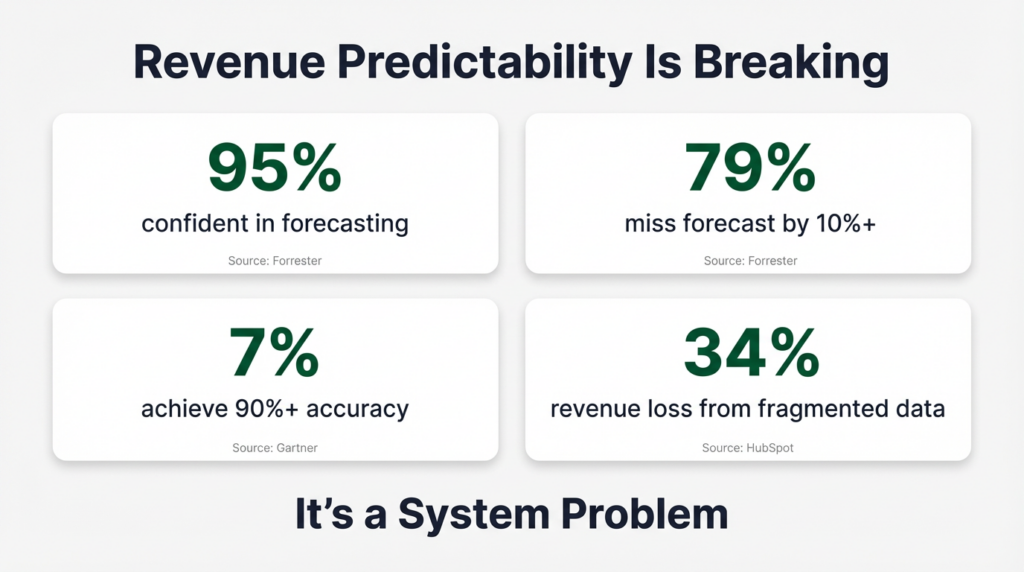
This is not an edge case. Consider the data. 95% of sales leaders express confidence in their forecasting methodology. However, 79% miss their forecast by more than 10%. The Revenue Circle
Gartner puts it even more starkly: only 7% of enterprise teams achieve forecast accuracy of 90% or higher. Enterprise Forecasting in the AI Era
In short, the confidence-outcome gap is not a leadership problem. It is a system problem.
Here is the truth most leadership teams avoid. The infrastructure they operate was not designed for the environment they face today. Enterprise revenue systems were not architected — they were assembled. One tool, one acquisition, one workaround at a time.
Consequently, what exists in most enterprises today is not a revenue system. It is a patchwork — systems pushed together, welded, glued, and duct-taped across years of growth, acquisitions, and compounding technical debt.
The consequences are measurable. HubSpot research shows that 34% of businesses have already experienced direct revenue loss due to fragmented customer data alone. TechRadar
Pricing logic runs differently across platforms. Quotes, contracts, and billing drift out of alignment. Additionally, every acquisition adds another layer of fragmentation that nobody budgeted to resolve.
In fairness, these systems work. However, they were built for a world that no longer exists. Ultimately, they are structurally incapable of adapting at the pace the market now demands.
Why Internal Control Alone No Longer Delivers Revenue Predictability
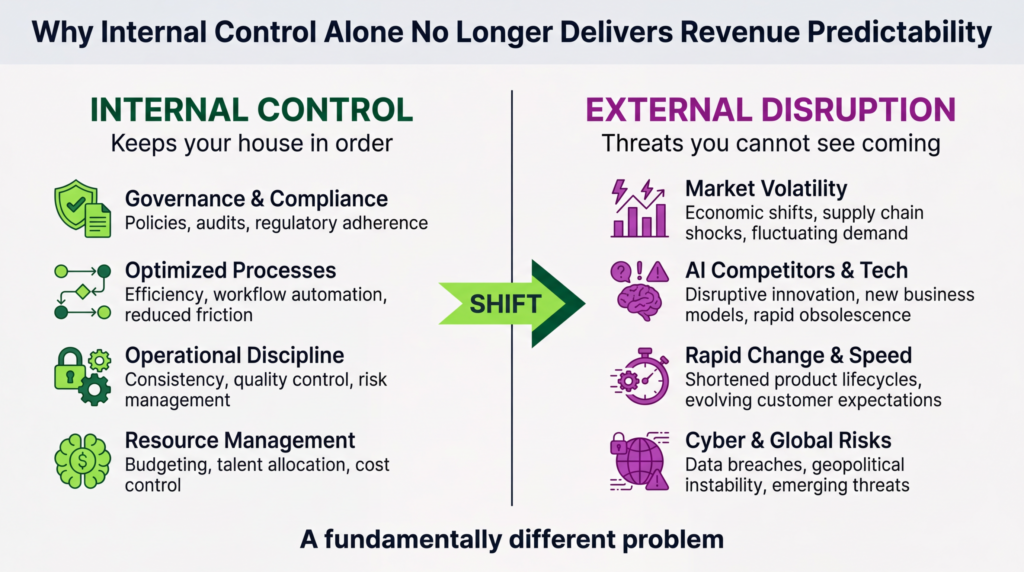
In a stable market, stronger governance produced better outcomes. Tighter discounting controls, sharper pipeline reviews, and enforced pricing discipline could materially improve forecast accuracy.
That model assumed one thing: that the primary sources of variability came from inside the organization.
That assumption is no longer valid.
Today, disruption is external and continuous. AI-enabled competitors enter markets in months — not years. Legacy adjacent incumbents repackage, reprice, and sell directly into your accounts. Startups enter monetization layers that were invisible twelve months ago. Meanwhile, platforms expand into adjacent revenue streams at a speed no quarterly planning cycle was built to track.
McKinsey’s 2025 State of AI survey found that 88% of organizations now use AI in at least one business function — up from 78% just one year prior. McKinsey & Company
Therefore, the barrier to AI-powered market entry has effectively collapsed. It is not recovering.
Internal control keeps your house in order. However, it does not protect you from threats you cannot see coming. That is a fundamentally different problem. And it requires a fundamentally different capability.
The Market Scan Imperative: Your Most Undervalued Financial Control
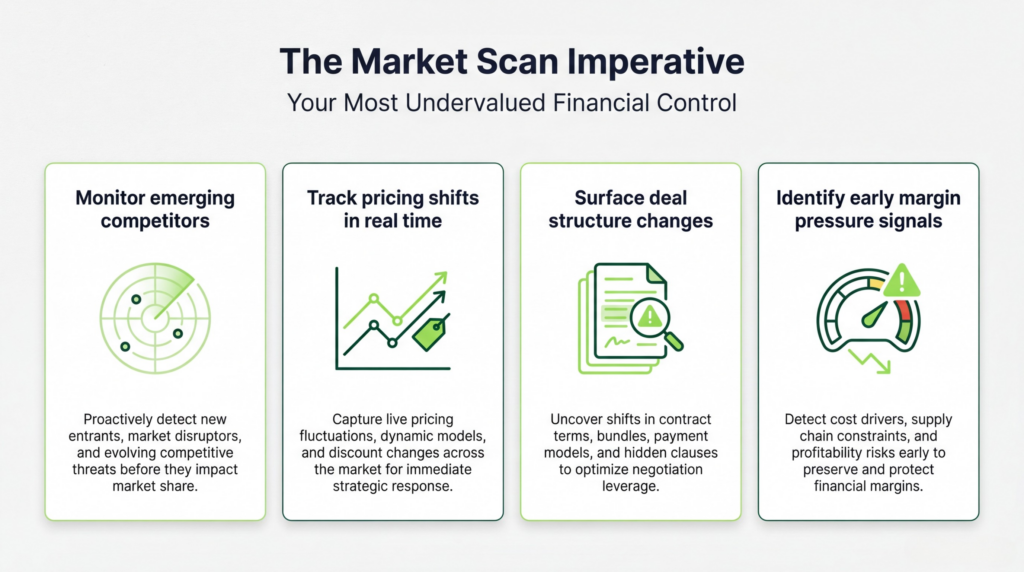
Think of a market scan not as a competitive intelligence exercise. Think of it as financial insurance.
A CFO routinely manages currency risk, interest rate exposure, and supply chain volatility. These are standard components of financial control. Yet commercial market risk — shifts in pricing, packaging, and customer expectations — receives far less systematic attention. This is a dangerous blind spot.
In 2026, AI creates new competitive entrants at unprecedented speed. Legacy adjacent incumbents pivot their business models. Startups build directly on top of your infrastructure category. As a result, market awareness has become a financial control function — not a marketing one.
A true market scan capability does several important things. It monitors emerging competitors across adjacent, upstream, and downstream vectors. It tracks pricing and packaging shifts in near real time. It surfaces changes in deal structures before they reach your pipeline data. Furthermore, it identifies early signals of margin pressure before they become margin events.
Without this capability, revenue decisions rely on internal data alone. Internal data is inherently backward-looking. In other words, you are steering by what already happened — in a market that has already moved on.
The fraction of enterprises getting this right have operationalized market awareness entirely. They translate continuous market signals into commercial decisions before those signals become costly surprises.
Nimble, Agile Revenue Systems: From Insurance to Action
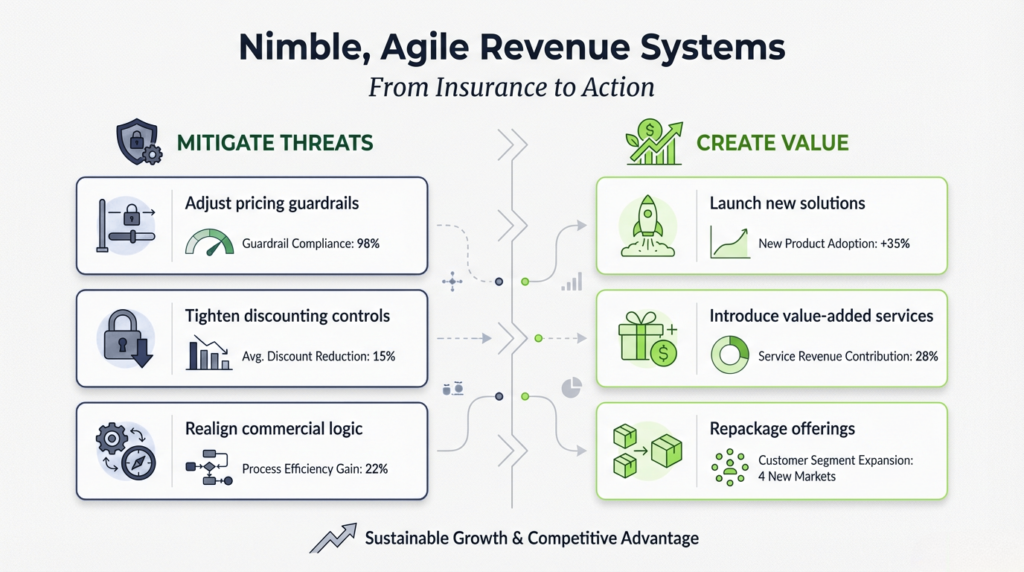
Knowing the risk is only half the equation. The other half is having a system capable of acting on it.
This is where most organizations face their hardest structural challenge. Market scans reveal the threat — a new competitor, a pricing shift, an emerging packaging model. However, the revenue system underneath cannot respond fast enough to matter. Not without manual workarounds, system reconfigurations, and delays that hand the market a head start.
This is precisely why organizations need nimble, agile revenue systems — not just as a technology preference, but as a strategic necessity. A nimble revenue system does two things simultaneously. First, it mitigates threats discovered through market scanning — adjusting pricing guardrails, tightening discounting controls, and realigning commercial logic before margin is lost. Second, and equally importantly, it creates new value. It enables organizations to launch new solutions, introduce value-added services, and repackage offerings in direct response to gaps the market scan identified.
The Two Jobs a Nimble Revenue System Must Do
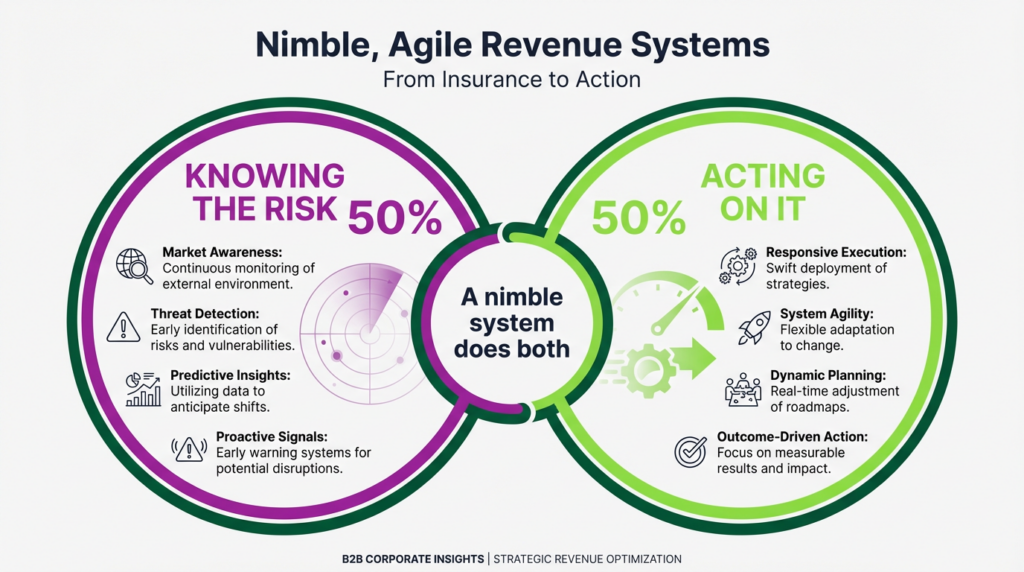
Think of it this way. The market scan is the intelligence layer. The nimble, agile revenue system is the execution layer. Together, they form the insurance policy for revenue predictability that no volatile market can take away. Without both working in tandem, organizations are left detecting threats they cannot act on — which is arguably worse than not detecting them at all.
From Signal to Execution: The Loop That Separates Leaders From Laggards
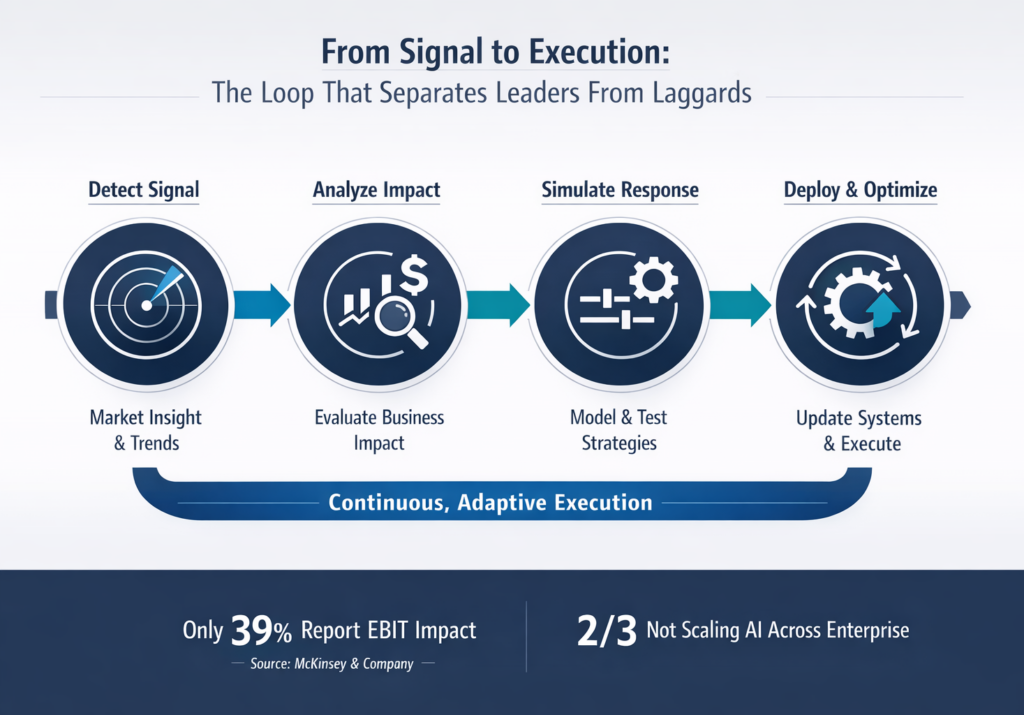
Market awareness without execution capability produces insight. It does not produce outcomes.
This is where most organizations stall. They detect that a competitor has shifted their pricing model. They know a new entrant is undercutting on packaging. However, they cannot respond — not without system reconfiguration, manual workarounds, and delays long enough to hand the market a head start.
Despite near-universal AI adoption, McKinsey found that nearly two-thirds of organizations have not yet begun scaling AI across the enterprise. Furthermore, only 39% report any EBIT impact at the enterprise level. McKinsey & Company
The tools exist. The execution capability does not. Consequently, this is not a technology problem. It is an architecture problem.
They detect the signal. Next, they interpret its commercial impact. From there, they simulate the pricing or packaging response. Then they update the revenue logic and deliver it consistently across every system that touches the customer.
Importantly, this loop runs continuously — not annually, not in the next planning cycle. The speed of market change now exceeds the speed of traditional planning. Therefore, periodic responses are no longer sufficient.
Where the Architecture Breaks: The Execution Gap

When pricing and packaging cannot adapt in time, sales teams compensate.
They restructure deals, applying discounts that were never sanctioned. Over time, these exceptions gradually become habits.
As a result, the variance between what the revenue system projects and what actually gets transacted widens into a gap. Neither finance nor revenue leadership can fully explain it.
The financial cost is not abstract. According to EY, enterprises lose between 1% and 5% of earned revenue annually to billing discrepancies, manual processing failures, and misaligned commercial logic. PureFacts
Nucleus Research puts the number even more precisely: legacy CPQ systems leak an average of 4% of annual revenue. CPQ Integrations
For a $500M business, that is $20M disappearing through the seams of a system everyone assumed was working.
Consequently, forecast accuracy degrades. The board starts asking whether they can trust the numbers. That is the most expensive question a leadership team can face — not because of what it costs to answer, but because of what it signals about the integrity of the system underneath.
This is not a people problem. It never was. It is an architecture problem.
The Revenue Predictability Framework: Four Conditions. No Shortcuts.
A growing number of enterprises have solved the revenue predictability problem. They did not do it through better execution alone. Instead, they made a deliberate architectural decision.
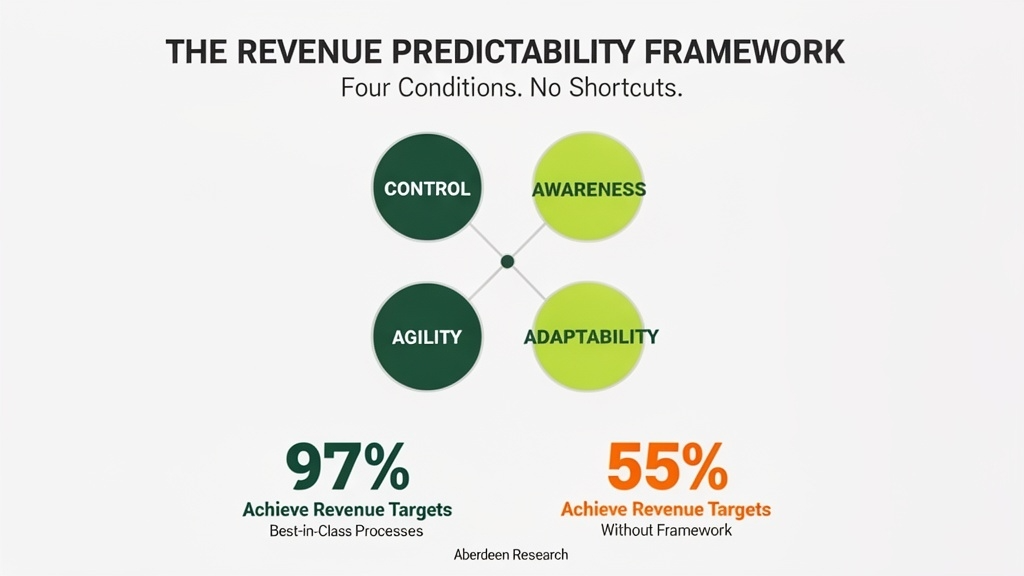
They recognized a fundamental truth: sustainable revenue predictability in volatile markets requires four conditions working together. If any one is missing, the other three degrade. We call this The Revenue Predictability Framework.
Control is the foundation. Deterministic, governed systems ensure your commercial logic — pricing, quoting, discounting, contracting — executes the same way every time. This consistency applies across every channel, every team, and every geography. Without control, everything else is noise.
Awareness is the intelligence layer. It provides continuous visibility into market dynamics before those dynamics show up in your numbers. This is not a quarterly report. It is an always-on signal that feeds real-time decision-making.
Adaptability is the change capability. It enables organizations to update pricing and packaging models safely and quickly. Importantly, it does this without requiring a system rebuild or the manual effort that makes most change initiatives slow and costly.
Agility is the execution edge. It is the ability to act on market signals immediately — both to protect margin under threat and to capture new revenue where opportunity emerges. Not eventually. Now.
Why All Four Conditions Must Work Together
Most organizations have two of these four. Some have three. However, very few have all four operating together reliably. Aberdeen research reinforces the stakes: 97% of companies with best-in-class revenue processes achieve their targets — versus only 55% without them. Forbes
The difference is not talent. It is architecture.
The Governed Execution Layer: The Only Logical Answer
Closing the gap between awareness and execution requires a capability most revenue stacks do not have today.
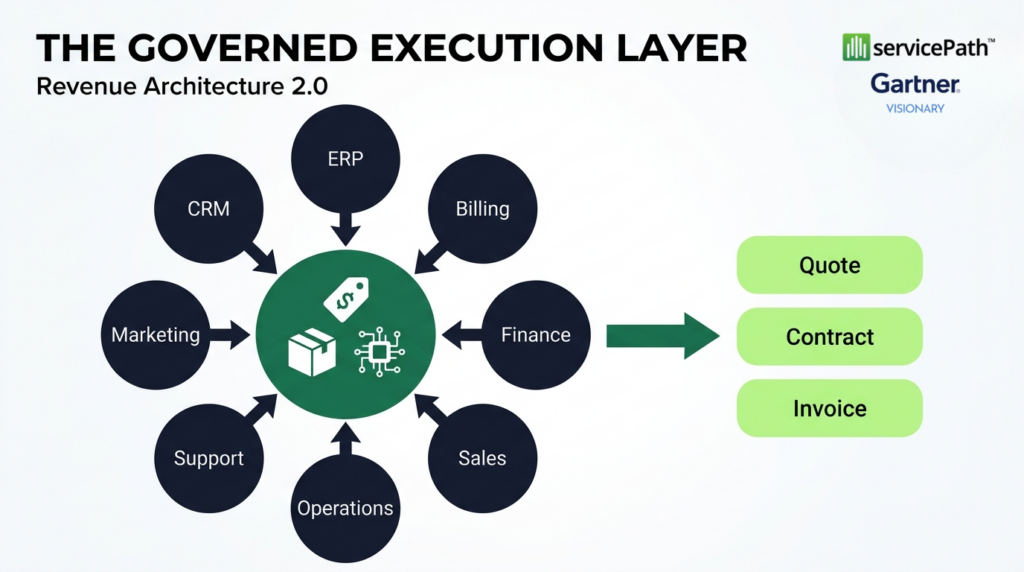
Not another CRM. Not another point solution. Instead, what organizations need is something most revenue stacks have never had. Not another point solution. This layer centralizes pricing, packaging, and commercial logic across systems. It enables controlled updates without fragmentation. And it maintains alignment from quote to contract to billing — consistently, across complex multi-CRM environments, through acquisitions, and across geographies.
This is what Revenue Architecture 2.0 looks like in practice. It is not a set of tools loosely connected by integrations and institutional knowledge. Instead, it is a purposefully engineered control layer. It determines how revenue decisions are made, governed, and executed — at the speed the market demands, with the consistency the board requires.
servicePath™ operates at exactly this layer. It translates market signals into governed pricing and quoting updates. Organizations can therefore adapt their commercial models without introducing the inconsistency that breaks forecasts. Furthermore, servicePath™ preserves alignment
across the full revenue chain — from the first quote to the final invoice — while giving finance the governance visibility it needs to trust the numbers.
The logic is straightforward. If your revenue system cannot evolve at the pace of the market, revenue predictability becomes an assumption. And assumptions do not hold up in board calls.
servicePath™ is the sole Visionary in Gartner’s 2026 Magic Quadrant for Configure, Price and Quote Applications — the fourth consecutive year in the Visionary quadrant and the third year standing alone among 16 evaluated vendors. Organizations including Dell, Telefónica, TierPoint, Park Place Technologies, and Telent are already operating at this standard.
The New Standard for Revenue Predictability
Revenue predictability has been fundamentally redefined. It is no longer achieved through internal discipline alone. Today, it depends on three interconnected capabilities.
First, the ability to detect external market change early. Second, the ability to translate that change into commercial decisions. Third, the ability to execute those decisions consistently across every revenue-facing system — without losing control.
The enterprises that make this architectural shift will maintain forecast integrity under pressure. They will protect margin as competitive dynamics intensify. And they will adapt their monetization strategy with confidence.
The organizations that do not make this shift will face a growing gap. The distance between what they project and what they deliver will widen. And their ability to explain why will diminish over time.
Ultimately, revenue predictability is no longer a reporting metric. It is a direct reflection of how well your organization can sense, adapt, and act — without losing control. That is the new standard. The architecture to meet it exists today.
A Final Question
If your board asked today — “What specifically caused forecast variance last quarter, and how quickly could we prevent it next time?” — would your systems provide a clear, defensible answer?
Or would the explanation still depend on fragmented data, manual reconciliation, and assumptions about what changed?
That question is worth sitting with. The organizations that answer it confidently are not smarter or better staffed. They made a structural decision about how their revenue architecture works. The ones who cannot answer it yet have not made that decision.
The decision is available. Ultimately, the question is when.
Continue the Conversation
Talk to us directly — If you are a CFO, CRO, or executive sponsor evaluating how your revenue systems are holding up, we will have a direct, practical conversation. Just an honest discussion about where revenue predictability is breaking, how your current architecture is responding, and what it would take to restore control.
Request a walkthrough — See in a focused session how organizations translate market signals into pricing updates, maintain alignment across the full revenue chain, and adapt commercial models — without replacing existing CRM investments.
Explore the Glossary — Revenue Architecture, Commercial Excellence, deal governance, margin management — the language of modern revenue systems, defined in plain terms. Use it to align your leadership team and accelerate the internal conversation.
servicePath™ is headquartered in Burlington, Ontario, Canada, with offices in London, UK and Dubai, UAE. Learn more at servicepath.co
References & Sources
- CFO.com (The CFO Alliance, 2025)
54% of midmarket CFOs say forecasts are worsening amid global uncertainty
https://www.cfo.com/news/54-of-midmarket-cfos-say-2025-forecasts-are-worsening-nick-araco-jr-the-cfo-alliance-trial-balance/746164/
- Based on a survey of 9,000+ CFOs, highlighting declining forecast confidence and rising economic volatility (CFO)
- 1BusinessWorld (2025)
Enterprise Forecasting in the AI Era: Accuracy, Agility, and Integrated Business Planning
https://1businessworld.com/2025/12/1artificialintelligence/enterprise-forecasting-in-the-ai-era-accuracy-agility-and-integrated-business-planning/
- Discusses the growing gap between forecasting confidence and accuracy, and the need for AI-enabled, integrated forecasting approaches
- TechRadar Pro (2025)
Fragmented data is causing businesses huge issues — especially for AI
https://www.techradar.com/pro/fragmented-data-is-causing-businesses-huge-issues-especially-when-it-comes-to-ai
- Reports that 34% of businesses have experienced revenue loss due to fragmented data, with major implications for decision-making and AI readiness (TechRadar)
- McKinsey & Company (2025)
The State of AI
https://www.mckinsey.com/capabilities/quantumblack/our-insights/the-state-of-ai
- Comprehensive global survey on enterprise AI adoption, scaling challenges, and impact across business functions
- PureFacts Financial Solutions (2025)
Revenue Leakage Has Become a Top Priority for CFOs in 2025
https://purefacts.com/revenue-leakage-has-become-a-top-priority-for-cfos-in-2025/
- Highlights growing executive concern around revenue leakage, billing inaccuracies, and financial control gaps
- CPQ Integrations (2026)
2026 Gartner CPQ Magic Quadrant SaaS Guide
https://cpq-integrations.com/cpq-analyst-insights/2026-gartner-cpq-magic-quadrant-saas-guide/
- Provides insights into CPQ market positioning, analyst perspectives, and performance benchmarks
- Forbes Business Council (2025)
Forecasting Accuracy: Overcoming a Major Sales Industry Hurdle
https://www.forbes.com/councils/forbesbusinesscouncil/2025/02/13/forecasting-accuracy-overcoming-a-major-sales-industry-hurdle/
- Explores systemic challenges in sales forecasting accuracy and the structural causes behind forecast gaps
Frequently Asked Questions
What does revenue predictability actually mean in today’s environment?
Revenue predictability is no longer defined by historical accuracy alone. It reflects an organization’s ability to detect external market changes early, adjust commercial strategy accordingly, and execute those adjustments consistently across all systems. Without these capabilities, forecasts become lagging indicators rather than decision tools. Gartner data shows that only 7% of enterprise teams currently achieve the 90%+ forecast accuracy threshold that makes forecasts genuinely useful at the board level. Enterprise Forecasting in the AI Era
Why are traditional revenue systems struggling to keep pace?
Most enterprise revenue systems were built for a stable operating environment that no longer exists. They are duct-taped together across years of acquisitions, workarounds, and technical debt — functional, but fragile under pressure. HubSpot research found that 34% of businesses have already seen direct revenue loss from data fragmentation alone. TechRadar
As a result, these systems cannot adapt without introducing the inconsistency that degrades forecast accuracy and opens margin to leakage.
What is the role of finance in this new model?
Finance is no longer solely accountable for forecasting and reporting. It is now accountable for ensuring external market signals are reflected in revenue assumptions, governing how commercial changes are executed, and maintaining alignment between strategy, execution, and financial outcomes. The CFO Alliance’s 2025 survey of 9,000+ CFOs found that scenario planning and financial modeling has become the top operational priority — cited by 40% of respondents. CFO.com
How do market scans improve revenue predictability?
Market scans provide forward-looking visibility into competitive dynamics, pricing pressure, and shifts in customer behavior. Importantly, they surface these signals before they appear in your own performance data. When organizations integrate this visibility into their revenue systems, they can adjust forecasts proactively, refine pricing strategies, and identify emerging risks while there is still time to act. Without this, forecasting remains reactive and structurally incomplete.
What defines a nimble, agile revenue system in practice?
A nimble revenue system can update pricing and packaging logic rapidly. It can introduce new offerings without system rework. And it maintains governance while adapting to change — consistently, across all revenue processes. It allows organizations to both mitigate emerging risk and create new revenue opportunities without operational disruption. It is the difference between an organization that responds to the market and one that permanently chases it.
What happens if organizations do not evolve their revenue architecture?
The financial consequences are concrete and measurable. EY data shows enterprises lose 1–5% of earned revenue annually through billing misalignment and system fragmentation. PureFacts
Nucleus Research found that legacy CPQ environments leak an average of 4% of annual revenue. CPQ Integrations
For a $500M business, that is $20–25M in earned revenue that never reaches the bottom line — not through strategic failure, but through architecture that can no longer keep pace with how the market operates.