Product-Led Growth (PLG)
Synonyms
-
PLG (abbreviation)
-
Product-first strategy
-
Product-driven growth
-
Product-centric growth
-
Self-serve growth model
-
Bottom-up growth
-
Product-led go-to-market
-
Product-powered growth
-
Try-before-you-buy model
-
Product-qualified funnel
What is Product-Led Growth (PLG)?
Product-Led Growth (PLG) is a business methodology where the product is the main vehicle for acquiring, activating, and retaining customers. It flips the traditional sales-led approach by putting the product experience at the forefront, allowing users to realize value early—often through free trials or freemium models.
In PLG companies, the product is not just a tool but a strategic growth engine. Users can self-onboard, explore features, and reach “aha” moments without needing heavy sales involvement. This model creates a viral loop where delighted users invite others, increasing adoption organically.
Key Characteristics of Product-Led Growth
-
Self-serve onboarding: Users can sign up, activate, and start using the product with minimal friction.
-
Freemium or free trial models: Users experience value before paying.
-
Usage-based value delivery: The more a customer uses the product, the more value they get—and the more they’re willing to pay.
-
Data-driven product iteration: Customer behavior inside the product guides development.
-
Cross-functional alignment: Product, marketing, and customer success work in sync around the product.
Power Your Product-Led Growth With Scalable CPQ & Pricing Automation; Only With servicePath™ CPQ+
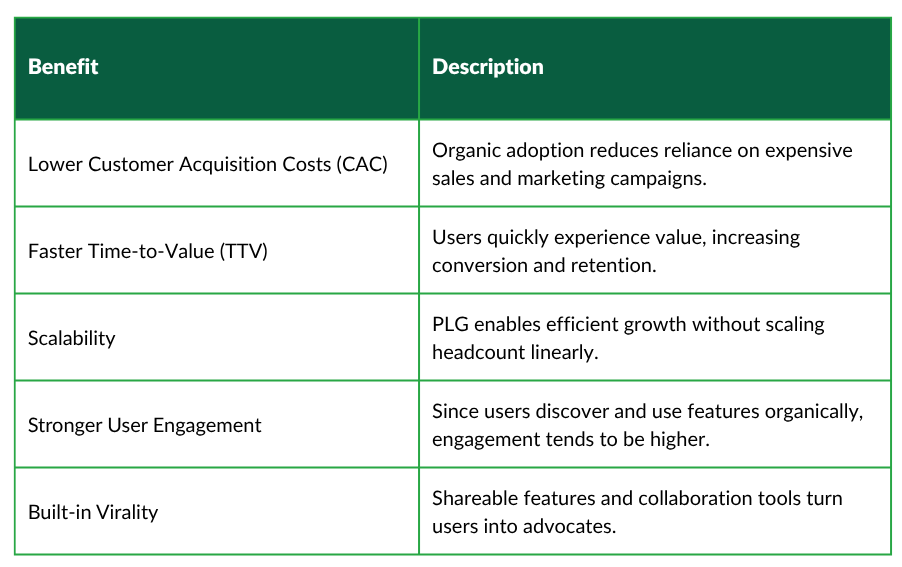
Benefits of a Product-Led Growth Strategy
Real-World Examples of Product-Led Growth
-
Slack: Allowed teams to sign up and communicate immediately, expanding virally within organizations.
- Dropbox: Offered free storage for referrals, incentivizing user-driven growth.
-
Zoom: Delivered frictionless video conferencing with a freemium tier and viral meeting links.
-
Notion: Let users explore a rich feature set for free, then expand usage across teams.
Product-Led vs. Sales-Led vs. Marketing-Led
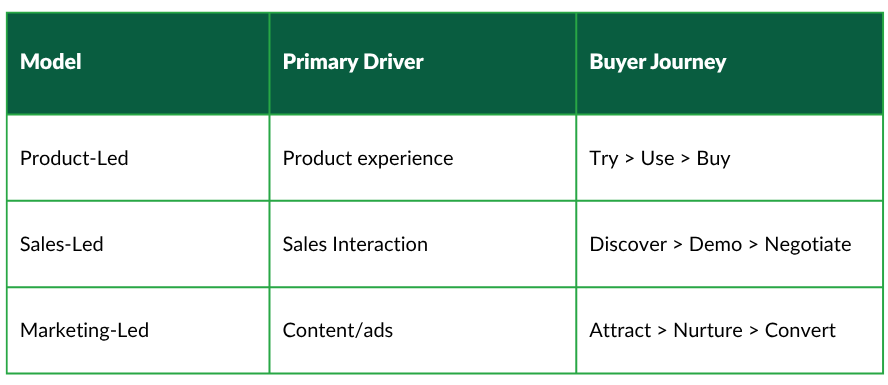
PLG is not the absence of sales or marketing—it’s the prioritization of the product as the initial and central touchpoint in the buyer journey.
Is PLG Right for Your Business?
Product-Led Growth thrives in environments where:
-
The product solves a clear, immediate pain point.
-
Users can onboard without hand-holding.
-
There’s a low barrier to entry (freemium or trial).
-
The business wants scalable, cost-efficient growth.
If you’re in SaaS, especially with SMB or mid-market focus, PLG can reduce churn, speed up sales cycles, and unlock viral growth loops.
How Product-Led Growth Connects to CPQ and Revenue Management
For companies implementing PLG, managing product configurations, pricing tiers, and quoting becomes critical as usage scales. This is where servicePath™’s CPQ and revenue optimization platform plays a key role. We help PLG-driven organizations:
-
Configure dynamic pricing models aligned with user behavior.
-
Automate complex quote-to-cash flows.
-
Support hybrid models that combine PLG and sales-led motions.
With servicePath™, fast-growing companies can scale operations without compromising on governance or pricing accuracy.
Related Terms
-
PLG
-
Product-Qualified Lead (PQL)
-
Freemium Model
-
Self-Service Onboarding
-
Usage-Based Pricing
-
Customer-Led Growth
-
SaaS Growth Models
-
Bottom-Up Selling
-
Go-To-Market Strategy
-
Land and Expand
Frequently Asked Questions (FAQs)
1. What is an example of a Product-Led Growth strategy?
A freemium SaaS model where users sign up for free, get value quickly, and upgrade to paid tiers as they grow (e.g., Dropbox or Slack).
2. How does PLG impact the sales team?
PLG doesn’t eliminate sales—it repositions them. Sales teams focus on Product-Qualified Leads (PQLs), or users who’ve already experienced value and are primed for upselling or enterprise packages.
3. What metrics are important in PLG?
Key metrics include:
-
Time-to-Value (TTV)
-
Product-Qualified Leads (PQLs)
-
Net Revenue Retention (NRR)
-
Daily/Monthly Active Users (DAU/MAU)
-
Expansion Revenue
4. Can large enterprises use PLG?
Yes. While PLG started in SMB-focused SaaS, enterprise companies increasingly adopt hybrid PLG+sales-led models to enable scalable self-service while capturing large deals.
Bring Clarity to Your PLG Monetization Strategy
Product-Led Growth is more than a buzzword—it’s a proven, scalable approach to driving revenue through customer experience. As software buyers increasingly prefer to “try before they buy,” PLG meets them where they are: inside the product. With the right tools and strategy, companies can grow faster, lower costs, and increase customer loyalty.
Ready to take the Next Step?
📞 Contact us for a demo | 📚 Explore success stories | 🎧 Listen to our CEO’s podcast with Frank Sohn