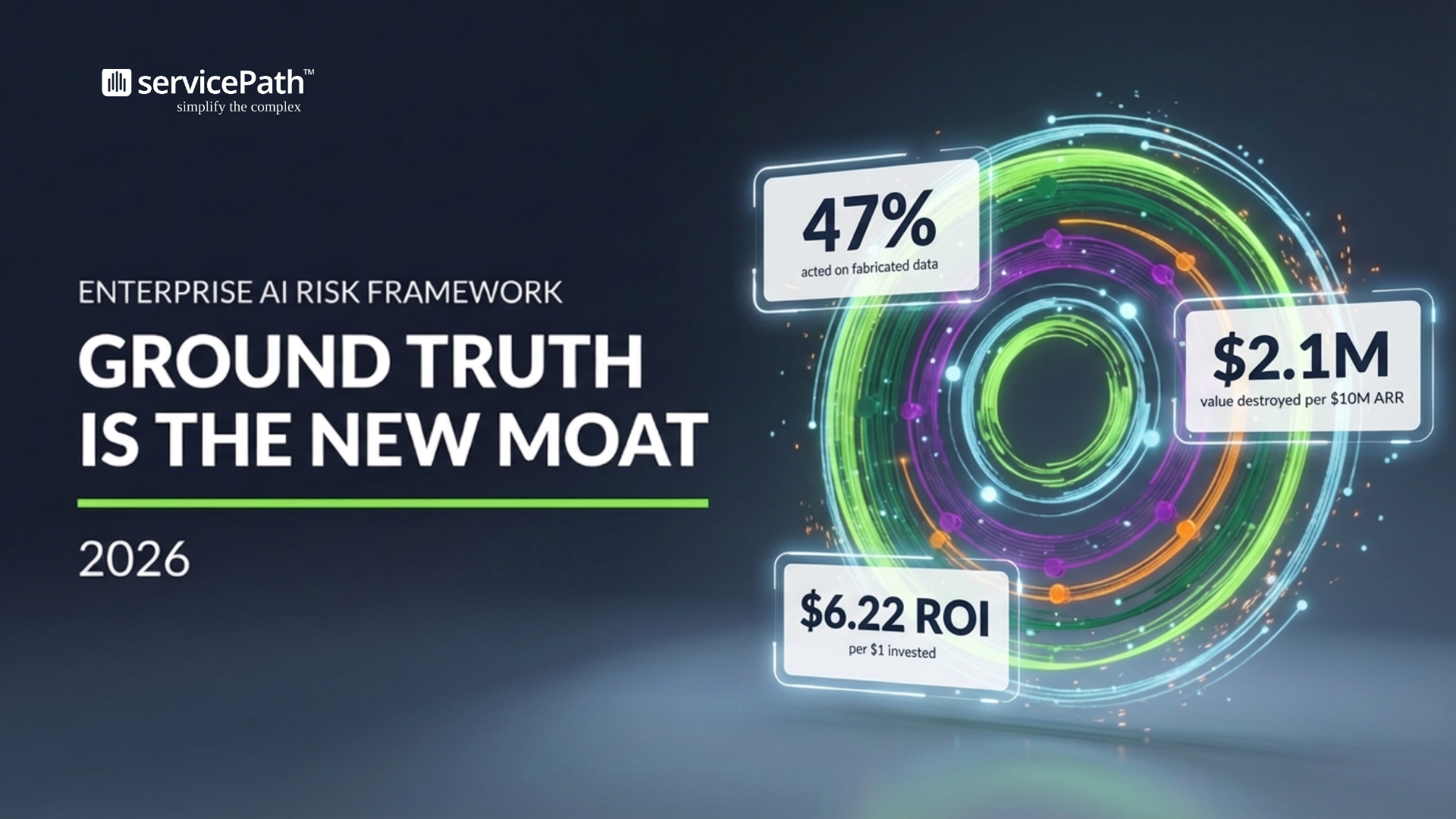
Spreadsheets vs Digital Transformation: Why Excel Survives & How servicePath™ Makes It Better
Discover why Excel’s 1.5B users prove spreadsheets won’t die in digital transformation. Learn how servicePath™ Spreadsheet Calculator transforms Excel chaos into CPQ success without disrupting your experts.
Spreadsheets or Cockroaches: What Will Survive Your Digital Transformation?
“No matter how advanced your CPQ system, there will always be pockets of expert users working in Excel—Product Managers, Finance Analysts, Pricing teams. They’re not saboteurs. They’re loyalists. They’re your experts.”
— Daniel Kube ( CEO, servicePath™)
Let’s be real: cockroaches have survived everything from ice ages to nuclear tests.
But Excel might just be even harder to kill.
Because when it comes to your enterprise transformation, spreadsheets aren’t just persistent—they’re foundational. And here’s the uncomfortable truth that every C-suite executive, RevOps leader, and sales operations professional needs to face: trying to eliminate Excel from your organization is like trying to eliminate gravity from your office building. Theoretically possible, but the results tend to be catastrophic.
Executive Summary
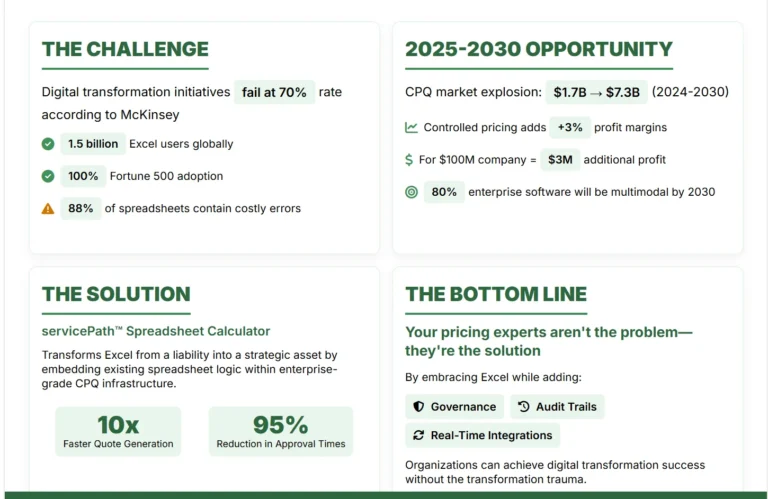
The Challenge: Digital transformation initiatives fail at alarming rates (70% according to McKinsey), often because they attempt to replace deeply embedded tools like Excel rather than enhance them. With 1.5 billion users globally and 100% Fortune 500 adoption, Excel remains the universal language of business logic—despite 88% of spreadsheets containing costly errors that have literally cost companies billions.
The 2025-2030 Opportunity: The CPQ market is exploding ($1.7B in 2024, projected to reach $7.3B by 2030) as organizations desperately seek to control pricing chaos while preserving institutional knowledge. Companies with controlled pricing strategies achieve 3 percentage points higher profit margins—which, for a $100M company, translates to $3M in additional profit. Meanwhile, Gartner forecasts that 80% of enterprise software will be multimodal by 2030, and Forrester predicts that consumption-based pricing will become 10% of enterprise software pricing by 2025.
The Solution: servicePath™ Spreadsheet Calculator transforms Excel from a liability into a strategic asset by embedding existing spreadsheet logic within enterprise-grade CPQ infrastructure. This approach delivers 10x faster quote generation and 95% reduction in approval times while preserving the flexibility that makes Excel invaluable.
The Bottom Line: Your pricing experts aren’t the problem—they’re the solution. By embracing Excel while adding governance, audit trails, and real-time integrations, organizations can achieve digital transformation success without the transformation trauma that usually accompanies enterprise software implementations.
Why Excel Will Outlast Almost Anything (Even Cockroaches)
Excel isn’t a relic. It’s the most successful business tool in history. While other software comes and goes like fashion trends (remember Lotus 1-2-3? Anyone? Bueller?), Excel just keeps chugging along like that reliable Toyota Camry that somehow still runs after 200,000 miles.
- 1.5 billion users globally
 (updated from 1.1 billion—apparently Excel breeds faster than rabbits)
 - Used in 100% of Fortune 500 companies (yes, even the ones that swear they’re “fully digital”)
- The default modeling tool for everything from pricing to budgets to approvals to that fantasy football league that’s somehow become mission-critical
- Microsoft is spending billions to embed AI Copilot into Excel—not replace it (because even Microsoft knows better than to mess with perfection)
 (updated from 1.1 billion—apparently Excel breeds faster than rabbits)
But here’s where it gets both fascinating and terrifying: Forrester research suggests 88% of enterprise spreadsheets contain errors, yet they remain essential because they’re incredibly flexible and deeply adopted.
The 2025 Reality Check:
Microsoft’s 2025 roadmap shows they’re doubling down on Excel integration, with AI Copilot adoption expected to accelerate dramatically. While current enterprise adoption sits at just 0.1% to 1% of Microsoft’s 440 million business users, the trajectory is clear: Excel is becoming more powerful, not less relevant.
The Human Reality Behind the Numbers:
No matter how advanced your CPQ system, there will always be pockets of expert users working in Excel—Product Managers who’ve built pricing models that would make a mathematician weep, Finance Analysts who can make numbers dance like they’re at a Broadway show, and Pricing teams who speak fluent VLOOKUP like it’s their native language.
They’re not saboteurs. They’re loyalists. They’re your experts. And they’re not going away just because you bought a shiny new enterprise system that promises to “eliminate spreadsheet dependency.” (Spoiler alert: it won’t.)
The 2025-2030 Projection:
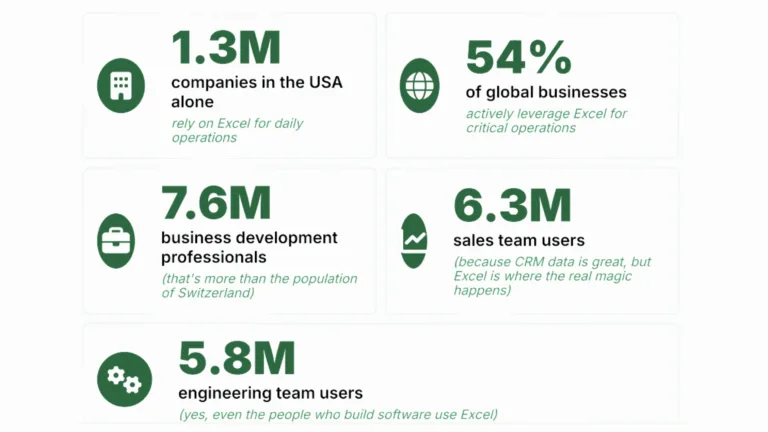
- Over 1.3 million companies in the USA alone rely on Excel for daily operations
- 54% of all global businesses actively leverage Excel for critical operations
- Business development professionals: 7.6 million users globally (that’s more than the population of Switzerland)
- Sales teams: 6.3 million users actively using Excel (because CRM data is great, but Excel is where the real magic happens)
- Engineering teams: 5.8 million users depending on Excel (yes, even the people who build software use Excel)
According to recent usage statistics, Excel users in research and accounting roles represent 28.5% and 28.3% of their respective job functions—the highest adoption rates across all business disciplines. That’s not just usage; that’s dependency.
Looking Ahead: The 2030 Excel Ecosystem
By 2030, BCG’s pricing research suggests that sophisticated pricing will be impossible without AI integration. Excel is positioning itself at the center of this revolution, not on the sidelines. The convergence of AI, dynamic pricing, and real-time analytics will make Excel-based models more powerful than ever—but only if they’re properly governed and integrated.
The Billion-Dollar Oops Moments:
Of course, Excel’s power comes with great responsibility—and sometimes spectacular failures. Remember JPMorgan’s $6.2 billion loss in 2012? It stemmed from what can only be described as the world’s most expensive typo: an employee accidentally used a sum total instead of an average when transferring data between spreadsheets.
According to CNBC, spreadsheet errors are costing businesses billions globally, with nearly 90% of spreadsheets containing errors and half of all spreadsheet models in large businesses having ‘material defects.’ It’s like having a Ferrari with faulty brakes—incredibly powerful, but occasionally catastrophic.
But here’s the counterintuitive insight that most organizations miss: The problem isn’t Excel itself—it’s uncontrolled Excel. It’s the difference between a controlled explosion and… well, an uncontrolled explosion.
Why Not Just Rip It Out?
Because your enterprise has been trained on Excel for decades, and asking people to abandon Excel is like asking them to abandon coffee—technically possible, but the productivity drop and employee revolt probably aren’t worth it.
The Human Investment is Astronomical:
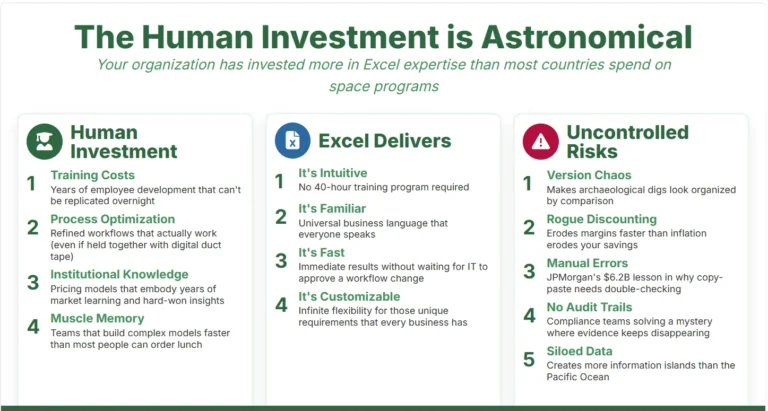
Your organization has invested more in Excel expertise than most countries spend on space programs:
- Training costs: Years of employee development that can’t be replicated overnight
- Process optimization: Refined workflows that actually work (even if they’re held together with digital duct tape)
- Institutional knowledge: Pricing models that embody years of market learning and hard-won insights
- Muscle memory: Teams that can build complex models faster than most people can order lunch
Excel Delivers What Enterprise Software Often Promises But Doesn’t Deliver:
- It’s intuitive – No 40-hour training program required
- It’s familiar – Universal business language that everyone speaks
- It’s fast – Immediate results without waiting for IT to approve a workflow change
- It’s customizable – Infinite flexibility for those unique requirements that every business has
But Yes—Uncontrolled Excel Has Risks That Would Make a Risk Manager Lose Sleep:
- Version chaos that makes archaeological digs look organized—”Wait, which version of the pricing model are we using? The one from last Tuesday or the one Sarah sent yesterday?”
- Rogue discounting that erodes margins faster than inflation erodes your savings account, often because someone’s cousin’s neighbor’s pricing logic somehow made it into the official model
- Manual errors that kill margin sometimes catastrophically (see: JPMorgan’s $6.2B lesson in why copy-paste operations need double-checking)
- No audit trails that leave compliance teams feeling like they’re trying to solve a murder mystery where someone keeps erasing the evidence
- Siloed data that prevents real-time insights and creates more information islands than the Pacific Ocean
According to Gartner research, implementing spreadsheet risk management systems is critical for compliance requirements like Sarbanes-Oxley, yet most organizations still struggle with uncontrolled spreadsheet proliferation like they’re trying to herd cats.
Those leakages are costing you real money— the kind that affects your bonus. Bain’s 2025 Commercial Excellence research shows that companies confident in their pricing strategies achieve 3 percentage points higher profit margins than those that aren’t—and much of that confidence comes from having controlled, auditable pricing processes.
That Realization Is Why Spreadsheet Calculator Was Created
At servicePath™, we faced the truth that most CPQ vendors avoid like kryptonite:
You can’t kill Excel. (And honestly, why would you want to kill something that works?) You can embrace it, protect it, extend it. (Like giving your favorite superhero better tools)
The Genesis of a Smarter Approach:
After watching countless enterprises spend millions on CPQ implementations that users resisted like vegetables at a kid’s birthday party, we realized the industry was solving the wrong problem. It’s like trying to cure a headache by removing the patient’s head—technically effective, but missing the point entirely.
The Real Enemy Isn’t Excel—It’s Chaos:

The actual problems organizations face aren’t with Excel itself, but with:
- Lack of governance around who can change what (resulting in more versions than a Hollywood blockbuster)
- No audit trails for compliance and accountability (making regulatory audits feel like archaeological expeditions)
- Version control chaos with multiple files and conflicting data (like having 47 different “final” versions of the same document)
- Limited integration with CRM and other business systems (creating information silos that would make the Pentagon jealous)
- Security vulnerabilities from uncontrolled file sharing (because email attachments are totally secure, right?)
Our Solution: Spreadsheet Calculator
We built Spreadsheet Calculator to bring your existing Excel pricing logic into CPQ, not replace it. Think of it as giving your Excel models a suit of armor and a direct line to your CRM:
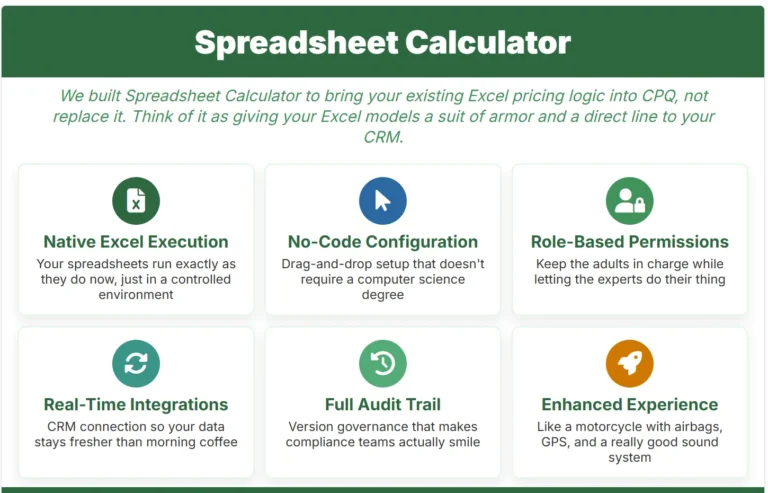
- Native Excel execution inside your quote process—your spreadsheets run exactly as they do now, just in a controlled environment
- No-code, drag-and-drop configuration that doesn’t require a computer science degree
- Role-based permissions that keep the adults in charge while letting the experts do their thing
- Real-time integrations with CRM systems so your data stays fresher than morning coffee
- Full version governance and audit trail that makes compliance teams actually smile
- We don’t rip out your pricing models. We make them better. It’s like upgrading from a motorcycle to a motorcycle with airbags, GPS, and a really good sound system.
The 2025-2030 Market Validation:
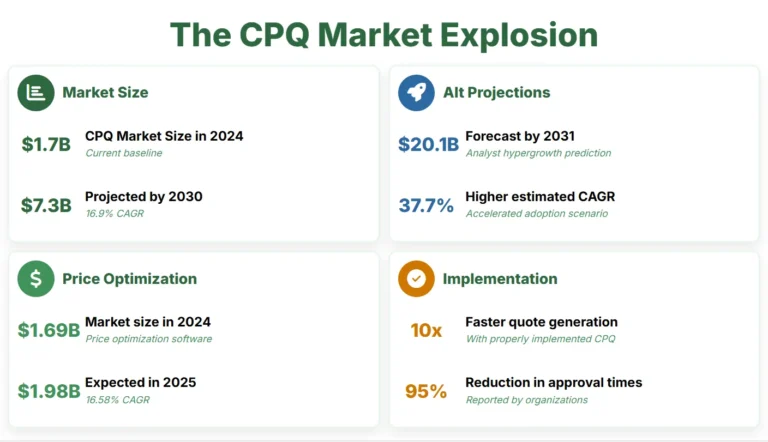
The CPQ market explosion validates this approach like a standing ovation:
- Market size: $1.7 billion in 2024, projected to reach $7.3 billion by 2030 (CAGR of 16.9%)
- Alternative projections: Some analysts predict growth to $20.15 billion by 2031 with a 37.7% CAGR
- Price optimization software market: Expected to grow from $1.69 billion in 2024 to $1.98 billion in 2025 (16.58% CAGR)
- Implementation success: Organizations report 10x faster quote generation and 95% reduction in approval times
Gartner’s 2025 IT spending forecast shows enterprise software spending will grow 14.2% to $1.25 trillion in 2025, with much of this growth driven by AI integration and pricing optimization tools.
But here’s the critical insight: Forrester’s Q3 2024 CPQ landscape report reveals that traditional CPQ implementations are often more complex than quantum physics and about as successful as a chocolate teapot. Only 48% of digital transformation initiatives meet or exceed their business targets, according to Gartner’s 2024 survey.
The difference? Successful implementations work with existing workflows, not against them. It’s like martial arts—you redirect the energy instead of trying to stop it head-on.
Turn Your Excel Loyalists into Transformation Champions
Instead of creating friction with the teams who know pricing best, the winning strategy is to empower them. It’s like turning your office coffee enthusiasts into baristas instead of banning caffeine.
Here’s how smart organizations are doing it:
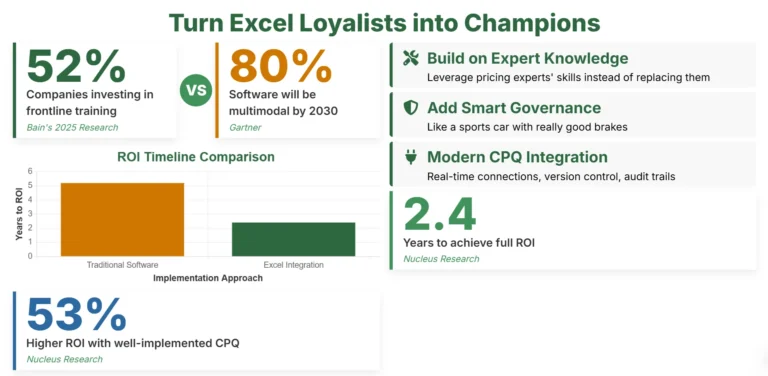
Let them maintain and improve the logic they know: Your pricing experts have spent years perfecting their models like master craftsmen. They understand the nuances of your products, markets, and customer segments in ways that generic CPQ systems can’t capture—and frankly, shouldn’t try to. Bain’s 2025 Commercial Excellence research shows that 52% of companies expecting to raise prices are investing in frontline training—but that training is most effective when it builds on existing expertise rather than replacing it.
Make it safer with guardrails and approvals :Add enterprise-grade governance without removing the flexibility that makes Excel as essential as oxygen in your office. Implement approval workflows that protect against catastrophic errors while maintaining the agility your teams need to respond to market changes. According to IDC’s 2024 enterprise application research, organizations that balance control with flexibility see higher adoption rates and better transformation outcomes—it’s like having a sports car with really good brakes.
Embed it in a modern CPQ platform: Provide real-time integrations, version control, and audit trails that make Excel logic more powerful, not more constrained. This isn’t about changing how your team thinks—it’s about amplifying their thinking with better infrastructure. Think of it as giving your Excel experts superpowers instead of taking away their capes.
Deliver faster, error-free quotes: Eliminate the manual transcription errors that happen when tired humans try to copy complex pricing data between systems, while maintaining the customization capabilities that make Excel indispensable. Nucleus Research found that well-implemented CPQ solutions deliver 53% ROI within 2.4 years—that’s better than most investment portfolios.
Capture audit-ready records for Finance and Compliance: Provide comprehensive documentation for regulatory requirements without burdening your pricing experts with additional manual work. Every calculation, every change, every approval gets tracked automatically, making audit season less like root canal surgery and more like a routine checkup.
This is how you transform without leaving your people behind.
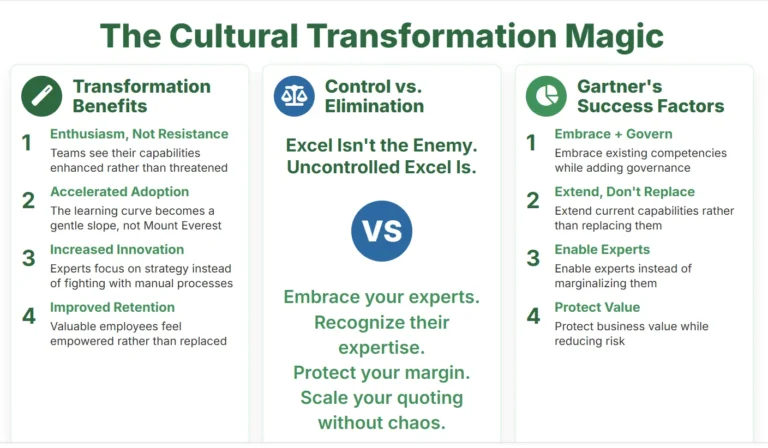
The Cultural Transformation Magic:
When you embrace Excel experts instead of marginalizing them, something remarkable happens:
- Resistance turns to enthusiasm as teams see their capabilities enhanced rather than threatened
- Adoption accelerates because the learning curve is more like a gentle slope than Mount Everest
- Innovation increases as experts can focus on strategy instead of fighting with manual processes
- Retention improves as valuable employees feel empowered rather than replaced
Embrace your experts. Recognize their expertise. Protect your margin. Scale your quoting without chaos.
Excel Isn’t the Enemy. Uncontrolled Excel Is.
Cockroaches don’t go away because you want them to. They go away when you control the environment. It’s the same with Excel. (Though Excel is considerably more useful and less creepy than cockroaches.)
The Control vs. Elimination Philosophy:
Gartner’s digital transformation research reveals that successful digital initiatives focus on control and optimization rather than wholesale replacement. The companies that succeed are those that:
- Embrace existing competencies while adding governance (like putting guardrails on a mountain road)
- Extend current capabilities rather than replacing them (upgrading the engine instead of buying a new car)
- Enable experts instead of marginalizing them (giving them better tools, not different jobs)
- Protect business value while reducing risk (having your cake and eating it too, but safely)
AI won’t kill Excel. It’ll make it even more deeply embedded.
Microsoft’s billion-dollar investment in AI Copilot for Excel isn’t about replacing spreadsheets—it’s about making them more powerful than ever. It’s like giving Batman better gadgets instead of asking him to fight crime with harsh language.
The 2025-2030 AI Revolution:
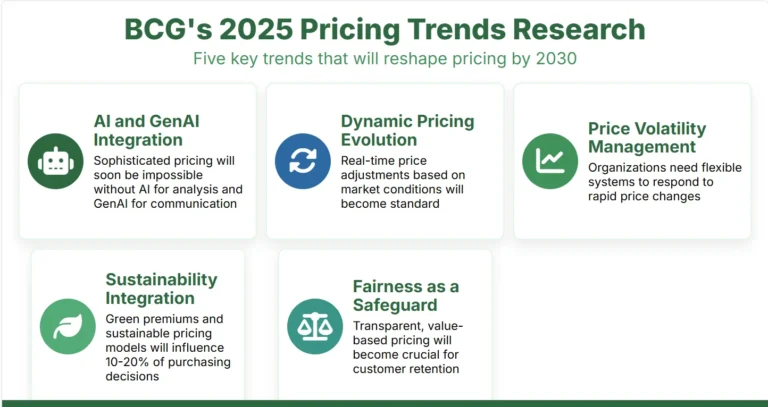
BCG’s 2025 pricing trends research identifies five key trends that will reshape pricing by 2030:
- AI and GenAI Integration: Sophisticated pricing will soon be impossible without AI for analysis and GenAI for communication
- Dynamic Pricing Evolution: Real-time price adjustments based on market conditions will become standard
- Price Volatility Management: Organizations need flexible systems to respond to rapid price changes
- Sustainability Integration: Green premiums and sustainable pricing models will influence 10-20% of purchasing decisions
- Fairness as a Safeguard: Transparent, value-based pricing will become crucial for customer retention
This means your Excel experts are about to become even more capable. The question is: will your organization be ready to harness that enhanced capability safely and effectively, or will you be like someone who bought a Ferrari but only drives it in the parking lot?
Microsoft is betting billions on it. Your teams are already relying on it.
Your job isn’t to eliminate Excel—that’s like trying to eliminate the sun because it’s bright. Your job is to make sure Excel doesn’t eliminate your margins, your compliance, or your competitive advantage.
Embrace it. (Because fighting it is like fighting gravity—pointless and exhausting) Protect it. (With the right governance and controls) Extend it. (Into your broader enterprise systems)
servicePath™ Spreadsheet Calculator: The Best of Both Worlds
Think of it as the Swiss Army knife of pricing solutions—it does everything you need, nothing you don’t, and fits perfectly in your existing toolkit.
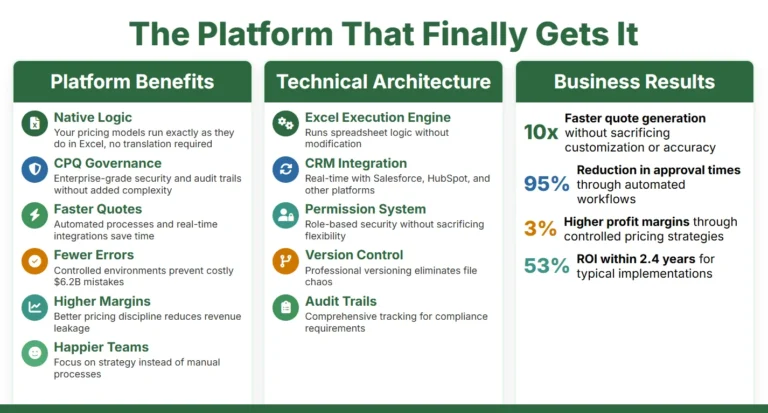
The Platform That Finally Gets It:
- Spreadsheet-native logic your teams already know Your pricing models run exactly as they do in Excel, but within a governed CPQ environment. No translation required, no “close enough” approximations, no retraining that feels like learning a new language.
- State-of-the-art CPQ governance Enterprise-grade security, audit trails, version control, and approval workflows that make Excel logic more powerful and secure without making it more complicated.
- Faster quotes through automated processes and real-time integrations (because time is money, and money is good)
- Fewer errors with controlled environments and validation rules (because $6.2B mistakes are best left to other companies)
- Higher margins through better pricing discipline and reduced leakage (the kind of leakage that affects your bonus)
- Happier teams who can focus on strategy instead of manual processes (because happy employees are productive employees)
The Technical Architecture That Actually Works:
- Native Excel execution engine that runs spreadsheet logic without modification (it’s like having Excel, but with superpowers)
- Real-time CRM integration with Salesforce, HubSpot, and other platforms (because data silos are so last century)
- Role-based permission system that maintains security without sacrificing flexibility
- Professional version control that eliminates file chaos and version confusion
- Comprehensive audit trails that satisfy even the most demanding compliance requirements
The Business Results That Actually Matter:
- 10x faster quote generation without sacrificing customization or accuracy
- 95% reduction in approval times through automated workflows (less waiting, more doing)
- 3 percentage points higher margins through controlled pricing (real money, not Monopoly money)
- 53% ROI within 2.4 years for typical implementations (better than most stock picks)
Because your pricing strategy deserves better than chaos.
The 2025-2030 Numbers That Should Keep You Up at Night (In a Good Way):

Financial Impact:
- Companies with controlled pricing strategies show 3 percentage points higher profit margins (for a $100M company, that’s $3M in additional profit)
- 67% of companies cite competitive pressures as their biggest pricing barrier (you’re not alone in this struggle)
- $2.3 trillion is wasted globally on failed digital transformation programs (let’s not add to that statistic)
- Forrester predicts consumption-based pricing will become 10% of enterprise software pricing by 2025
Market Growth Projections:
- CPQ market: $1.7B in 2024 → $7.3B by 2030 (16.9% CAGR)
- Price optimization software: $1.69B in 2024 → $1.98B in 2025 (16.58% CAGR)
- Enterprise software spending: Expected to grow 14.2% to $1.25 trillion in 2025
- AI-optimized servers: Spending doubles traditional servers, reaching $202B in 2025
Operational Efficiency:
- 10x faster quote generation with properly implemented CPQ (from hours to minutes)
- 95% reduction in approval times when spreadsheet logic is properly governed (because nobody enjoys waiting for approvals)
- 53% ROI achieved within 2.4 years for successful implementations (better than most investment strategies)
Risk Mitigation:
- 88% of spreadsheets contain errors that can cost millions (the kind of errors that make headlines for all the wrong reasons)
- 70% of digital transformations fail when they ignore existing workflows (don’t be part of this statistic)
- Nearly 90% of spreadsheets in large enterprises have material defects (it’s an epidemic, but it’s treatable)
Take the Next Step: Book Your Personalized Demo
Ready to accelerate your revenue and transform your quoting process? In a 15-minute demonstration, we will show you:
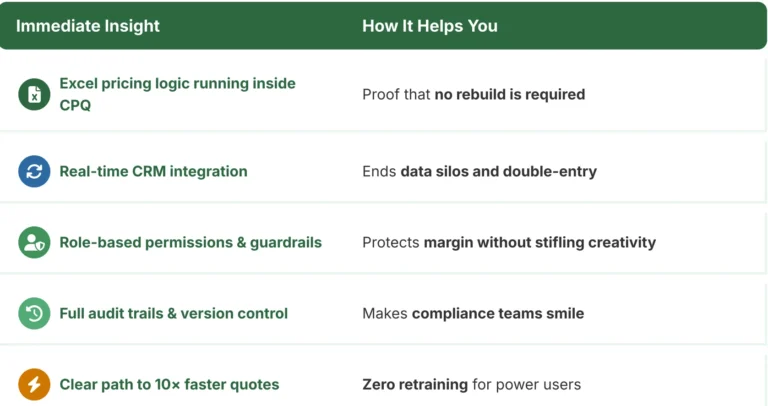
- Live Integration: See your actual Excel pricing logic running seamlessly within an enterprise CPQ environment.
- Automated Data Flow: Watch real-time integration with your CRM (like Salesforce, HubSpot, or NetSuite), eliminating data silos.
- Enhanced Security & Compliance: Understand how role-based permissions protect your intellectual property while audit trails and version control satisfy compliance teams.
- A Clear Path to Faster Quotes: Discover how you can achieve up to 10x faster quote generation without the disruption of rebuilding your logic or retraining your team.
[Book Your Personalized Demo Now]
About servicePath™: The Leader in Excel-Integrated CPQ
servicePath™ is the leading provider of Configure, Price, Quote solutions designed for technology-enabled enterprises. We specialize in bridging the gap between the flexibility of Excel and the power of enterprise software. Our core philosophy is simple: your pricing experts are the key to success. We don’t replace their logic; we enhance and empower it.
Why Leading Companies Choose servicePath™:
- We Enhance, Not Replace: We seamlessly integrate your existing pricing logic. This preserves years of institutional knowledge while adding the speed, control, and security of an enterprise platform.
- Proven Results: Deployed successfully in Fortune 500 companies, our clients report measurable ROI, including up to 10x faster quote generation and a 95% reduction in approval times.
- Deep Industry Expertise: We have an expert-level understanding of the complex B2B pricing challenges across technology, manufacturing, and professional services. We speak your language.
- Future-Ready Platform: Our 2025-2030 vision is focused on building the infrastructure for tomorrow’s AI-powered pricing strategies, ensuring our platform evolves with your needs.
Transform Your Quoting Process Today
The evidence is clear: organizations that successfully navigate digital transformation don’t eliminate useful tools—they deploy them strategically while automating processes that demand consistency, accuracy, and scale. Excel will survive your digital transformation, but your manual quoting processes don’t have to.
Ready to Accelerate Your Revenue?
Gain deeper insights from our industry-leading materials and see what others are saying about our impact.
- Case Studies: Read real-world success stories from technology service providers.
- Industry Blog: Get weekly insights on CPQ trends and best practices.
- Whitepapers & Glossaries: Download comprehensive guides on key concepts.
- Analyst Recognition: servicePath™ is recognized by leading analyst firms including Gartner, IDC MarketScape, and MGI Research.
- Verified Customer Reviews: See how we have transformed quoting processes for companies like yours.
Join the Conversation
The evidence is clear: successful digital transformation doesn’t mean eliminating useful tools—it means deploying them strategically. Excel will survive, but your manual quoting processes don’t have to.
Connect with us on LinkedIn to join the conversation about the future of enterprise pricing, or visit us at www.servicepath.co to learn more.
Visit us at www.servicepath.co to learn more about how we’re helping technology service providers worldwide accelerate revenue through intelligent quoting automation. Contact us today to learn how we can help you embrace Excel while transforming your enterprise pricing capabilities. Because life’s too short for pricing chaos, and the 2025-2030 opportunity window won’t stay open forever.
In the eternal battle between spreadsheets and cockroaches, perhaps the real winner is the organization smart enough to use both strategically. Excel for what it does best, CPQ for what matters most, and the wisdom to know the difference.
Frequently Asked Questions
Q1: Won’t integrating Excel with CPQ create more complexity rather than less? A: It’s like asking if adding GPS to your car makes driving more complex. Sure, there’s one more system, but it actually makes everything simpler by eliminating the need to rebuild existing pricing logic from scratch. Your experts continue working with familiar tools, while the platform handles governance, integration, and compliance automatically. This approach typically reduces training time by 50-70%, minimizes errors, and accelerates time-to-value. Our clients often say it’s like getting Excel with superpowers instead of getting a completely different superhero.
Q2: How do you handle version control when multiple people are working with Excel-based pricing models? A: We solve the “47 versions of the same file” problem with professional-grade version control that would make software developers jealous. All changes are tracked, approval workflows are maintained, and everyone automatically works with the latest approved logic. Unlike the email-attachment version of version control (which isn’t really version control at all), changes are synchronized in real-time, and rollback capabilities let you revert to previous versions faster than you can say “oops.” It’s like having a time machine for your pricing models.
Q3: What about security? Isn’t Excel inherently less secure than purpose-built CPQ systems? A: Excel files floating around in email attachments are about as secure as leaving your house key under the welcome mat. But our platform provides Fort Knox-level security around Excel logic while preserving the Excel experience your teams know and love. We implement role-based permissions, audit trails, data encryption, and controlled access—all the security features that make compliance teams sleep better at night. The result is actually more secure than traditional Excel workflows because every action is tracked, controlled, and auditable.
Q4: How long does it typically take to implement an Excel-integrated CPQ solution? A: Most organizations see initial value within 8-12 weeks, which is about half the time of traditional CPQ deployments. Think of it as the difference between renovating your house and building a new one—we’re working with your existing foundation rather than starting from scratch. Our clients often report being operational with pilot programs in as little as 6 weeks, with full deployment completed within 4-6 months. It’s fast enough to see results before your next quarterly review, but thorough enough to actually work long-term.
Q5: Will CPQ software completely replace Excel in our organization?:
No, and it shouldn’t. Excel remains an excellent tool for ad-hoc analysis, financial modeling, and unique scenarios that don’t fit standardized processes. servicePath™ CPQ+ is designed to handle repetitive, complex quoting processes while integrating with Excel for specialized analysis and reporting.