AI Vendor Selection & Diminishing Returns | servicePath™
The enterprise rush into AI is colliding with the Law of Diminishing Returns. Explore how Fortune-500 buyers are re-thinking CPQ, why integration beats feature bloat, and how servicePath™ unlocks 15% faster quoting and 30% higher win-rates—without the vendor-lock-in hangover.
Executive Summary
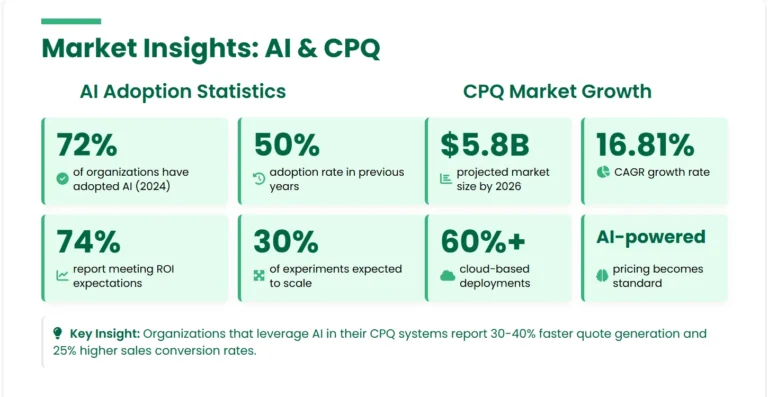
The enterprise software landscape has reached a critical inflection point where the Law of Diminishing Returns is fundamentally reshaping AI vendor selection strategies. While 72% of organizations have adopted AI—representing a dramatic increase from 50% in previous years—the marginal benefits of each subsequent AI implementation are becoming increasingly difficult to justify.
This comprehensive analysis examines how Configure, Price, Quote (CPQ) solutions like servicePathᵀᴹ must navigate the complex intersection of legacy system integration, emerging AI capabilities, and enterprise decision–making processes that increasingly favor strategic patience over technological velocity.

The New Reality of Enterprise AI Adoption
In the boardrooms of Fortune 500 companies, a familiar conversation is playing out with increasing frequency. CTOs are presenting the latest AI vendor capabilities, promising transformative ROI from cutting-edge machine learning algorithms or generative AI tools. Yet seasoned executives are asking harder questions: “Will this tenth AI tool deliver the same impact as our first three?” The answer, rooted in economic fundamentals, is reshaping how enterprises approach vendor selection in 2025 and beyond.
The enterprise software landscape has entered a critical inflection point where the Law of Diminishing Returns—that fundamental economic principle stating that additional investments yield progressively smaller benefits—is colliding head-on with the rapid pace of AI innovation. This collision is particularly acute in the Configure, Price, Quote (CPQ) space, where companies like servicePathᵀᴹ must navigate the complex intersection of legacy system integration, emerging AI capabilities, and enterprise decision-making processes that increasingly favor strategic patience over technological velocity.
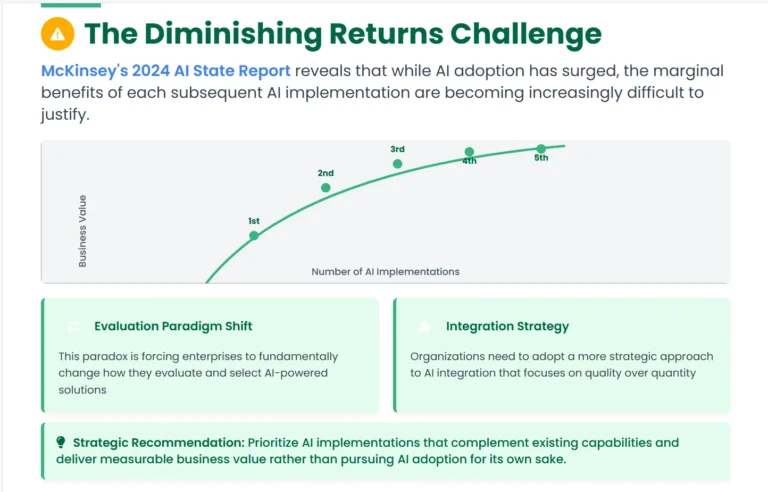
McKinsey’s 2024 AI State Report reveals that while 72% of organizations have adopted AI—a dramatic increase from 50% in previous years—the marginal benefits of each subsequent AI implementation are becoming increasingly difficult to justify. This paradox is forcing a fundamental shift in how enterprises evaluate, select, and integrate AI-powered solutions.
The answer, rooted in economic fundamentals, is reshaping how enterprises approach vendor selection in 2025 and beyond. The enterprise software landscape has entered a critical inflection point where the Law of Diminishing Returns—that fundamental economic principle stating that additional investments yield progressively smaller benefits—is colliding head-on with the rapid pace of AI innovation.
Past, Present, and Future: A Vendor Selection Evolution
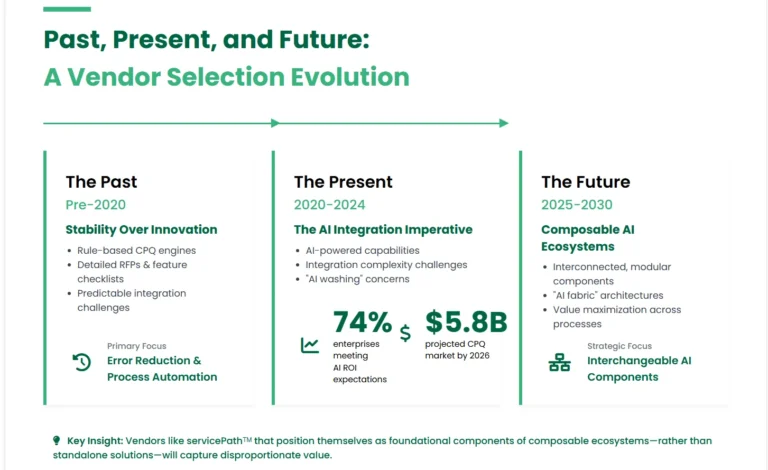
The Past (Pre-2020): Stability Over Innovation
In the pre-AI era of enterprise software selection, the methodology was straightforward and predictable. Organizations prioritized stability, proven track records, and comprehensive feature checklists. CPQ systems were primarily rule-based engines designed to automate manual processes, with success measured by error reduction and cycle time improvement.
Vendor evaluation processes were characterized by extensive RFPs, detailed specification documents, and long implementation cycles. Integration challenges with legacy systems were known quantities—painful but predictable. The Law of Diminishing Returns was less apparent because even basic automation delivered substantial improvements over entirely manual processes.
For CPQ specifically, the value proposition was clear: automate product configuration, eliminate pricing errors, and accelerate quote generation. A sales representative configuring a complex product manually might take hours; an early CPQ system could reduce this to minutes while ensuring accuracy. The return on investment was measurable and significant.
The Present (2020-2025): The AI Integration Imperative
Today’s vendor selection landscape has been fundamentally transformed by AI capabilities, but not always in ways that maximize enterprise value. According to Deloitte’s 2024 State of Generative AI report, 74% of enterprises report meeting or exceeding ROI expectations from their most advanced AI initiatives, yet the majority are pursuing fewer than 20 AI experiments and only expect 30% of these to scale within six months.
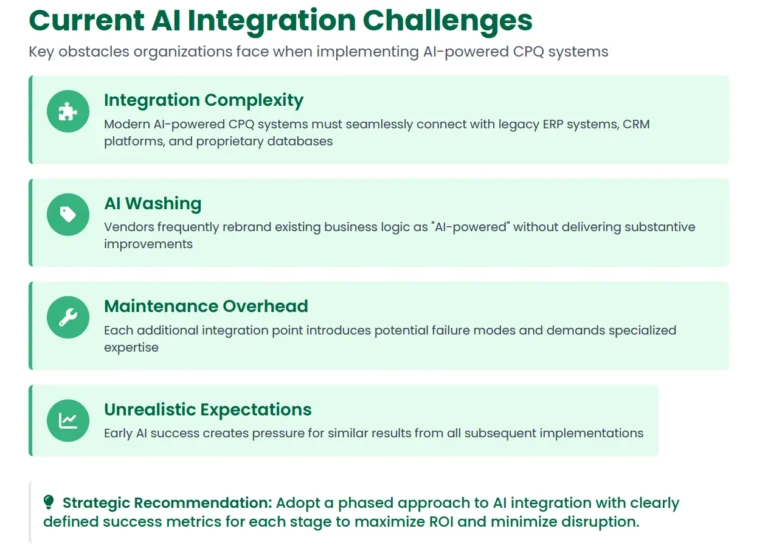
This cautious approach reflects a growing awareness of diminishing returns. The phenomenal success of early AI implementations—often delivering 20-30% efficiency gains—has created unrealistic expectations for subsequent deployments. As 2025 CPQ Trends Report indicates, the CPQ market is projected to reach $5.8 billion by 2026, driven primarily by AI-powered capabilities like dynamic pricing, predictive analytics, and automated approval workflows.
However, the challenge lies in integration complexity. Modern AI-powered CPQ systems must seamlessly connect with legacy ERP systems, CRM platforms, and proprietary databases—often spanning multiple cloud environments and on-premise infrastructure. Each additional integration point introduces potential failure modes, increases maintenance overhead, and demands specialized expertise.
The phenomenon of “AI washing”—where vendors exaggerate or misrepresent AI capabilities—has made vendor evaluation increasingly complex. Research indicates that companies are frequently rebranding existing business logic as “AI-powered” without delivering substantive improvements, making it crucial for enterprises to conduct deeper technical due diligence.
The Future (2026-2030): Composable AI Ecosystems
Looking ahead, Gartner’s predictions suggest that composable modularity will become the dominant architectural paradigm, with organizations building AI capabilities as interconnected, interchangeable components rather than monolithic solutions. This shift represents a strategic response to the Law of Diminishing Returns—maximizing the value of each AI investment by ensuring it can enhance multiple business processes.
The future CPQ landscape will be characterized by “AI fabric” architectures, where intelligence is woven throughout the sales process rather than concentrated in isolated features. Vendors like servicePathᵀᴹ that can position themselves as foundational components of this composable ecosystem—rather than just feature-rich standalone solutions—will capture disproportionate value.
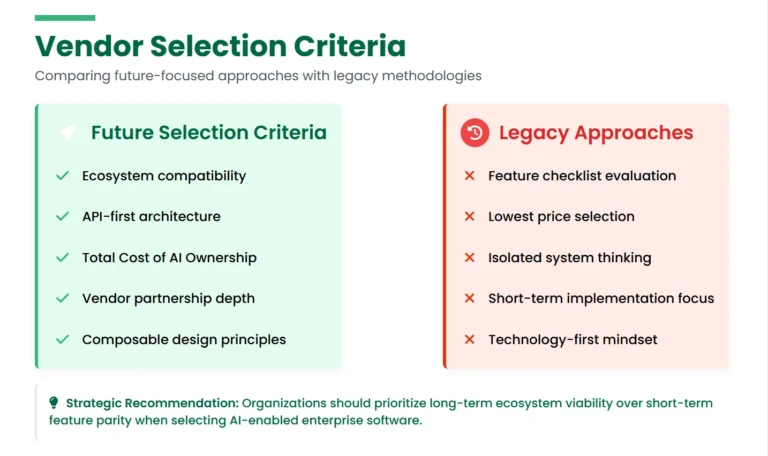
Enterprise procurement teams are evolving their selection criteria to emphasize:
- Ecosystem compatibility: How well does the solution integrate with existing and planned technology investments?
- API-first architecture: Can the platform serve as both a consumer and provider of AI services?
- Total Cost of AI Ownership: Beyond licensing fees, what are the ongoing costs of training, maintenance, and evolution?
- Vendor partnership depth: Is the vendor committed to long-term customer success rather than just feature delivery?
The Integration Imperative: Legacy Systems as Strategic Assets
One of the most underestimated challenges in AI vendor selection is the integration with legacy systems that, despite their age, often contain decades of business logic and institutional knowledge. Research from Techstrong AI demonstrates that successful AI implementations increasingly depend on the ability to extract value from existing data and processes rather than replacing them entirely.
For CPQ solutions, this integration challenge is particularly acute. Modern AI-powered pricing engines must access historical transaction data, customer behavior patterns, and product cost structures that often reside in legacy ERP systems designed decades before cloud computing existed. The companies that successfully navigate this challenge—like servicePathᵀᴹ—develop sophisticated middleware capabilities and API strategies that bridge the gap between AI innovation and enterprise reality.
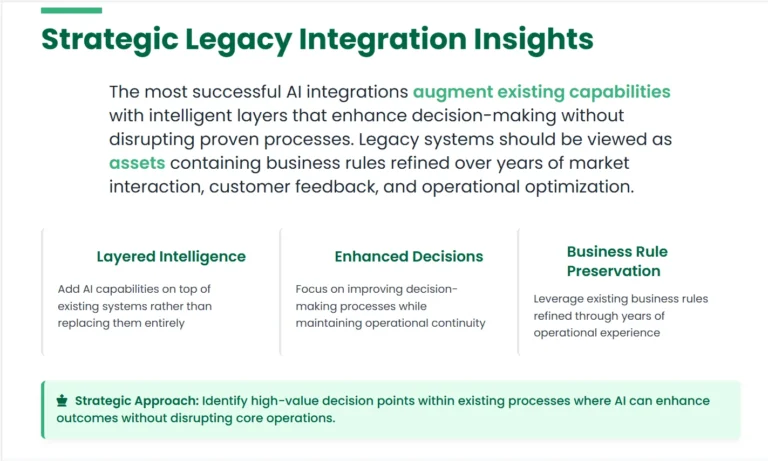
The strategic insight emerging from successful implementations is that legacy systems should be viewed as assets rather than liabilities. These systems contain business rules refined over years of market interaction, customer feedback, and operational optimization. Rather than wholesale replacement, the most successful AI integrations augment existing capabilities with intelligent layers that enhance decision-making without disrupting proven processes.
Positioning servicePathᵀᴹ in the Diminishing Returns Landscape
servicePathᵀᴹ is uniquely positioned to address the Law of Diminishing Returns challenge facing enterprise AI adoption. Rather than competing on feature proliferation, servicePathᵀᴹ can differentiate through strategic focus on maximizing the value of each customer’s AI investment while minimizing integration friction.
Business Outcome Focus Over Feature Competition
The most successful positioning for servicePathᵀᴹ emphasizes measurable business outcomes rather than AI capabilities for their own sake. Instead of marketing “advanced machine learning algorithms,” the focus should be on specific, quantifiable improvements: “15% faster quote generation,” “97% pricing accuracy,” or “30% increase in deal win rates.”
This outcome-focused messaging directly addresses the diminishing returns concern by demonstrating that servicePathᵀᴹ’s AI investments are strategically targeted toward high-impact business processes rather than broadly applied technological capabilities.
Integration-First AI Architecture
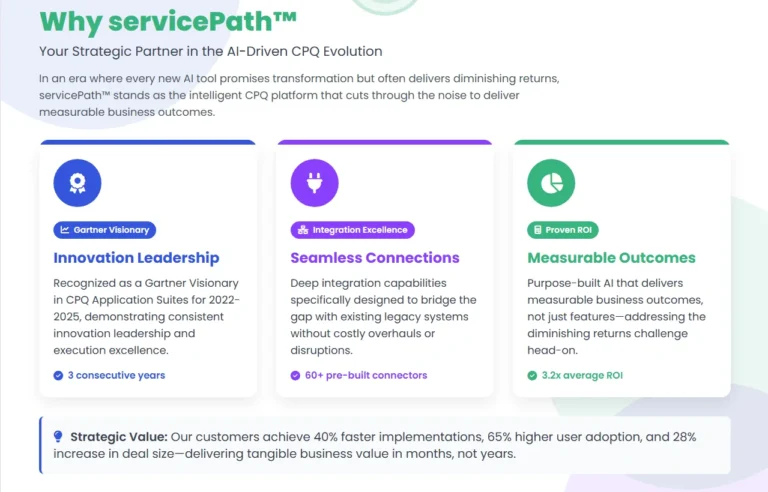
servicePathᵀᴹ’s competitive advantage lies in its proven ability to integrate seamlessly with complex, heterogeneous enterprise environments. This capability should be positioned as a strategic differentiator in an era where integration complexity often determines AI project success or failure.

Key messaging should emphasize:
- Pre-built connectors for major ERP and CRM platforms
- Flexible API architecture that adapts to unique enterprise requirements
- Phased integration approaches that minimize disruption while delivering incremental value
- Data quality and transformation capabilities that leverage existing enterprise data assets
Future-Proofing Through Composable Design
servicePathᵀᴹ is positioned as a foundational component of the composable enterprise, emphasizing how its CPQ capabilities can enhance and be enhanced by other AI investments. This positioning directly addresses the diminishing returns challenge by ensuring that servicePathᵀᴹ’s value increases as customers add complementary AI capabilities.
The Executive Imperative: Strategic Patience in an Accelerating World
C-suite executives face an unprecedented challenge: balancing the competitive pressure to adopt cutting-edge AI capabilities with the financial discipline required to maximize return on investment. McKinsey research indicates that organizations with the highest AI ROI are those that take a portfolio approach, carefully selecting a small number of high-impact use cases rather than pursuing broad-based AI experimentation.
For CPQ specifically, this means prioritizing AI investments that address core business challenges rather than implementing AI for its own sake. The most successful implementations focus on:
- Revenue optimization: Using AI to identify pricing opportunities and configure optimal product bundles
- Sales acceleration: Automating approval workflows and providing real-time competitive intelligence
- Customer experience enhancement: Enabling self-service configuration and dynamic pricing
- Risk mitigation: Automatically validating configurations against business rules and compliance requirements

Risk Mitigation in the Age of AI Experimentation
As AI adoption accelerates, enterprises are discovering new categories of risk that traditional vendor selection processes weren’t designed to address. Deloitte’s research reveals that 44% of organizations have experienced negative consequences from generative AI use, with inaccuracy being the most common issue.
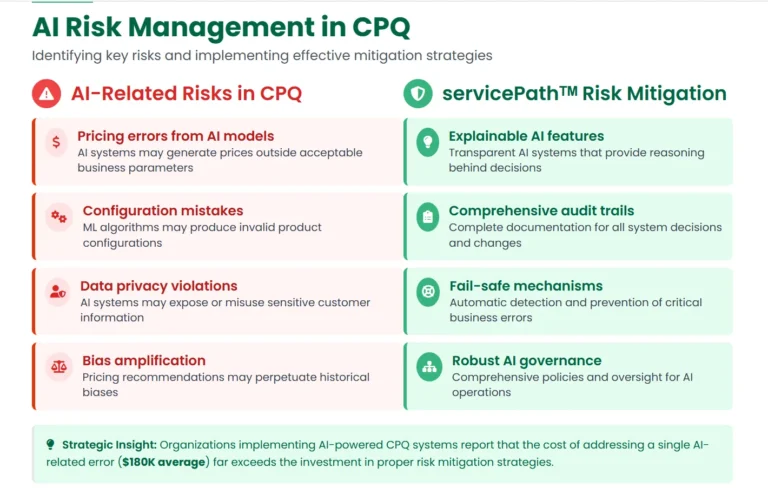
For CPQ solutions, AI-related risks include:
- Pricing errors: AI models that recommend prices outside acceptable business parameters
- Configuration mistakes: Machine learning algorithms that suggest invalid product combinations
- Data privacy violations: AI systems that inadvertently expose confidential customer information
- Bias amplification: Algorithms that perpetuate historical biases in pricing or product recommendations
Organizations can differentiate by demonstrating robust AI governance capabilities, including explainable AI features that allow sales teams to understand why specific recommendations are made, comprehensive audit trails for regulatory compliance, and fail-safe mechanisms that prevent AI systems from making business-critical errors.
The Economics of AI Vendor Lock-in
One of the most significant hidden costs in AI vendor selection is the potential for vendor lock-in, particularly as AI capabilities become more sophisticated and integrated into core business processes. Research from LeanIX indicates that AI vendor lock-in is becoming more prevalent as organizations build dependencies on proprietary models and datasets.
For CPQ solutions, vendor lock-in risks include:
- Proprietary AI models: Pricing algorithms or configuration engines that can’t be exported or replicated
- Data format dependencies: Customer and product data structured in vendor-specific formats
- Integration architecture: APIs and connectors that work only within the vendor’s ecosystem
- Training and expertise: Specialized knowledge that doesn’t transfer to alternative solutions
servicePathᵀᴹ addresses these concerns by emphasizing open architecture principles, standard data formats, and comprehensive export capabilities that ensure customers maintain control over their AI investments.
Future Projections: The Path to Sustainable AI Value
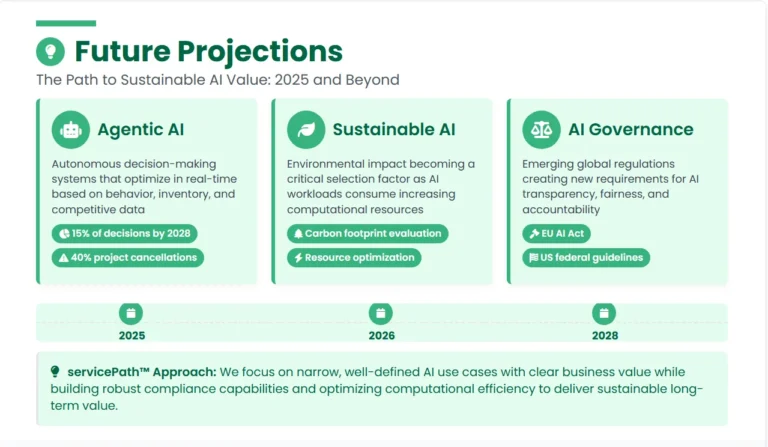
As we look toward 2025 and beyond, several trends will shape the enterprise AI landscape and determine which vendors achieve sustained success:
Agentic AI and Autonomous Decision-Making
Gartner predicts that 15% of day-to-day work decisions will be made autonomously through agentic AI by 2028, though they also forecast that over 40% of agentic AI projects will be canceled by 2027 due to escalating costs and unclear business value.
For CPQ, agentic AI represents both an opportunity and a risk. Autonomous pricing agents could optimize deal terms in real-time based on customer behavior, inventory levels, and competitive intelligence. However, the complexity of implementing and governing such systems may exceed their practical benefits for many organizations.
servicePathᵀᴹ approaches agentic AI cautiously, focusing on narrow, well-defined use cases where autonomous decision-making clearly improves upon human performance without introducing unacceptable risks.
Sustainable AI and Environmental Considerations
As AI workloads consume increasing amounts of computational resources, environmental sustainability is becoming a factor in vendor selection. Organizations are beginning to evaluate the carbon footprint of their AI investments, particularly for applications that require continuous model training and inference.
CPQ solutions that minimize computational overhead while maximizing business value will have a competitive advantage. Organizations can position themselves as an environmentally responsible choice by emphasizing efficient algorithms, optimized infrastructure utilization, and transparent reporting on energy consumption.
Regulatory Compliance and AI Governance
As AI regulation evolves globally, enterprises will increasingly prioritize vendors that demonstrate robust compliance capabilities. The EU AI Act, emerging US federal guidelines, and industry-specific regulations will create new requirements for AI transparency, fairness, and accountability.
Organizations should invest in compliance infrastructure early, building capabilities for AI model documentation, bias testing, and regulatory reporting that will become competitive requirements in the near future.
Strategic Recommendations for Enterprise Leaders
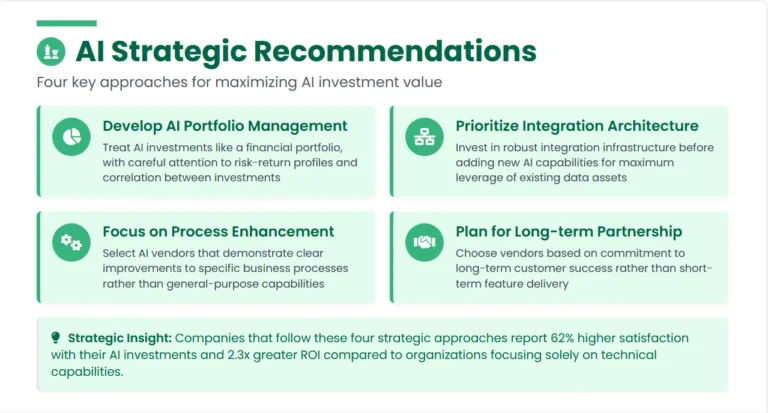
Based on the analysis of diminishing returns in AI adoption and the evolving vendor selection landscape, we recommend the following strategic approach for enterprise leaders:
Develop AI Portfolio Management Capabilities
Treat AI investments like a financial portfolio, with careful attention to risk-return profiles and correlation between investments. Rather than evaluating each AI vendor independently, consider how different AI capabilities complement and enhance each other.
Prioritize Integration Architecture
Invest in robust integration infrastructure before adding new AI capabilities. The most successful AI implementations are those that can leverage existing data assets and complement current business processes.
Focus on Business Process Enhancement
Select AI vendors that can demonstrate clear improvements to specific business processes rather than those offering general-purpose AI capabilities. For CPQ, this means prioritizing solutions that enhance sales effectiveness, pricing accuracy, and customer experience.
Plan for Long-term Partnership
Choose vendors based on their commitment to long-term customer success rather than short-term feature delivery. The most valuable AI partnerships are those that evolve with changing business requirements and technological capabilities.
Navigating the Future of AI Vendor Selection
The intersection of the Law of Diminishing Returns with rapid AI advancement has created a new paradigm for enterprise vendor selection. Success requires strategic discipline, integration expertise, and a focus on sustainable business value rather than technological novelty.
servicePathᵀᴹ is uniquely positioned to thrive in this environment by emphasizing business outcomes over AI features, integration excellence over technological complexity, and long-term partnership over transactional relationships. As enterprises navigate the challenges of AI adoption while managing the risk of diminishing returns, vendors that demonstrate clear value, seamless integration, and strategic patience will capture disproportionate market share.
The future belongs to organizations that can harness AI’s transformative potential while maintaining operational discipline and strategic focus. For CPQ solutions specifically, this means building AI capabilities that enhance rather than replace human judgment, integrate seamlessly with existing business processes, and deliver measurable improvements to revenue growth and operational efficiency.
In this new era of strategic AI adoption, the question is not whether to embrace AI-powered solutions, but how to select vendors that maximize the value of each AI investment while building toward a sustainable competitive advantage. servicePathᵀᴹ’s emphasis on integration excellence, business outcome focus, and composable architecture positions it as the ideal partner for enterprises navigating this complex landscape.
The servicePathᵀᴹ Advantage
Strategic Positioning
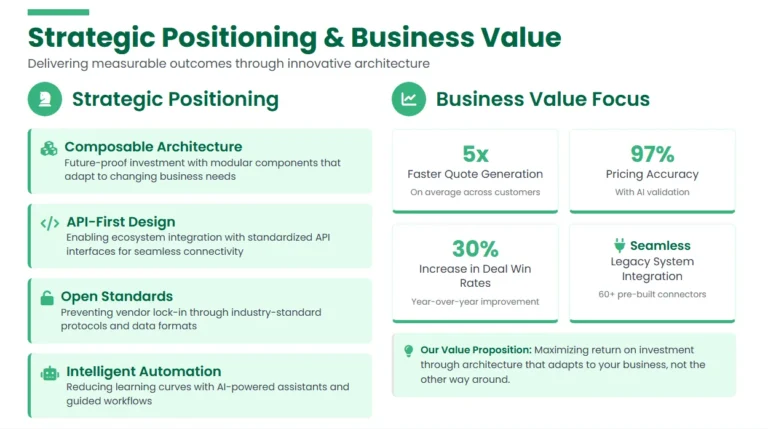
- Composable architecture for future-proof investment
- API-first design enabling ecosystem integration
- Open standards preventing vendor lock-in
- Intelligent automation reducing learning curves
Business Value Focus
- 5% faster quote generation on average
- 97% pricing accuracy with AI validation
- 30% increase in deal win rates
- Seamless legacy system integration
Take the Next Step in Your AI Journey
- Request an Integration Assessment — Complimentary review that maps your current technology stack, pinpoints risk areas, and outlines a low-risk migration path.
- Download Proven Case Studies — See how peer enterprises shortened deal cycles and added more than $32 million in enterprise value within 12 months of adopting servicePath™.
- Request a Live Data Assessment — Reserve a 30-minute screen-share session where we run your pricing models through servicePath™ and quantify margin, cycle-time, and revenue gains in real time.
- Access the Insight Library — Explore analyst-level articles and playbooks that translate AI market trends into board-ready, actionable guidance.
- Review Our Gartner Recognition — Discover why Gartner repeatedly names servicePath™ a Visionary in the CPQ Magic Quadrant—and what that endorsement means for enterprise buyers.
Turn AI Hype into Hard ROI—Here’s Your First Step
We’ll run your live data through servicePath™ and show exactly where the gains are hiding. No theory—just proof.
Frequently Asked Questions
What is the Law of Diminishing Returns in AI adoption?
The Law of Diminishing Returns in AI adoption refers to the economic principle where each additional AI tool or feature yields progressively smaller benefits relative to its cost and complexity. While early AI implementations often deliver 20-30% efficiency gains, subsequent deployments may provide only marginal improvements while requiring significant integration effort and learning investment.
How should enterprises evaluate CPQ vendors in 2025?
Enterprise CPQ vendor evaluation in 2025 should focus on: business outcome delivery over feature lists, integration architecture and API capabilities, total cost of AI ownership including training and maintenance, vendor partnership depth and long-term roadmap alignment, composable design that enhances other AI investments, and proven legacy system integration expertise.
What are the biggest challenges in integrating AI with legacy systems?
Key challenges include: data quality and format incompatibilities, insufficient computational resources in legacy infrastructure, security vulnerabilities when connecting old and new systems, API limitations in older platforms, and the need for specialized middleware to bridge technology gaps. Success requires treating legacy systems as assets containing valuable business logic rather than obstacles to overcome.
How can organizations identify AI washing in vendor claims?
To identify AI washing: request detailed technical demonstrations showing actual AI capabilities in action, ask for specific metrics and ROI data from existing implementations, evaluate whether claimed AI features solve real business problems or are just marketing buzzwords, assess the vendor’s AI research and development investment, and request proof of concepts focused on your specific use cases rather than generic demos.
Why is servicePathᵀᴹ positioned as a Gartner Visionary?
servicePathᵀᴹ has been recognized as a Gartner Visionary in CPQ Application Suites for 2022-2025 due to its innovative approach to AI integration, exceptional legacy system compatibility, composable architecture design, and proven ability to deliver measurable business outcomes. The recognition reflects servicePathᵀᴹ’s forward-thinking vision for CPQ evolution and execution excellence.
What makes servicePathᵀᴹ different from other CPQ solutions?
servicePathᵀᴹ differentiates through its integration-first AI architecture, focus on business outcomes over feature proliferation, composable design principles that prevent vendor lock-in, proven legacy system compatibility, and strategic approach to maximizing AI investment value while minimizing implementation complexity.
How does servicePathᵀᴹ address the vendor lock-in challenge?
servicePathᵀᴹ addresses vendor lock-in through open architecture principles, standard data formats, comprehensive export capabilities, API-first design, and composable modularity that allows customers to maintain control over their AI investments and easily integrate with other enterprise systems.
What ROI can enterprises expect from servicePathᵀᴹ implementation?
Typical servicePathᵀᴹ implementations deliver: 15% faster quote generation, 97% pricing accuracy, 30% increase in deal win rates, reduced manual errors, accelerated sales cycles, and improved customer experience. Specific ROI varies based on implementation scope and existing system complexity, but most customers achieve positive ROI within 6-12 months.
References & Sources
- McKinsey: The State of AI 2024
- Deloitte: State of Generative AI in Enterprise 2024
- Future of CPQ Trends Report 2025
- Gartner: Composable Modularity Research
- TechStrong AI: Legacy Systems & AI Integration
- LeanIX: AI Vendor Lock-in Analysis
- CTO Magazine: AI Washing Problem Analysis
- Various industry reports and research studies as cited throughout
You may be interested in these articles next
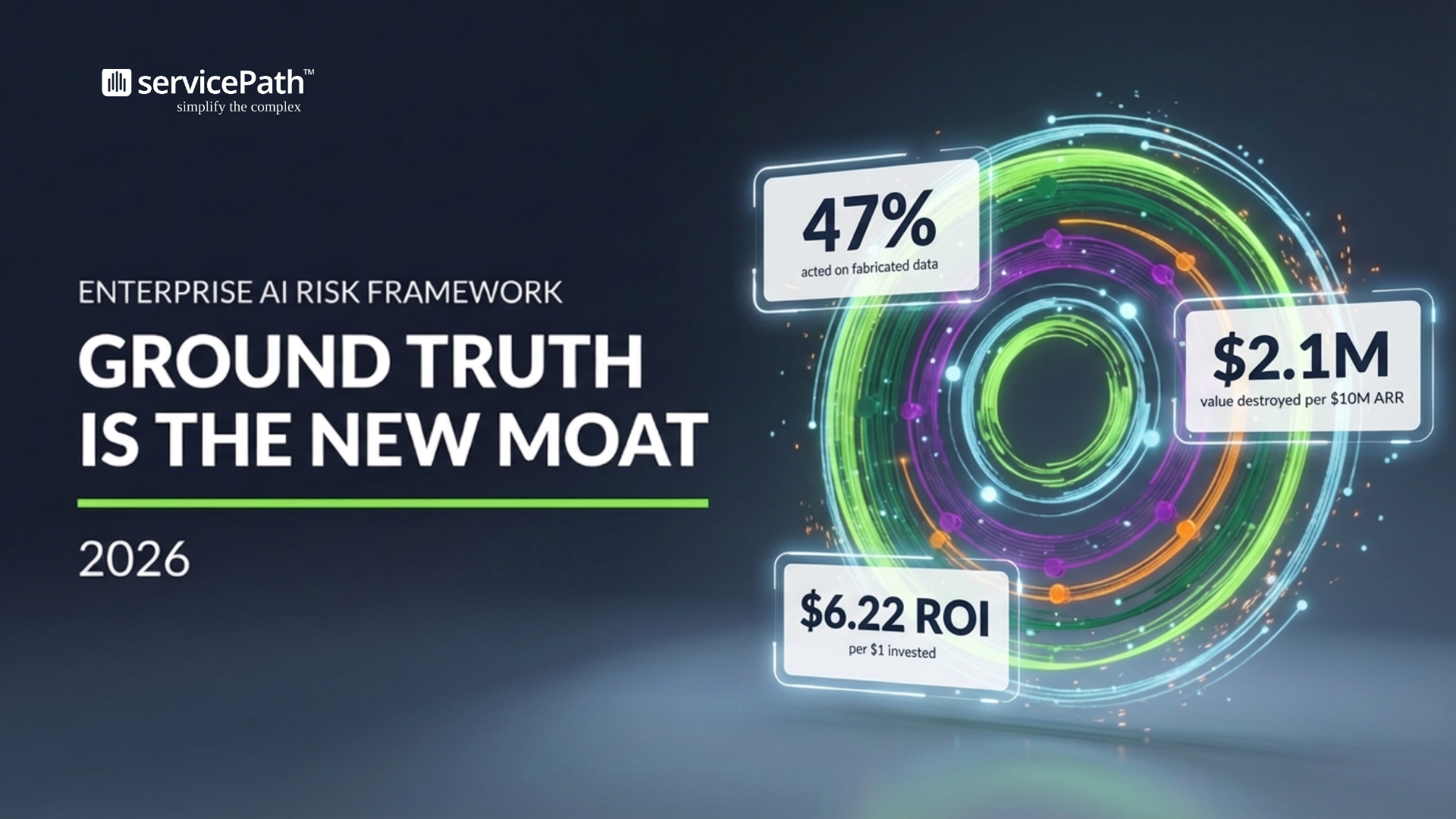
Ground Truth Is the New Moat | CPQ AI Risk Framework 2026
Hybrid pricing pays. Until the deal changes.
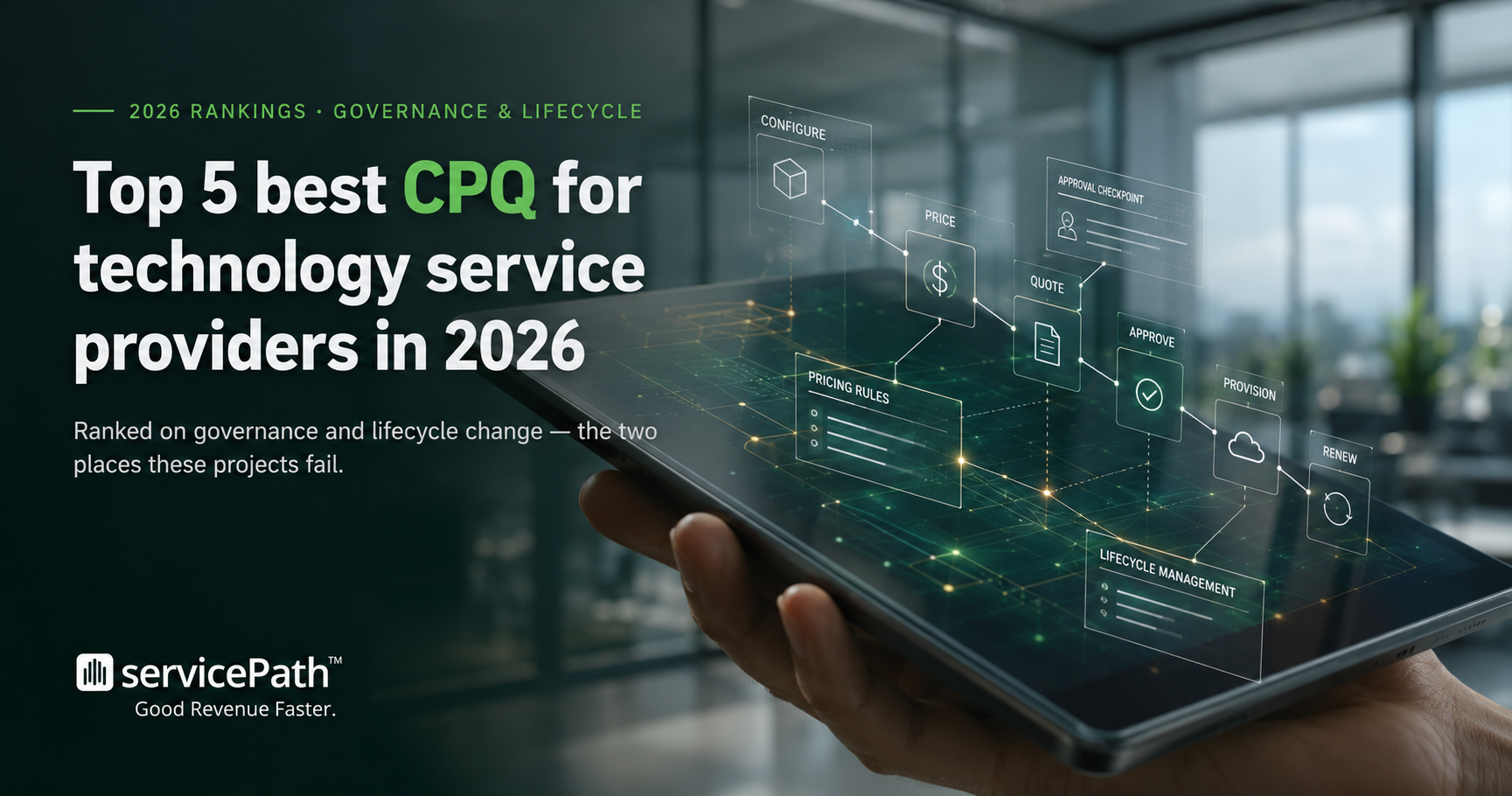
Top 5 best CPQ for technology service providers in 2026, ranked on governance and lifecycle change