AI-Native CPQ Field Service Management: Slash Quote Times 60% | servicePath™ 2025
Discover how AI-native CPQ transforms field service quoting with 35-60% faster cycles, 25% revenue growth, and predictive maintenance integration. Expert insights & 2025 projections.

The Silent Profit Killer in Field Service
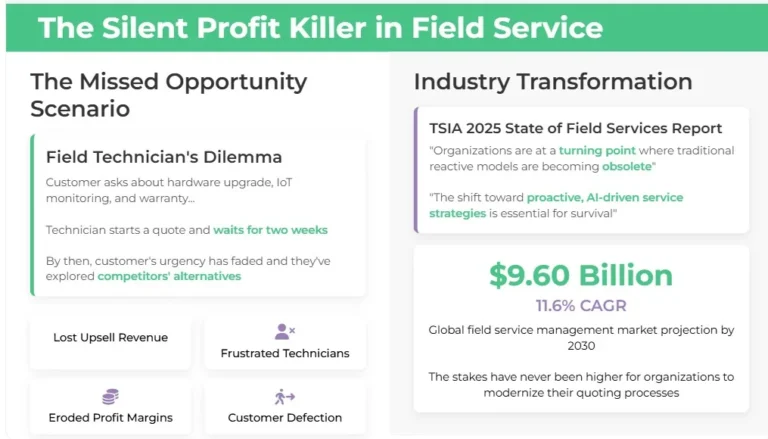
Picture this: your field technician has just completed a routine maintenance call. The customer asks about an upgrade to the latest hardware, a bundled IoT monitoring service, and an extended warranty. Your technician taps into their systems, starts a quote, and then… waits. Two weeks later, a price finally arrives—long after the customer’s urgency has faded and they’ve explored alternatives with competitors.
This scenario isn’t an isolated story; for many field service organizations (FSOs), the quoting process is the silent profit killer. Legacy SCADA systems, on-premise enterprise asset management (EAM) platforms, and paper work orders conspire to slow everything down. According to TSIA’s 2025 State of Field Services report, organizations are at a turning point where traditional reactive models are becoming obsolete, and the shift toward proactive, AI-driven service strategies is essential for survival.
The result is a cascade of missed opportunities: lost upsell revenue, frustrated technicians, eroded profit margins, and customers who turn to more agile competitors. With the global field service management market projected to reach $9.60 billion by 2030 at a CAGR of 11.6%, the stakes have never been higher for organizations to modernize their quoting processes.
Why Quoting Is Exponentially Complex for Field Service Organizations
Field service teams don’t sell simple products off a shelf. They deliver intricate, multi-component service packages across vast territories, often under challenging environmental conditions. MGI Research projects that the global market for cloud-based CPQ tools among publicly traded companies will reach nearly $5.8 billion by 2026, growing at a remarkable 16% CAGR, largely driven by the complexity challenges that traditional quoting systems cannot handle.
FSOs face the unique challenge of patching together legacy and cutting-edge systems while operating in unpredictable field conditions. Location isn’t just a logistical consideration—it fundamentally impacts service delivery costs, regulatory requirements, and technical complexity. Understanding how to fix a system is one thing; understanding how to do so efficiently across different geographical, weather, and regulatory conditions is another level of complexity entirely, requiring logic that must be harvested, codified, and accurately costed.
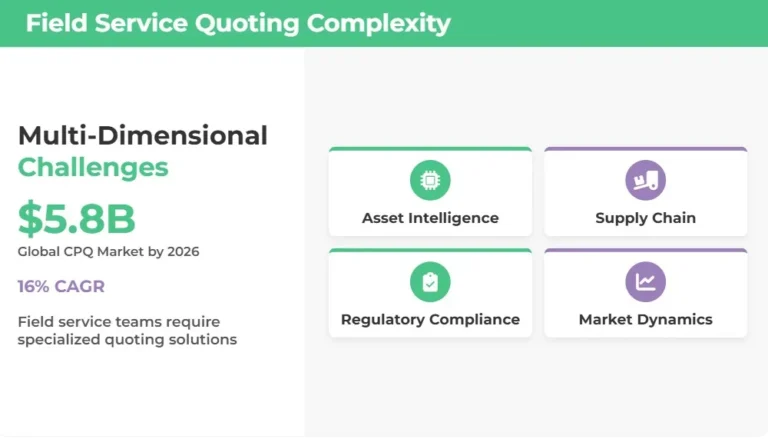
The Multi-Dimensional Quoting Challenge
Pricing a new service or maintenance upgrade demands real-time synthesis of numerous complex data points:
Asset Intelligence and Lifecycle Analysis
- Asset condition monitoring and lifecycle stage assessment to determine upgrade viability
- Historical performance data to predict failure patterns and service requirements
- According to Deloitte’s research, poor maintenance strategies can reduce plant productive capacity by 5-20%, making accurate asset assessment crucial for profitable quoting
Supply Chain and Logistics Optimization
- Real-time parts availability across multiple distribution centers
- Dynamic shipping costs and delivery timeframes
- Supplier lead times and potential substitution options
- McKinsey research shows that emerging technologies in maintenance lead to 20-50% reduction in downtime, making parts availability prediction critical
Regulatory and Compliance Complexity
- Regional labor laws and union requirements that vary by location
- Service-level agreements (SLAs) with different penalty structures
- OSHA, ISO 55000, and industry-specific safety regulations
- Environmental compliance requirements that vary by geography
Dynamic Market Conditions
- Real-time currency fluctuations for global operations
- Regional labor rate variations and overtime calculations
- Seasonal demand patterns affecting pricing strategies
- Economic factors influencing customer purchasing power
Quoting that fails to account for these interconnected variables can quickly transform profitable service opportunities into loss-generating commitments. Yet with disparate legacy systems and manual processes, most FSOs cannot synthesize this complexity until data slowly filters through multiple back-office teams—creating a revenue bottleneck precisely when technicians have customers’ full attention and buying intent.
The Broader Context: Maintenance Revolution and the AI Imperative
Field service quoting operates within a rapidly evolving maintenance ecosystem that’s undergoing fundamental digital transformation. The statistics paint a compelling picture of why AI integration isn’t optional—it’s essential for survival:
Predictive Maintenance ROI Revolution Research from multiple industry leaders demonstrates extraordinary returns on AI-driven maintenance strategies:
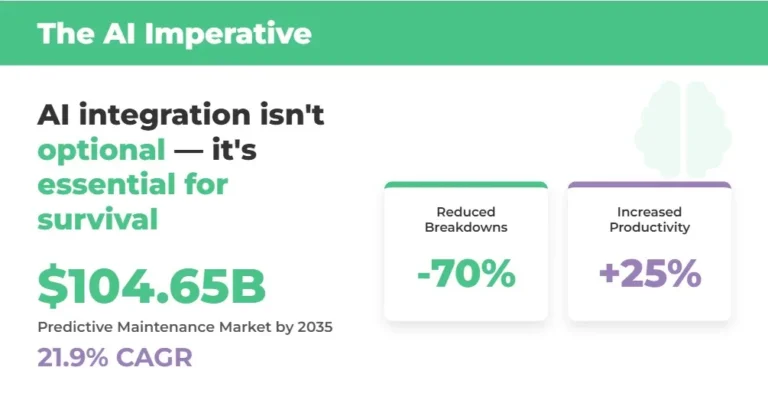
- Deloitte reports that predictive maintenance increases productivity by 25%, reduces breakdowns by 70%, and lowers maintenance costs by 25%
- McKinsey analysis indicates predictive maintenance can reduce machine downtime by 30-50% and increase machine life by 20-40%
- Studies show predictive maintenance decreases overall costs by 12% while improving availability by 9% and extending asset lifetime by 20%
The IoT Integration Imperative The Internet of Things has become the nervous system of modern field service operations. For organizations still operating reactively, IoT represents a paradigm shift from waiting for equipment failure to predicting and preventing it. Global Growth Insights research shows that 57% of firms plan to integrate AI-IoT capabilities into facility operations by 2025.
Market Growth Acceleration The predictive maintenance market itself is experiencing explosive growth:
- Market size projected to reach $104.65 billion by 2035, growing at 21.9% CAGR
- Field service management market expanding from $2.69 billion in 2024 to $3.28 billion in 2025
This transformation explains why leading FSOs are aggressively investing in AI-native solutions that can process IoT sensor feeds, maintenance histories, and predictive analytics in real-time to generate quotes that reflect true service complexity and protect profit margins.
What Is AI-Native CPQ and Why Does It Represent a Paradigm Shift?
Traditional Configure-Price-Quote (CPQ) software was designed for the relatively straightforward world of product sales from office environments. These systems automate basic product configuration, apply static pricing rules, and generate standardized proposals—adequate for simple B2B transactions but woefully inadequate for complex field service scenarios.

AI-Native CPQ: Beyond Configuration to Intelligence
AI-native CPQ represents a fundamental evolution in quoting technology. Rather than simply automating existing processes, it transforms how organizations think about pricing and service delivery. These systems continuously ingest and learn from live operational data, combining:
- Real-time IoT sensor feeds indicating equipment condition and performance
- Historical maintenance data revealing failure patterns and service success rates
- Dynamic pricing intelligence incorporating market conditions and competitor analysis
- Regulatory databases ensuring compliance across multiple jurisdictions
- Supply chain data providing accurate parts availability and logistics costs
According to Nucleus Research, integrating CPQ with field service management systems ensures real-time data flow, dramatically improving quote accuracy and service delivery efficiency. By connecting CPQ directly to maintenance management systems, organizations eliminate manual data entry errors, reduce quote preparation time, and boost customer satisfaction through faster response times.
The Knowledge Harvesting Revolution
Perhaps most importantly, AI-native CPQ systems excel at capturing and codifying the institutional knowledge of experienced field service professionals. Years of service experience, problem-solving insights, and hard-won wisdom from veteran technicians can be harvested, analyzed, and made instantly available to newer team members. This democratization of expertise transforms junior technicians into knowledgeable service consultants while freeing senior engineers to focus on the most complex, high-value challenges.
Guided Selling with Situational Intelligence
Modern AI-native CPQ solutions incorporate sophisticated guided selling capabilities that go far beyond simple product recommendations. These systems use machine learning to analyze:
- Customer purchase history and service preferences
- Equipment usage patterns and failure predictions
- Environmental conditions affecting service requirements
- Market trends and competitive positioning
This approach helps field technicians present optimal service bundles—combining hardware upgrades, IoT monitoring packages, extended warranties, and preventive maintenance schedules—while maximizing both customer value and organizational profitability.
How AI Fundamentally Augments the CPQ Process in Complex Field Service Scenarios
The integration of artificial intelligence into field service CPQ represents more than incremental improvement—it’s a complete reimagining of how service organizations approach customer interactions, pricing strategies, and operational efficiency. Based on real-world field service scenarios where technicians must deliver accurate quotes on-site while navigating complex asset conditions, regulatory requirements, and logistical constraints, AI augmentation delivers transformative capabilities:
1.Real-Time Operational Data Integration and Location Intelligence
AI-native CPQ systems create a unified data ecosystem that pulls information from multiple operational systems simultaneously:
- SCADA and IoT sensor networks providing real-time equipment performance metrics
- ERP and inventory management systems showing parts availability across distribution networks
- Geographic information systems (GIS) delivering location-specific data for travel time calculations and regional compliance requirements
- Weather and environmental databases factoring seasonal conditions into service complexity assessments
This comprehensive data integration becomes particularly critical for global FSOs managing services across multiple time zones, regulatory environments, and operational contexts.
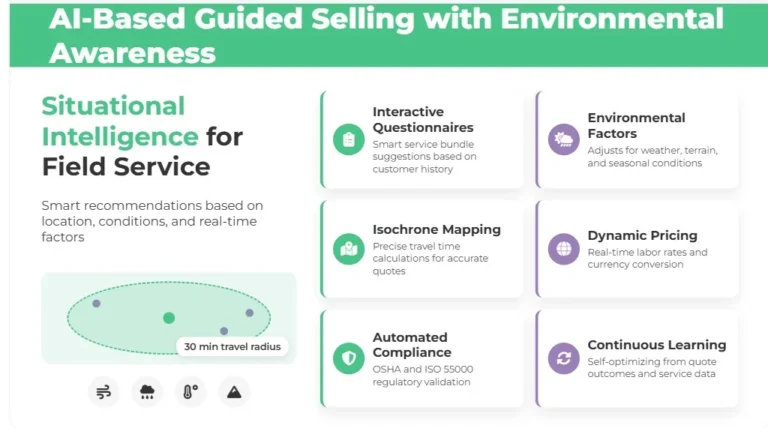
2.AI-Based Guided Selling with Environmental and Situational Awareness
Interactive questionnaires suggest the optimal service bundles based on historical customer behavior and market trends. For field technicians, this helps them present IoT monitoring packages, extended warranties, and preventive maintenance schedules that maximize customer value and comply with regional regulations. Guided selling also incorporates not only product dimensions but situational and weather dimensions—like the time of year, how much wind, sand, or rain, depending on what’s being maintained, installed, or fixed.
This is where detailed location understanding via an isochrone is essential for a CPQ to add real value to an FSO quote. An isochrone is a map that shows the area that can be reached from a specific point within a given travel time, taking into account factors like road networks and traffic. This allows a CPQ to factor in travel time to a location, which can vary greatly depending on conditions, to provide a more accurate and valuable quote.
3.Dynamic Pricing Intelligence and Market Responsiveness
Pricing engines factor in global labor rates, currency conversion, and transportation coefficients in real time. This capability is critical for FSOs operating across multiple jurisdictions where on-site labor costs and travel times vary widely.
4. Automated Compliance and Risk Management
AI models reference OSHA, ISO 55000, and local regulatory requirements, automatically flagging configurations that violate safety or warranty rules. In field service, the model also computes cost-to-serve in real time to protect margins on complex service bundles.
5.Continuous Learning and Performance Optimization
AI continuously tunes pricing and configuration recommendations based on actual quote outcomes and service performance. As more field-service data is collected, the system improves accuracy, reduces discounting errors, and increases first-time-fix rates.
servicePath™’s AI-Native CPQ for FSOs
For FSOs, servicePath™ offers a platform purpose-built for complex, asset-intensive service operations:
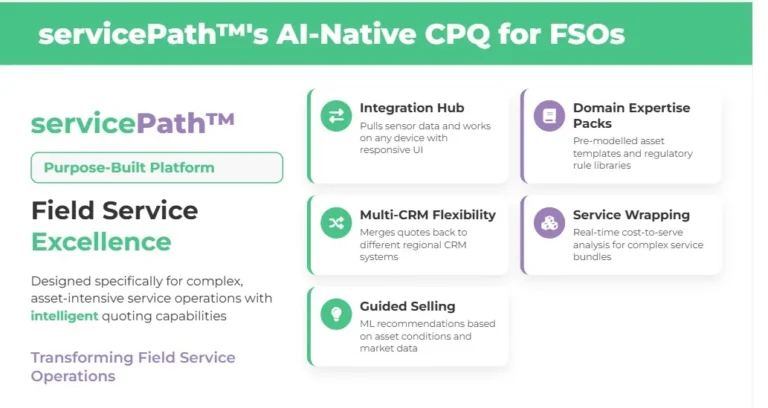
- Integration hub and responsive UI: Our integration hub pulls sensor data, inventory levels, and GIS coordinates into a browser-based, responsive CPQ interface. Technicians don’t need a separate mobile app—the interface works on any device.
- Domain expertise packs: We provide pre-modelled asset templates for common equipment, include OSHA & ISO 55000 rule libraries, and incorporate service-frequency heuristics. These expertise packs drastically reduce research time.
- Multi-CRM flexibility: Many FSOs operate through regional branches with different CRM systems. Our CPQ engine can merge quotes back to whichever CRM the branch uses, removing one of the largest barriers to adoption.
- Service wrapping and cost-to-serve analysis: In the age of IoT and servitization, FSOs are bundling preventive maintenance with OEM extended warranties, IoT monitoring services, and energy-efficiency upgrades. Our platform allows businesses to wrap maintenance services with partner offerings and calculate true cost-to-serve in real time. The cost engine incorporates labor rates, parts costs, travel expenses, and expected failure patterns, protecting margins on complex service packages.
- Guided selling and recommendations: We use machine-learning models to suggest recommended service bundles and pricing based on historical quote performance, current asset conditions, and market data. CPQ solutions can recommend add-ons and bundles based on real-time data and past purchases, boosting onsite revenue by double-digit percentages. The system captures and applies the knowledge and wisdom of experienced field workers, freeing them up to focus on the most difficult tasks.
The Power of the Service Contract
A central place for intelligence on an entire customer install and licensing, including what the customer has purchased before and what is and isn’t covered, is essential. An AI-native CPQ can provide this by leveraging historical data and customer service contracts, ensuring technicians and sales teams have a complete picture.
Upskilling Teams and Talent Management
An AI-native CPQ platform can also aid in training and talent management. Guided selling, with its embedded knowledge and wisdom, allows less experienced technicians to present complex quotes with the same authority as seasoned veterans. This not only upskills teams but also frees up highly skilled resources to work on more challenging, new problems.
According to TSIA’s 2025 State of Field Services report, workforce transformation is as critical as technology adoption, with organizations needing to address talent acquisition, retention, and skill development simultaneously.
Results You Can Bank On
Adopting AI-native CPQ delivers tangible business results. Based on data from clients and industry research, typical outcomes include:

- 35-60% faster quote-to-cash cycle: Automating product selection and pricing eliminates manual steps, enabling quotes in minutes rather than days.
- 15-25% increase in onsite upsell revenue: Guided selling and dynamic bundling encourage technicians to offer IoT monitoring, extended warranties, and other services that customers might otherwise overlook.
- 8-12% boost in first-time-fix rates: Accurate parts kits and predictive asset insights allow technicians to arrive with the right components and skills on the first visit. McKinsey notes that predictive maintenance reduces machine downtime by 30-50%; applying these insights to field service translates into higher first-time-fix rates.
- Better compliance and margin protection: Real-time cost-to-serve analysis ensures quotes align with contract SLAs and regulatory requirements while protecting profitability. Predictive maintenance lowers maintenance costs by 25% and reduces breakdowns by 70%.
The Industry Shifts: Hands-Free Agentic AI and Predictive Service Packages
On July 15, 2025, field-service technology provider Fulcrum announced its Agentic AI roadmap, promising hands-free, AI-guided fieldwork where intelligent agents automate dispatch, diagnostics, and quoting. This announcement underscores a wider industry pivot toward real-time, AI-driven service packages. As autonomous agents handle more routine tasks, the value lies in delivering customized, predictive service bundles and quoting them instantly. An AI-native CPQ like servicePath™’s positions FSOs to capitalize on this future by producing compliant, margin-optimized quotes before technicians leave the customer site.
Why servicePath™: Addressing Field-Service Pain Points
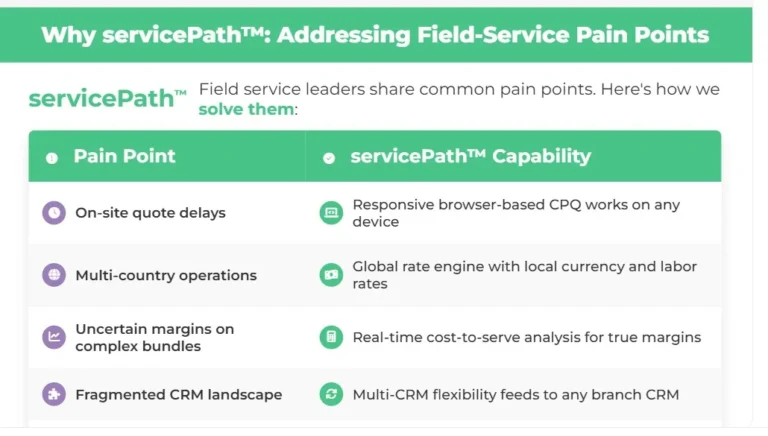
Field-service leaders often share the same pain points: quote delays, complexity, margin uncertainty, and fragmented systems. The table below summarizes how servicePath™’s capabilities map to these challenges:
Unlock Next-Level Revenue Performance with servicePath™
The shift toward unified revenue platforms is underway, and early adopters are securing durable advantages. Enterprises that move now will outpace competitors still relying on disconnected tools, while laggards risk ceding ground to more nimble, data-driven rivals.
Curious how servicePath™ can streamline your quoting process and drive revenue growth?
Read our latest insights: Dive deeper into unified revenue platform strategies, CPQ+ implementation best practices, and industry-specific transformation insights. Visit our insights library for technical architecture guides and strategic planning frameworks.
Download our case studies: See real-world results from organizations that have transformed their revenue operations with servicePath™. Learn how MSPs, technology companies, and system integrators achieved measurable improvements in quote-to-cash velocity, deal profitability, and operational efficiency.
Access our research library: Get comprehensive research on unified revenue platform trends, implementation strategies, and industry benchmarks. Our whitepapers provide the data-driven insights you need to build compelling business cases.
Need a quick definition? Browse the servicePath™ CPQ Glossary for clear, no-fluff meanings of every term. Open glossary
Book a demo: Experience how servicePath™ unifies your revenue operations without disrupting your existing systems. See firsthand how our composable CPQ+ platform integrates with your CRM, billing, and analytics tools to create a single source of commercial truth.
Frequently Asked Questions about AI-native CPQ for Field Service
1.What is the difference between traditional CPQ and AI-native CPQ?
Traditional CPQ automates product configuration and pricing based on static rules. AI-native CPQ ingests live operational data (sensor readings, inventory, regulatory requirements) and applies machine-learning models. This results in quotes that reflect real-time asset conditions and predictive cost estimates, reducing planning time and boosting equipment uptime.
2. How does AI-native CPQ improve first-time-fix rates?
First-time-fix rates improve when technicians arrive with the right parts and knowledge. AI-native CPQ integrates with predictive maintenance models that forecast component failures and suggest appropriate parts kits, reducing breakdowns and maintenance costs.
3. Will an AI-native CPQ work with my existing ERP and CRM?
Yes. servicePath™’s integration hub uses open APIs and pre-built connectors to pull data from SCADA, EAM, ERP, and CRM systems. Quotes can be generated in servicePath™ and synchronized back into your existing systems without forcing a rip-and-replace migration.
4. How do AI-based guided selling recommendations work?
Guided selling uses question-answer workflows, customer data, and AI to suggest the most relevant products and services. In field service, this helps technicians present IoT monitoring bundles, extended warranties, and preventive maintenance schedules tailored to each customer.
5.What ROI can field-service organizations expect?
Outcomes vary with baseline processes and service complexity. On average, organizations see 35-60% reductions in quote-to-cash cycle time, 15-25% increases in onsite upsell revenue, and 8-12% improvements in first-time-fix rates.
6. Is the AI explainable and compliant?
servicePath™ prioritizes transparency. Pricing models and recommendations are traceable, and compliance rules are codified based on OSHA, ISO 55000, and regional labor regulations. Quotes include clear breakdowns of parts, labor, and margin.
7.What if our organization already has a CPQ?
servicePath™’s AI-native CPQ can coexist with existing systems, handling complex field-service quotes while simpler quotes remain in the legacy tool. Alternatively, a phased migration can replace the old CPQ once data and processes are mapped.
8.What happens if regulations change?
The platform maintains a library of regulatory rules that can be updated centrally. AI models ingest these updates and automatically adjust quoting rules, ensuring compliance as regulations evolve.
Ready to Transform Your Field-Service Revenue?
The field-service landscape is changing fast. With predictive maintenance delivering productivity improvements of up to 25% and reducing breakdowns by 70%, and AI-powered tools raising equipment uptime while cutting downtime, FSOs that delay digital transformation risk falling behind competitors. Slow quoting is more than an operational nuisance—it’s a strategic vulnerability. Customers expect on-demand service bundles and transparent pricing, while investors expect reliable revenue growth.
Fulcrum’s July 2025 agentic AI announcement highlights the future of hands-free, AI-guided fieldwork. In this future, quotes will be generated automatically by systems that understand every asset, contract clause, and local regulation. servicePath™’s AI-native CPQ is built for this era. By uniting asset intelligence, predictive analytics, and dynamic pricing in one responsive interface, it helps FSOs move from reactive quoting to proactive revenue generation.
Call to Action
If your team is still sending quotes after the truck has rolled back to the depot, now is the time to act. Book a Field Service Revenue Diagnostic with servicePath™ and see a compliant, margin-optimized quote generated before your next truck rolls. We’ll analyze your current quoting process, integrate live asset and inventory data, and demonstrate how an AI-native CPQ can unlock double-digit revenue growth while protecting your margins. Don’t let slow quotes kill your profits—transform your field-service operations from work order to win.
Book Your Field Service Revenue Diagnostic →
servicePath™ is the AI-native CPQ platform purpose-built for complex field service environments. Trusted by leading FSOs worldwide, servicePath™ transforms quoting from bottleneck to competitive advantage, enabling organizations to deliver superior customer experiences while maximizing operational efficiency and profitability.