From Fragmentation to Intelligence: Why CPQ Is the Core System of Record for AI-Driven Enterprises
Discover how CPQ systems like servicePath™ unify data silos, fuel AI efficiency, and drive revenue growth. Essential insights for senior executives navigating AI-driven transformation.

Executive Summary
In today’s fast-paced market, fragmented data undermines efficiency, inflates costs, and hinders AI’s potential. This blog explains why CPQ (Configure, Price, Quote) solutions are crucial for consolidating data, powering intelligent decision-making, and automating revenue workflows. Modern platforms like servicePath™ not only streamline quoting but also integrate Cost of Serve analysis through their Advanced Pricing Engine (APE), delivering deep financial insights that protect margins and accelerate growth. Senior executives will discover how unified data and real-time analytics drive better forecasting, resource allocation, and overall business agility.
The SaaS Sprawl To Wake-Up Call
When Klarna cut 1,200 SaaS apps—including Salesforce—it wasn’t rejecting technology. It was redefining it. The message was clear: fragmented systems create fragmented outcomes. While Klarna’s specific context involved large-scale SaaS consolidation, any organization—regardless of size or industry—can relate to the chaos of too many disconnected tools.
The bigger issue isn’t the software itself but data fragmentation. Redundant apps, siloed processes, and inconsistent metrics all undermine efficiency and collaboration. As AI becomes essential for competitive advantage, it needs structured, unified data to produce reliable insights. That’s where CPQ (Configure, Price, Quote) solutions come in. Traditionally seen as a quote-generation tool, modern CPQ platforms—such as servicePath™—are emerging as the operational backbone for AI-driven enterprises. They centralize product catalogs, pricing models, and contract data, enabling organizations to move from chaos to clarity.
This blog explores why CPQ is vital for consolidating data, enabling AI success, and driving scalable growth—from smaller businesses to global tech giants and Managed Service Providers (MSPs). We’ll also dive deep into how advanced cost analysis—embodied in servicePath™’s Advanced Pricing Engine (APE)—reinforces financial intelligence, improves pricing accuracy, and transforms revenue operations into a true system of record.
The Problem: Data Silos Are Killing Your AI Potential
A 2023 Forrester report found that 89% of organizations struggle with data silos, costing mid-sized companies up to $2.5 million annually in lost productivity. More recently, 2024 IDC research confirms that fragmented data continues to hamper business agility and digital transformation. These silos aren’t just an IT headache—they create strategic liabilities that affect everything from sales velocity to customer retention.
Why It Matters for AI and Growth

Real-World Impact:
- A global manufacturing firm reduced quote errors by 52% after consolidating pricing rules with CPQ.
- A healthcare provider cut contract processing time by 40% by replacing manual workflows with CPQ automation.
When data is fragmented, even the best AI strategies falter. A single source of truth is essential—not only for automating quotes but also for analyzing cost structures that protect profitability.
CPQ as Your Single Source of Truth
Modern CPQ systems, exemplified by servicePath™, do far more than simplify quoting. They address three critical challenges:

1. Unify Data
CPQ platforms consolidate product catalogs, discount policies, and contract terms under one digital roof—ending the reliance on tribal knowledge and scattered spreadsheets. Collaboration improves and decision-making accelerates when every team works from the same unified dataset.
2. Structure for AI
By enforcing data accuracy, consistency, and context, CPQ platforms like servicePath™ provide a reliable foundation for AI engines. Structured data drives accurate forecasting and dynamic pricing models—a key insight from Gartner’s latest CPQ reviews.
3. Automate Revenue Workflows
CPQ systems streamline tasks like dynamic pricing, proposal generation, and renewal management. This automation reduces manual errors and accelerates growth, while also scaling operations as your business expands.
Ending Tribal Knowledge with Unified Data
“Tribal knowledge”—undocumented expertise locked in employees’ heads—can silently undermine profits. CPQ platforms eliminate this by:
- Centralizing Product & Pricing: No more scattered spreadsheets or outdated messages.
- Automating Approval Flows: Consistent governance ensures discounts, terms, and compliance rules are enforced automatically.
Example: A Fortune 500 tech company eliminated over 300 separate pricing spreadsheets, reducing new-sales onboarding time by 30%.
Clean Data Fuels Reliable AI
CPQ ensures AI systems are powered by high-quality data:
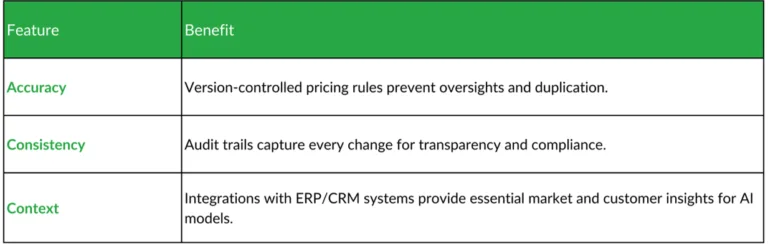
Case Study: Cisco integrated CPQ with its AI engine to adjust pricing in real time based on demand, boosting margins by 8% in competitive deals.
Automating the Revenue Engine
CPQ is not just about efficiency—it’s about scalability:
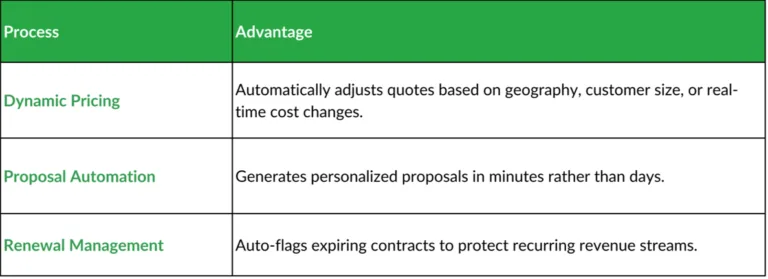
Result: One SaaS company using servicePath™ reduced its sales cycle from 14 days to 5, attributing 25% of new revenue to faster deal closures.
Maximizing Financial Insights with Cost of Serve—Elevating Your CPQ+ to a True System of Record
Understanding the true cost of delivering a service is crucial for safeguarding profitability. This is where servicePath™’s Advanced Pricing Engine (APE) significantly enhances your CPQ system by integrating detailed Cost of Serve analysis.
1. Why Cost of Serve Matters More Than Ever
A CFO’s Perspective
For many CFOs, “Cost of Serve” is more than just another metric—it’s a financial lifeline. Without accurate insights into service delivery costs (personnel hours, third-party fees, software licenses, hardware expenses), it’s nearly impossible to gauge a deal’s true profitability. According to 2024 IDC findings, organizations that integrate unified cost analysis are 35% more likely to improve their margins in complex service environments.
Key Benefits:
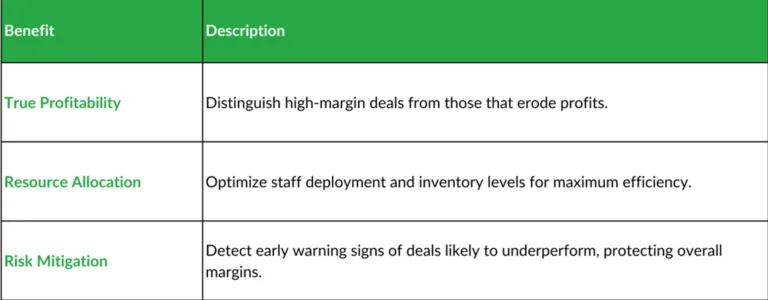
In an era of subscription-based revenue and multi-year service contracts, ignoring Cost of Serve can lead to costly surprises and unpredictable ROI.
2. Introducing servicePath™ CPQ+ APE: The Cost of Serve Game-Changer
servicePath™ CPQ+ consolidates product catalogs, pricing rules, and contract data into one authoritative system. APE (Advanced Pricing Engine) builds on that foundation by adding dynamic pricing, detailed cost analysis, and robust demand forecasting.
How It Works
- Granular Cost Breakdown
APE dissects each deal to reveal exactly which components (hardware, licensing, support hours) contribute to overall cost. This helps teams assess deal health long before finalizing proposals. - Integration with Existing Data
By syncing with CRM, ERP, and other financial systems, APE automatically pulls relevant cost structures and usage data, ensuring your pricing engine operates with full context. - On-the-Fly Adjustments
In volatile markets, APE recalculates cost parameters in real time, preventing outdated assumptions from creeping into quotes. - Deal Dashboard Visualization
APE’s Deal Dashboard offers color-coded indicators for IRR (Internal Rate of Return), NPV (Net Present Value), and payback periods. This quick-view interface lets CFOs and deal teams spot any subpar or “suspicious” deals that might undercut margins or strain resources.
Real-World Scenario (Enhanced with Key Questions)
Imagine your organization has 50 active quotes, each requiring 200 servers. APE aggregates these requirements, highlighting a total need for 10,000 servers—helping you forecast inventory demands with precision. Meanwhile, the Deal Dashboard calculates IRR, NPV, and payback for each prospective contract.
Critical Questions:
 IRR Threshold: “Does each deal’s IRR meet our corporate benchmark?”
- NPV Across the Portfolio: “Are we generating sufficient net present value across all deals?”
- Payback Period: “How soon can we recoup our capital investment?”
- Cash & Infrastructure: “Do we have enough investment capacity to finance 10,000 servers? Are there enough racks, cables, and data center floor space?”
 IRR Threshold: “Does each deal’s IRR meet our corporate benchmark?”
If a deal’s IRR is subpar or its payback period extends beyond your tolerance, the system flags it. Finance might then adjust vendor terms, or sales could renegotiate line items. Operations can verify whether they truly have the racks and cables to support this expansion—or if the cost of expansions is feasible given the deals’ projected returns.
Result:
- Financial Health: Deals align with IRR/NPV thresholds—no more hidden unprofitable contracts.
- Data-Driven Confidence: Stakeholders see exactly why 10,000 servers might be needed, supported by payback analytics.
- Proactive Decision-Making: Suspicious deals (e.g., excessive hardware fees, uncertain ROI) are flagged, protecting the bottom line.
Deep-Dive: How Cost of Serve Transforms Key Business Functions
A. CFO & Financial Teams: Data-Driven Profitability Checks
For CFOs and finance teams, understanding the full cost of service delivery is critical. With servicePath™ CPQ+ APE, organizations gain granular insights into every expense—from hardware to labor—enabling a comprehensive look at both CAPEX (capital expenditure) and OPEX (operating expenditure).
Key Benefits:
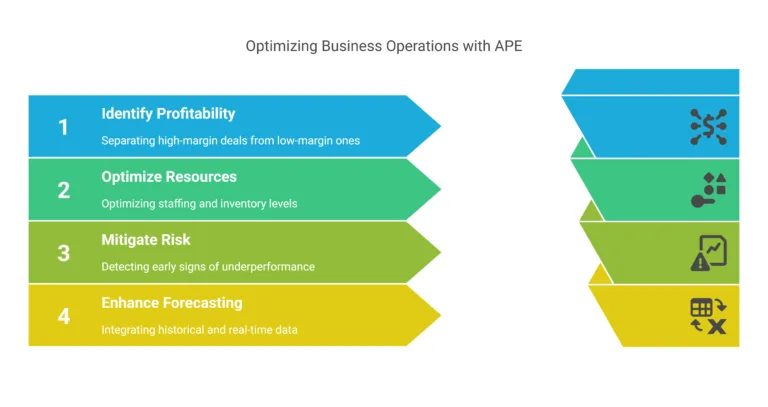 True Profitability: Separate high-margin deals from those that erode profits. APE’s cost breakdown ensures CAPEX and OPEX are visible.
- Resource Allocation: Optimize staffing and inventory levels by clearly identifying recurring operational costs versus one-time capital investments.
- Risk Mitigation: Detect early warning signs of underperforming deals. Detailed cost-of-serve data pinpoints potential overspending—whether in CAPEX or OPEX—and triggers corrective action.
- Enhanced Forecasting: APE integrates historical data with real-time cost adjustments, ensuring both CAPEX and OPEX are factored into your financial model.
Example:
One technology services company using servicePath™ CPQ+ APE identified a hidden infrastructure fee significantly inflating their CAPEX. After renegotiating vendor contracts, they not only boosted profit margins but also lowered ongoing OPEX. The CFO then recalibrated the company’s overall investment strategy for better IRR and payback alignment.
B. Operations & Supply Chain: Demand & Inventory Clarity
 Aggregated BOMs (Bills of Materials)
APE tallies pending quotes across all teams, revealing the total demand for large-scale hardware or components—servers, racks, cables, or even forklift drivers for logistics. This granular visibility prevents guesswork and ensures precise resource planning.-
Capacity & Infrastructure Checks
Beyond raw numbers, APE highlights infrastructure readiness: Do we have enough floor space or rack capacity in data centers? Enough cables for expansions? If forecasted demand outstrips current capacity, the system flags potential bottlenecks so supply-chain managers can secure additional resources in advance. -
Probabilistic Weighting
Not every quote has the same likelihood of closing. APE applies probability-of-closure data to refine forecasts, preventing overcommitment on deals that may not materialize. -
Inventory Efficiency
Managers can place bulk orders or adjust stock levels to avoid shortages or excess. If 50 quotes each require 200 servers, the system projects 10,000 servers—but also weighs IRR, NPV, and payback for the capital outlay. This dynamic approach addresses any “suspicions” from finance or operations about overordering or tying up capital in underutilized equipment.
 Aggregated BOMs (Bills of Materials)
Example:
If 70% of those 50 quotes are likely to close, APE might suggest an initial 7,000 servers. CFOs can see how soon they might recoup that investment via payback metrics, while operations verify they have enough racks, cables, and space to accommodate the surge. This synergy ensures a perfect balance of cost and capacity.
C. For Sales & Account Teams: Confident, Profitable Deals
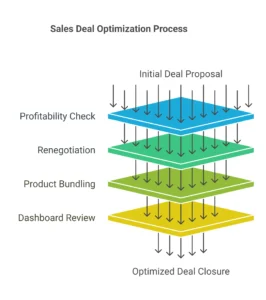
- Real-Time Profit Checks & Deal Governance
Sales reps see if each deal meets IRR, NPV, and payback thresholds before finalizing. If the system flags subpar IRR or a drawn-out payback, reps can renegotiate line items or adjust discount structures. -
Guided Bundling
APE’s intelligence suggests complementary products or services that maintain margins while adding genuine value for the customer. If a standard hardware bundle lacks a profitable maintenance plan, the system recommends including it—provided it doesn’t push payback beyond acceptable limits. -
Deal Dashboard Visibility
The same dynamic dashboard used by finance also benefits sales teams. It reveals how close a deal is to margin thresholds, IRR benchmarks, and how quickly it can generate positive cash flow. This keeps reps from pushing deals that might strain capacity or lock the company into questionable payback timelines.
Win-Win
Sales teams focus on value-added selling rather than guesswork, while customers receive transparent, accurate quotes that clearly show cost alignment with benefits. The integrated IRR/NPV/payback data also builds trust: it demonstrates that your organization has both the infrastructure capacity (racks, cables, data center space) and financial stability to deliver without hidden fees or last-minute resource shortfalls. Ultimately, both sides gain confidence—customers see the ROI of their investment, and your company secures deals that align with operational feasibility and long-term profitability.
From Quotes to Governance: Making CPQ+ a True System of Record
Data fragmentation remains a major challenge—especially when organizations rely on spreadsheets or disconnected solutions. By centralizing deals, costs, approvals, and multi-year contract terms in servicePath™ CPQ+, you create a single, auditable source of truth.
 Financial Intelligence
 Financial Intelligence
- Instant P&L Snapshots: CFOs can quickly view projected margins and net profit once deals are approved.
- Portfolio Analysis: Identify which deals or product lines drive the most value—and which need reevaluation.
Governance & Compliance
- Audit Trails: Every cost change and pricing tweak is logged, simplifying regulatory compliance.
- Approvals & Thresholds: Multi-tier governance rules ensure no unprofitable or suspicious deal slips through.
The AI Advantage: Turning Data into Strategy
CPQ systems like servicePath™ enable your organization to convert raw data into actionable strategies.
Predictive Insights for Smarter Decisions
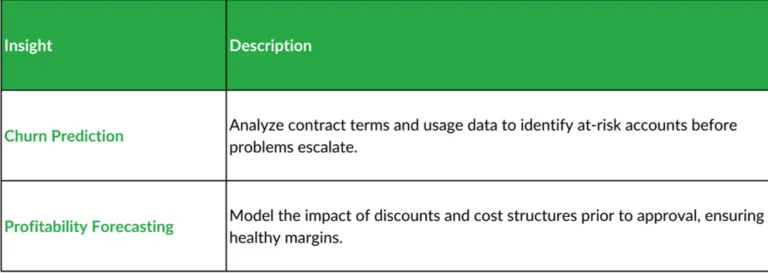
Case Study:
A cybersecurity provider reduced churn by 15% in one quarter by leveraging CPQ-driven AI insights, as reported in a 2024 Gartner study.
Real-Time Market Adaptability
- Dynamic Adjustments: AI-powered CPQ instantly modifies pricing in response to market or supply-chain shifts.
- Tailored Bundling: Real-time recommendations on complementary products maximize margins.
Example:
During a supply-chain crisis, a hardware manufacturer rerouted inventory using CPQ’s dynamic logic, avoiding $4 million in delayed orders.
Empowering Teams with AI Co-Pilots
- Proposal Drafting: AI tools generate near-final proposals using pre-approved templates and real-time pricing data.
- Upsell Alerts: Sales teams get instant suggestions for upsell opportunities, driving larger deals and better margins.
Overcoming Implementation Challenges
Despite the clear ROI, adopting CPQ and integrating cost-of-serve analysis can be complex. Here’s how to ensure a smooth transition:
-
Start Small, Scale Fast
Focus on high-impact areas—like multi-year service contracts—then expand. -
Ensure Data Hygiene
Validate item costs, vendor fees, and overhead rates before integration. -
Involve Finance Early
CFOs and finance teams must shape the cost data to align with forecasting and margin goals. -
Automate Approvals
Implement tiered workflows so no deal is approved without meeting margin thresholds. -
Iterate and Refine
Continuously update cost assumptions and forecasting models. The more accurate your data, the more reliable your AI insights.
Example:
Microsoft achieved 90% user adoption in six months by rolling out CPQ in phases and linking training to sales performance metrics.
The Future of CPQ: AI, Subscriptions, and Beyond
As markets evolve, CPQ systems must adapt to new demands. IDC and Gartner (2024) predict that by 2025, 80% of software products will be subscription-based. servicePath™ excels in this area by:
- Managing Tiered Pricing & Usage Thresholds: Automate renewals and upsell triggers to maintain margins.
- Generative AI Integration: Tools like ChatGPT can streamline proposal drafting and self-optimize pricing based on real-time market data.
These innovations ensure your CPQ system remains a critical competitive advantage in a rapidly evolving landscape.
The Bottom Line for Senior Executives
Klarna’s transformation isn’t about ditching technology—it’s about strategic prioritization. In a fast-paced environment where complexity and rapid change are the norms, CPQ systems are not optional—they’re essential. For organizations managing complex deals and dynamic revenue models, CPQ systems like servicePath™ deliver:
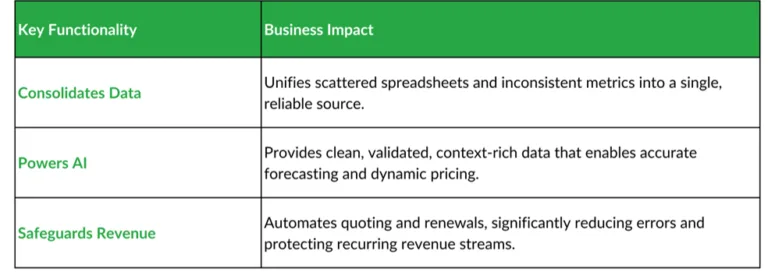
Reflect on These Critical Questions:
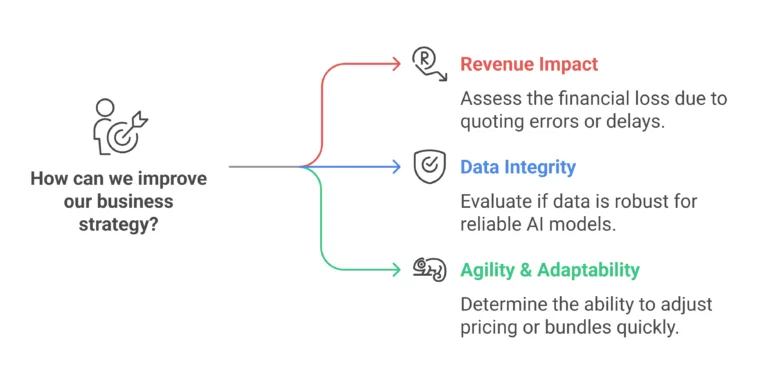
- Revenue Impact: How much revenue are we losing due to quoting errors or delays?
- Data Integrity: Is our data robust enough to feed reliable AI models that guide strategic decisions?
- Agility & Adaptability: Can we quickly adjust pricing or product bundles to match shifting market demands?
If these questions raise concerns, it’s time to act.
Final Takeaway
From Klarna’s consolidation lesson to the rise of AI-driven pricing, CPQ is at the heart of the modern revenue engine. If you’re ready to leave behind scattered data and harness AI effectively, now is the moment to embrace CPQ and transform complexity into a streamlined, future-ready advantage.
By integrating granular Cost of Serve insights via servicePath™ CPQ+ APE, you not only centralize your product and pricing data—you empower finance and operations with the clarity needed to drive profitable growth. This unified system of record converts disjointed information into actionable intelligence, fueling smarter decisions across your organization.
Experience the servicePath™ Advantage
servicePath™ is recognized as a three-time visionary in the Gartner Magic Quadrant and has earned accolades from IDC for its innovative CPQ solutions.
Ready to Transform Your Revenue Engine?
- Read Our Blogs: Stay updated with the latest insights on CPQ, digital transformation, and AI-driven pricing.
- Download Case Studies: Explore real-world examples of how servicePath™ drives efficiency and revenue growth.
- Contact Us for a Complimentary Consultation: Get a personalized ROI analysis tailored to your business.
- Book a Demo: Experience servicePath™ CPQ+ APE in action and see firsthand how it can revolutionize your data, pricing, and revenue operations.
Take the Next Step Today:
Transform your data into intelligence and secure a competitive edge in the age of AI with servicePath™.
Citations & Sources
- Forrester (2023) – Data Silos and the Productivity Gap. Forrester Research.
- IDC (2022) – Subscription and Usage-Based Pricing Trends. IDC Research.
- IDC MarketScape (2024) – Worldwide Configure, Price, Quote Applications for Commerce 2024–2025 Vendor Assessment. IDC.
- Gartner Peer Insights (2025) – Reviews and ratings of CPQ applications. Gartner.
(All client examples and financial figures are based on aggregated industry data and anonymized research from reputable sources to ensure accuracy and confidentiality.)