
What is CPQ?
Accelerate Growth with servicePath™: The CPQ Platform Trusted by Market Leaders.








What is CPQ?
CPQ (configure, price, quote) is software that helps sales teams build accurate quotes for complex deals. A CPQ system, or CPQ solution, checks that the products and services in a deal fit together, applies the right prices, discounts and approvals, and produces the proposal the customer signs.
What does CPQ stand for?
CPQ stands for configure, price, quote, the three steps every quote goes through:
- Configure: choose the products and services that fit the customer’s needs, using rules that stop invalid combinations.
- Price: apply price books, discounts, terms and approval thresholds so every quote is priced consistently.
- Quote: generate the proposal document, route it for approval and signature, and hand the order on to delivery and billing.
What does CPQ mean in sales?
In sales, CPQ means the process and the system a team uses to turn a customer’s requirements into a priced, approved quote. Without it, complex quotes are usually built in spreadsheets, which is slow and lets pricing errors and margin leakage slip through.
What is CPQ software?
CPQ software is the application that runs configure, price and quote in one place. It usually works alongside a CRM such as Salesforce, Microsoft Dynamics 365 or HubSpot, where the opportunity lives. For technology service providers, CPQ software also has to handle hardware, software, cloud, connectivity and managed services from many vendors, priced over multi-year terms, with cost and margin visible on every quote line. That is the problem servicePath™ CPQ+ is built for.
What is a CPQ system, and how does it work?
A CPQ system holds three things: a product and service catalogue with the rules for what can be sold together, pricing logic (price books, discounts, margin floors and approval thresholds), and document templates. A seller, or a buyer in a self-service portal, picks what the customer needs. The system checks the configuration, applies the pricing, routes any exception for approval and produces the quote. It takes account and opportunity data from the CRM and passes the approved order on to billing and ERP.
CPQ or spreadsheets for enterprise pricing?
Spreadsheets work while the catalogue is small and one person owns pricing. They break down when deals mix products, services and multi-year terms, when several teams quote, or when finance needs to see who approved a discount and why. At that point a CPQ system replaces copied price lists with one governed set of rules, so every quote is priced the same way and every exception leaves an audit trail.
CPQ in Salesforce
CPQ in Salesforce means configure, price, quote functionality that runs inside or alongside Salesforce: either Salesforce’s own product or a third-party CPQ that integrates with it. Salesforce stopped selling Salesforce CPQ to new customers in 2025 (end of sale, not end of life), so many teams are reviewing their options. See CPQ in Salesforce and Salesforce CPQ alternatives.
CPQ technology has been around since the 1980s. It started with a configuration system, or “configurator”, whose role in sales was that it enabled customers to choose their specifications.
Fast forward to today, the CPQ technology has evolved in every way imaginable. But what is CPQ?
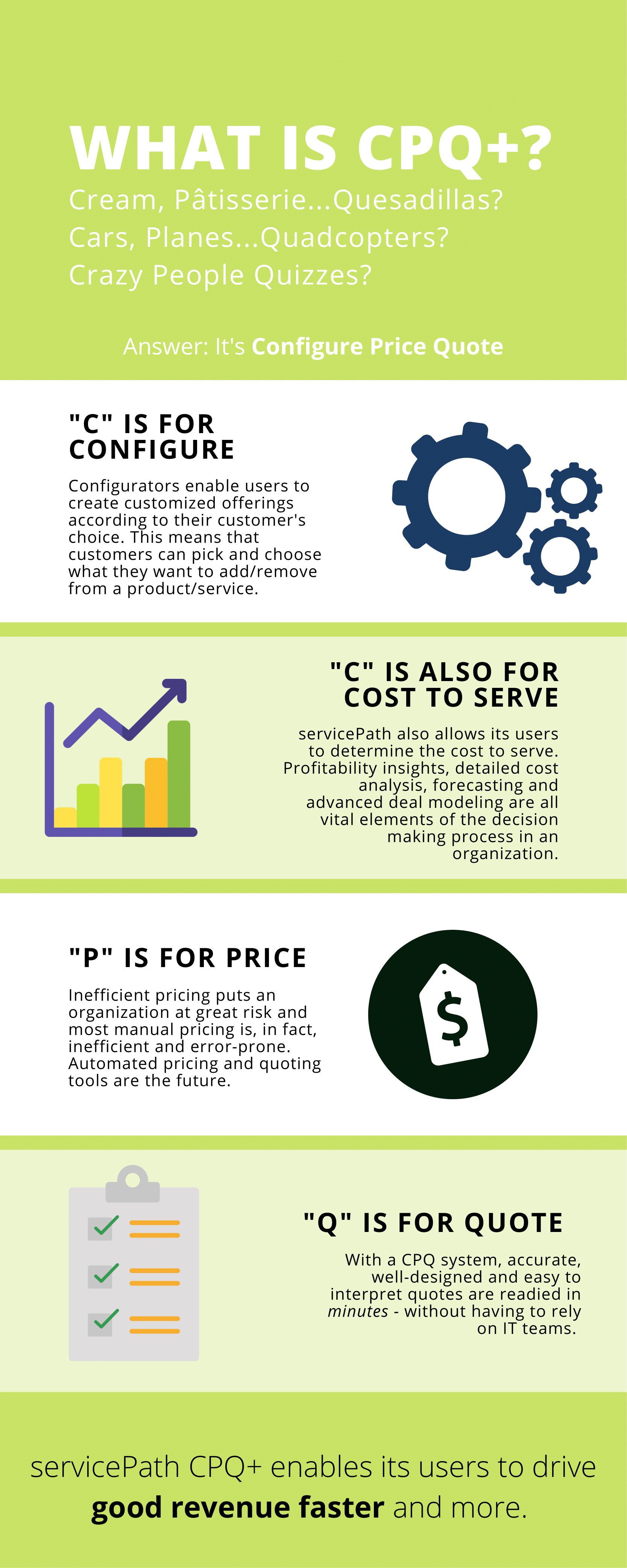
Configure: The procedure of comprehending and packing a company’s product and service options. Tailored to the customer’s specific needs, whilst considering company policies and domestic/international regulations.
Price: Affected by a magnitude of factors; customer relationship, industry dynamics, economic conditions, as well as production volumes and bundles.
Quote: Amendments, renewals, and generation requires the internal approval of the quote, creating professional proposal documents, and having a process in place to quickly accept a client and amend or renew an order. A CPQ system can improve the speed and accuracy of this process massively.
CPQ is a sales enablement tool for companies to
quickly and accurately generate quotes for orders
CPQ (Configure Price Quote) is a sales enablement tool for organizations to quickly and most importantly, accurately, generate quotes for orders. This automated quoting mechanism is designed to enable the sales team to sell better and make good revenue, faster.
CPQ applications often work coupled with CRM platforms, ERP programs, and other business technology, which enables the systems to work with integrated data and accuracy.
Sales reps spend a large part of their week on work that is not selling. Where does that time go?
They’re generating quotes and proposals and gaining approvals.
What does CPQ do for your business?
- Larger, more complete deals, because guided selling surfaces the right products, services, and add-ons
- Better conversion, because buyers get accurate, professional quotes while they are still engaged
- More reps reaching quota, because less of their time goes on admin
- Faster quotes, because configuration and pricing rules are built in
- Shorter approval cycles, because deals route automatically to the right approver
- A faster path from quote to cash, because quote data flows into orders and billing
- Fewer pricing and configuration errors, because the rules check every quote

Having a correctly implemented CPQ system can help you achieve your business goals in numerous ways
Signs you need CPQ software
You may consider your current sales quote generation to be adequate. However, look out for the signs your organization needs a CPQ implementation:
- You’re sending out inaccurate quotes
- You rely on spreadsheets and legacy systems
- Your sales reps aren’t spending their time selling
- You’re providing lacklustre customer experiences
- You’re not taking cross and upsell opportunities
- You still use face-to-face approvals
- Your sales cycle is slow
Benefits of CPQ
- Worry-Free Deal Making: Automated workflows ensure your customer’s needs are accurately captured and matched with appropriate solution components. Breathe easy knowing that your team is always quoting valid and the most up-to-date configurations.
- Requirements Wizards guide the capture of customer needs
- Pre-set solution components automatically matched to requirements
- Proper approvals followed each and every time
- Sell Faster. Sell More: Pulling together complex technology and service quotes is challenging. Get rid of your spreadsheets and simplify the entire process with servicePath™. Slam the door shut on competitors by responding with quotes in minutes vs days. Wow your prospects and renewal customers with timely information.
- Quotes in Minutes
- Right price the first time
- Leave nothing on the table
- Complete Deal Transparency: Get complete visibility to the financials of every quote and track the entire history of each deal. See your overall deal flow and potential impact on operations through servicePath™’s dashboards.
- Instantly see margins, unit costs and discounts on every deal
- Track all deal activity from initial conversation to final close
- React faster to changing business and market place conditions
What analysts say CPQ improves
- Increase productivity of sales team and back-office functions by automating the sales process
- Optimize quotes and discounting to improve profit margins
- Increase revenue from guiding sales to opportunities for cross-selling complementary products and services
- Create efficient, accurate, and tailored sales processes that improve the sales experience, thus enhancing the sellers brand, which improves their conversion ratio and opportunities for repeat business
- Streamline processes, while also ensuring that sales teams are meeting company compliance policies and regulatory
“The immediate outcome of developing an automated CPQ process with a unified set of business processes is significantly increased productivity for a company’s sales team, allowing its sales reps to focus on selling, instead of administrative tasks”, Gilles Muys, VP of Customer Solutions, Simplus.
How a CPQ system handles complex pricing
It does this by empowering the user to:
- Phase the implementation of different services and being able to make changes to those product/service groups, for example, you can defer the start, you can terminate a service coming maybe a little bit further on and you can also make pricing and cost adjustments.
- View all the products, all the pricing in centralized system as a grid view. The user doesn’t have to navigate throughout the quote, each individual configured product and sub components within. They’ve got it all in one place.
- Manually enter the varying quantities for each respective period (month).
With servicePath™’s Advanced Pricing Engine’s advanced features and functionality, complex pricing is no longer complex.
A best of breed system’s cost to serve analysis capabilities allow the user to understand quickly the detailed impact of pricing, discounting and configuration modifications. Previously, organizations would have to resubmit modified quotes and configurations back to the pricing teams, sales and tech operations, to understand if the deal was still profitable for the organization. This process is time-consuming and expensive and reduces the chances of winning a deal as it prolongs the time to close. However, it is an important process because if a deal has changed significantly in margin, price or configuration, it can cost the organization millions of dollars, reputational risk and jeopardize the viability of the organization. Embedded cost of serve analysis allows for this to be done quickly and make informed decisions with confidence that enable you to win good revenue.
Renewals no longer take days and rows and rows of work, multiple quote iterations are generated within a few clicks.
Cost to serve
Analysis that calculates the profitability of products, customers and routes to market, and provides a fact-based focus for decision making on service mix and operational changes for each customer.
Deal modeling
Deal modeling includes the ability to be able to look at a quote through various filters that are important to an organization.
Who uses CPQ: sales, finance and operations
CEO: A CEO’s top priorities; Customer Acquisition, Business Performance Management and Corporate Development are all, in one way or another, largely contingent upon one of the core activities in any business, sales. “Sales is one of the core activities in any business. Without a good customer acquisition process, you can’t grow.”, Frank V. Cespedes, Lecturer of Business Administration, Harvard. Needless to say, a tool like CPQ that guarantees quote accuracy and speeds up selling is a valuable asset for any business.
VP of Sales: The VP of Sales often develops sales proposals and responds to customer inquiries and requests for proposals for high profile client accounts. The VP of Sales also ensures that employees in the sales department are equipped with the products like CPQ, that they require to succeed in their duties.
Sales Management/Operations: CPQ systems enable operations to reduce errors, protect margins, and effectively manage standardized contracts for profitability by:
- Reducing pricing and quoting errors through managing constraints and rules
- Formalizing change control processes
- Viewing and managing commissions in real-time
- Reducing risk and ensuring compliance Standardizing proposal management
- Building process efficiencies with workflow authorization and approval process.
- Maintaining approved contract repository
Customers: Sitting at the end of the spectrum, customers wholly enjoy the benefits of a CPQ system. When presented with quick and accurate quotes, you can turn around quick accurate quotes that have no errors and issues in them.
Marketing team: CPQ systems enable marketing teams to better enable sales enablement with more accurate marketing materials and value-based sales tools. Key benefits of CPQ solutions for marketing include:
- Providing branded proposal documents and contracts
- Ensuring all marketing documents have accurate up-to-date pricing and product configuration information
- Developing customer-facing product catalogs
- Providing sales playbooks that increase win rates
- Providing value-based sales tools like propositions, white papers, ROI/TOC calculators, and benefit estimators
CTO: Cares that it’s easy to use and implement by the sales team. Furthermore, it’s no-code/low-code so it doesn’t consume lots of their cycles. They also care that its future proof, meaning that if it’s agnostic of a CRM it gives the CTO the independence to move on and select the best solution and tools.
Channel Partner: CPQ systems allow companies to support, promote, and control the configuration and pricing through their distribution channels. This benefits the channel network by:
- Improving cross-channel visibility and management
- Enabling quick roll-outs of new products and pricing configurations locally and globally
- Streamlining channel order flow from lead to close
- Reducing errors by allowing users to centrally access, manage, and control offer and document content
- Tracking and measuring channel activity by product and price
- Protecting channel margins and preventing unauthorized discounting

What is the CPQ process? Step by step
Digital transformation and CPQ
The CPQ process covers everything from the first customer conversation to a signed quote and an order your delivery and billing teams can act on. In a CPQ platform, each step follows rules, so every seller quotes the same way.
- Capture requirements
- Configure the solution
- Price the deal
- Approve
- Generate the quote and proposal
- Accept and hand off
- Amend and renew
1. Capture requirements
Guided selling asks the right questions, so sellers record what the customer needs before choosing products.
2. Configure the solution
Rules allow only valid combinations of products, services and options, so nothing is quoted that cannot be delivered.
3. Price the deal
Pricing rules apply list prices, discounts, multi-period and usage-based pricing, and show cost to serve and margin on every line.
4. Approve
Deals and discounts outside agreed limits go to the right approver automatically, with a record of who approved what.
5. Generate the quote and proposal
The quote becomes a branded document with current pricing and terms, ready to send.
6. Accept and hand off
Once the customer signs, quote data flows into orders and billing. This is where the quote to cash process begins.
7. Amend and renew
Changes, co-terming and renewals start from the existing quote, so nothing is rebuilt from scratch.
servicePath™ CPQ+ works natively with Salesforce, Microsoft Dynamics 365 and HubSpot CPQ. ERP and billing systems connect through the API. Talk to a CPQ architect.
CPQ and digital transformation
Digital transformation should be at the forefront of every business’s organizational strategy, and is defined as “the adoption of digital technology to transform services or businesses, through replacing non-digital or manual processes with digital processes or replacing older digital technology with newer digital technology”
CPQ enables organizations to go from using old manual processes such as the ‘zombie’ spreadsheet to using automated processes. With this in mind CPQ goes hand in hand with digital transformation and for many organizations can be seen as the first step towards digitization. It’s understood that when organizations look to digitally transform a core benefit they want to reap is helping to support the sales team. Quote-to-cash is a sales employee’s best friend in the sense that it allows for quick, accurate quotes and this provides more time for selling and chasing leads.

Use this matrix to obtain information about key vendors that can help you build your CPQ.
