Agile Billing
Synonyms
- Adaptive Billing
- Dynamic Billing
- Flexible Billing
- Usage-Based Billing
What is Agile Billing?
Agile Billing refers to a flexible, adaptive approach to billing that allows businesses to manage complex pricing models, recurring revenue, and dynamic customer demands efficiently. It enables companies to quickly adjust pricing, subscriptions, and invoicing structures based on market changes, customer usage, or new business strategies.
How Agile Billing Works
- Automate subscription billing and recurring payments.
- Adjust pricing based on customer usage and demand.
- Offer multiple payment models, including tiered, metered, and pay-as-you-go.
- Integrate billing with CRM, ERP, and CPQ systems for seamless financial operations.
Example:
A SaaS company uses agile billing to charge customers based on actual product usage instead of a fixed monthly fee. If a customer consumes more resources than their base plan, the system automatically adjusts their invoice to reflect the additional usage.
Streamline Agile Billing & Revenue Management with servicePath™
Benefits of Agile Billing
- Faster Revenue Recognition – Automates invoicing and reduces payment delays.
- Scalability – Supports growing businesses with flexible pricing and contract structures.
- Improved Customer Experience – Provides personalized billing options that align with customer needs.
- Reduced Revenue Leakage – Ensures accurate billing and minimizes errors.
- Regulatory Compliance – Aligns with global accounting standards such as ASC 606 and IFRS 15.
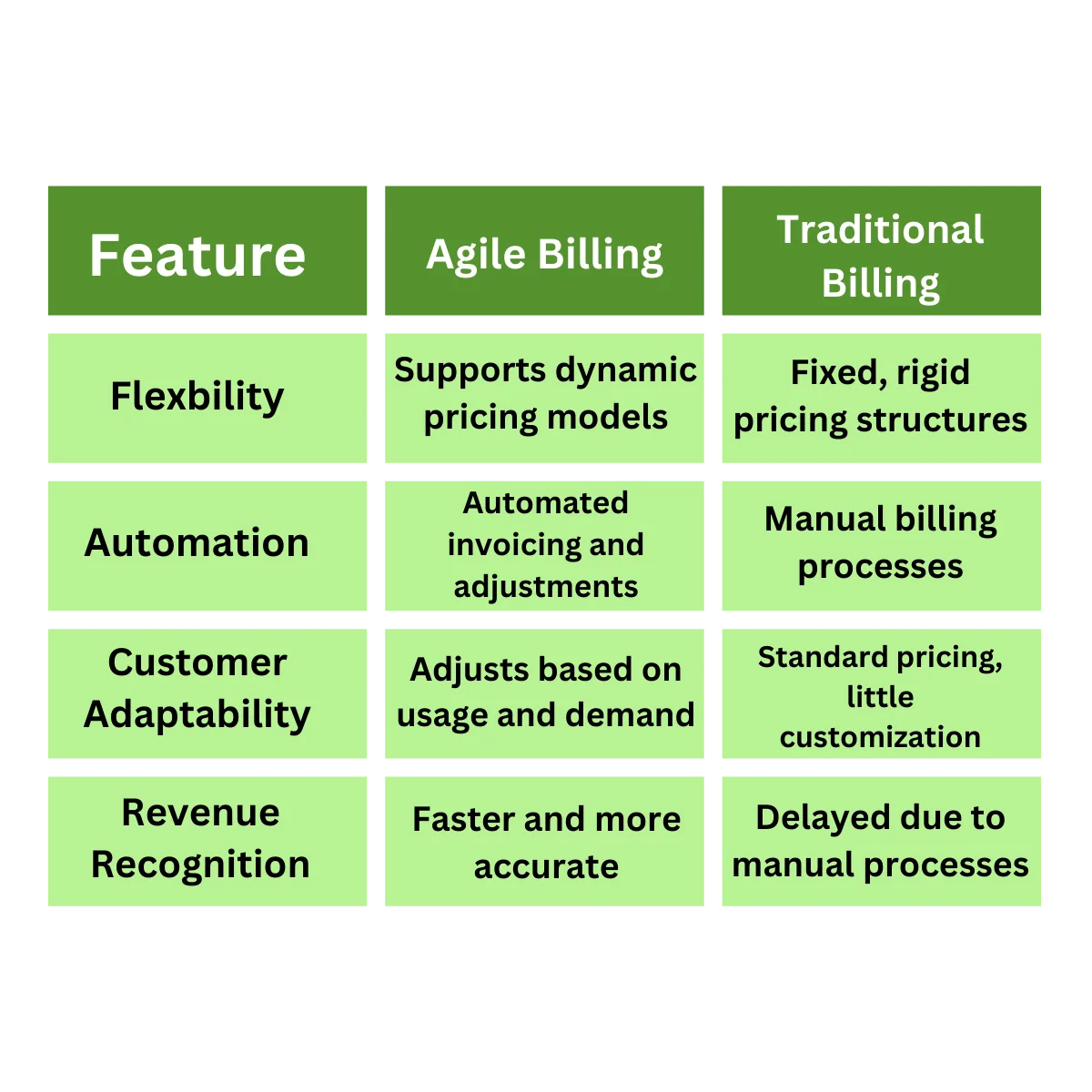
Agile Billing vs. Traditional Billing
Industries That Benefit from Agile Billing
- SaaS & Cloud Computing – Enables subscription-based and consumption-based pricing.
- Telecommunications – Supports tiered data plans, metered billing, and add-ons.
- Financial Services – Ensures compliance and flexible payment terms.
- E-commerce & Retail – Allows for on-demand pricing and personalized billing.
- Media & Entertainment – Manages streaming subscriptions and usage-based pricing models.
Challenges in Agile Billing
- Complex Pricing Management – Requires robust systems to handle multiple billing structures.
- Integration Issues – Must seamlessly connect with existing CRM, ERP, and financial software.
- Regulatory Compliance – Needs to align with global financial regulations to avoid misstatements.
- Customer Disputes – Dynamic billing may lead to billing discrepancies if not managed properly.
Best Practices for Implementing Agile Billing
- Use Cloud-Based Billing Systems – Automate and scale with demand.
- Ensure Transparent Pricing – Clearly communicate changes in pricing structures.
- Integrate with CPQ and ERP Systems – Connect billing with financial and sales workflows.
- Monitor Billing Analytics – Track revenue trends and customer behavior for better decision-making.
How servicePath™ Helps Optimize Agile Billing
servicePath™’s CPQ+ (Configure, Price, Quote) solution empowers businesses to:
- Automate Billing & Pricing Adjustments – Ensuring real-time accuracy.
- Enhance Revenue Forecasting – Data-driven insights for financial planning.
- Improve Subscription & Usage-Based Pricing – Seamless integration with various billing models.
- Ensure Compliance with ASC 606 & IFRS 15 – Standardized financial reporting for global operations.
Related Terms
- Subscription Billing
- Recurring Revenue
- Usage-Based Pricing
- Revenue Recognition
- Dynamic Pricing
- Billing Automation
Frequently Asked Questions (FAQs)
How does agile billing differ from traditional billing?
Agile billing adapts to dynamic pricing structures, while traditional billing relies on fixed, static pricing models.
Why is agile billing important for SaaS businesses?
What are the key components of an agile billing system?
How can businesses reduce billing errors in agile billing?
Driving Business Growth with Agile Billing
Agile Billing is essential for modern businesses that require flexible, scalable, and automated billing solutions. servicePath™’s CPQ+ solution helps organizations optimize their billing processes, improve revenue recognition, and enhance financial forecasting.
Ready to transform your billing strategy? Contact us today to learn how our CPQ software can drive revenue efficiency.