
The Unsung Hero of Sales Operations: Why CPQ and Billing Might Just Eclipse CRM – servicePath™
Discover why Configure-Price-Quote (CPQ) and billing platforms are becoming more critical than CRM alone for driving sales efficiency and revenue growth in modern B2B operations.
For over two decades, Customer Relationship Management (CRM) systems have dominated the conversation around sales operations excellence. Salesforce, commanding an impressive 20.7% market share in 2024, has successfully positioned CRM as the foundational pillar of modern sales organizations. Yet, as enterprise businesses grapple with increasingly complex product configurations, dynamic pricing models, and accelerated digital transformation demands, a paradigm shift is emerging.
The Configure, Price, Quote (CPQ) and Billing software market is experiencing unprecedented growth, projected to surge from $2.2 billion in 2022 to $7.3 billion by 2030 at a remarkable 17-20% compound annual growth rate. This explosive expansion reflects a fundamental truth: while CRM manages the relationship, CPQ and Billing systems drive the revenue.
This strategic analysis examines why forward-thinking enterprise leaders are recognizing CPQ and Billing solutions as the true revenue engines of modern sales operations, often delivering more immediate and measurable impact than CRM investments alone. The CPQ market has experienced explosive growth, reaching USD 1.7 billion in 2024 and projected to expand to USD 3.14 billion by 2025, representing a robust 16% compound annual growth rate according to Mordor Intelligence research.
The Hidden Champions of Revenue Operations
In the complex ecosystem of sales operations, where every process, tool, and decision impacts revenue, there exists an unsung hero that quietly orchestrates some of the most critical functions of the sales cycle. While Customer Relationship Management (CRM) systems get most of the attention and billing systems handle the final transaction, Configure-Price-Quote (CPQ) and billing platforms are rapidly emerging as the true powerhouses of modern sales operations.
The Foundation: Understanding CRM’s Role vs. Revenue Engine Requirements
Salesforce’s perspective on sales operations, as outlined in their comprehensive framework, correctly identifies CRM as essential for managing customer relationships, tracking deals, and optimizing sales team performance. CRM excels at answering the “who,” “when,” and “where” of sales operations—who are your customers, when should you engage them, and where are they in the buying journey.
However, for enterprise organizations with complex products and sophisticated pricing structures, the critical questions become “what” and “how much”—what specific solutions meet the customer’s exact requirements, and at what optimized price point. This is where traditional CRM capabilities reach their limitations, and specialized CPQ and Billing solutions demonstrate their strategic value.
Research from Valorx’s 2024 CPQ Statistics report reveals a striking reality: sales representatives spend only 34% of their time actively selling, with the majority consumed by administrative tasks, particularly pricing and proposal generation. This represents a massive opportunity cost that CPQ solutions directly address.
Beyond CRM: The Revenue Generation Imperative
CRM is Necessary but Not Sufficient
There’s no denying the importance of CRM in sales operations—91% of companies with 10+ employees now use a CRM system, and it remains the hub for contact management, sales forecasting, and pipeline tracking. But revenue doesn’t come from managing contacts alone. For companies with complex offerings, the friction often lies in moving from customer interest to a closed deal and ultimately to cash in the bank.
This is where the traditional CRM-centric view of sales operations shows its limitations. A CRM, on its own, isn’t designed to handle the intricate “configure, price, quote” process for complex products or the billing and revenue recognition that follows.
As one sales operations expert put it, just one part of the process functioning poorly can bring everything to a grinding halt… If you’re taking too long to get quotes out or your quotes are riddled with errors, it can put leads off.
The Pain Points of Manual Quoting and Disconnected Tools
It’s still common to find sales representatives using Excel or manual methods to configure deals and prepare quotes, even while the CRM houses the customer information. Imagine a sales team dealing with a huge product catalog, complex discount rules, region-specific pricing, and ever-changing bundles. Without a robust CPQ, the process typically involves error-prone spreadsheets, back-and-forth emails for approvals, and tedious data re-entry between systems.
This manual approach creates multiple critical pain points:
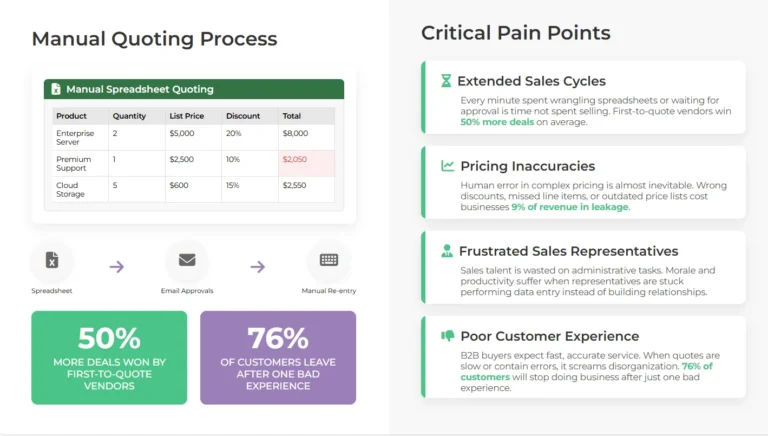
- Extended Sales Cycles: Every minute a representative spends wrangling pricing spreadsheets or waiting for approval is time not spent actually selling. Deals bog down in the quote stage. In fact, the first vendor to respond with a quote wins 50% more deals on average—a compelling statistic that underscores how slow quoting can directly translate to lost revenue.
- Pricing Inaccuracies and Revenue Leakage: Human error in complex pricing is almost inevitable when done manually. A wrong discount, a missed line item, or an outdated price list can erode margins or even sink a deal. Studies have found that quoting errors and scattered pricing data can cost businesses around 9% of revenue in leakage. That’s revenue left behind due to errors and inefficiencies.
- Frustrated Sales Representatives and Underutilized Talent: Salespeople are usually hired and paid well to build relationships and close deals, not to play the role of pricing analyst or data entry clerk. When representatives are stuck performing administrative tasks, morale and productivity suffer. This inefficiency means you’re effectively paying your sales talent to do work that automation could handle.
- Poor Customer Experience: Today’s B2B buyers expect fast, accurate, and personalized service. When a prospect requests a quote and you respond days or weeks later with a document riddled with errors or inconsistencies, it screams disorganization. According to research, 76% of customers will stop doing business with a company after just one bad experience. A botched quote or billing mistake qualifies as that kind of bad experience.
The Evolution of Sales Operations
The Strategic Backbone of Revenue Generation
Sales Operations teams have evolved from administrative support functions to strategic revenue enablers. They design and maintain the processes, tools, and data governance frameworks that allow every revenue-facing role—Sales, Marketing, Product, and Customer Success—to operate seamlessly and efficiently.
Modern Sales Operations teams own CRM hygiene, build sophisticated deal desks, optimize quoting workflows, and translate cross-functional needs into actionable strategies. They handle territory planning, forecasting accuracy, pipeline cadence optimization, and ensure that sales representatives can close deals faster and more predictably.
The Limitations of CRM-Centric Approaches
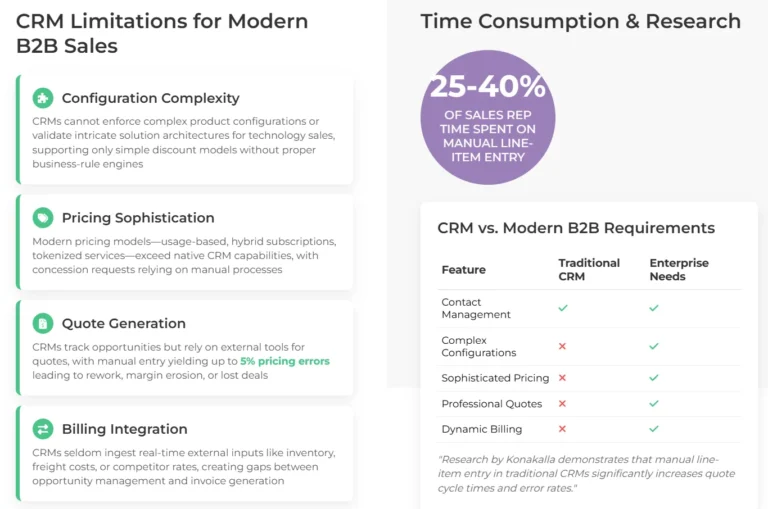
While CRM platforms like Salesforce, HubSpot, and Microsoft Dynamics 365 excel at centralizing contacts, opportunities, and customer interactions, they face significant limitations when it comes to the complex realities of modern B2B sales. Research by Konakalla demonstrates that manual line-item entry in traditional CRMs can consume 25-40% of a sales representative’s time, significantly increasing quote cycle times and error rates.
- Configuration Complexity: CRM systems cannot enforce complex product configurations or validate intricate solution architectures that characterize today’s technology sales. Traditional CRMs often support only simple flat, tiered, or volume-discount models, lacking the business-rule engines needed to enforce bundle eligibility, complex volume breaks, multi-currency margins, or customer-specific rates.
- Pricing Sophistication: Modern pricing models—usage-based, hybrid subscriptions, tokenized services, and dynamic discounting—exceed the native capabilities of most CRM platforms. When sales representatives request concessions beyond fixed thresholds, traditional workflows rely on manual email or ticketing, delaying approvals by days and reducing win rates.
- Quote Generation: While CRMs can track opportunities, they often rely on external tools or manual processes for generating accurate, professional quotes. Studies show that manual entry yields up to 5% pricing errors in B2B scenarios, leading to rework, margin erosion, or lost deals.
- Billing Integration: The gap between opportunity management and invoice generation creates friction, errors, and revenue leakage. CRM platforms seldom ingest real-time external inputs like inventory, freight costs, or competitor rates, so quotes can be outdated or margin-leaking.
The Market Reality: CPQ’s Explosive Growth Trajectory
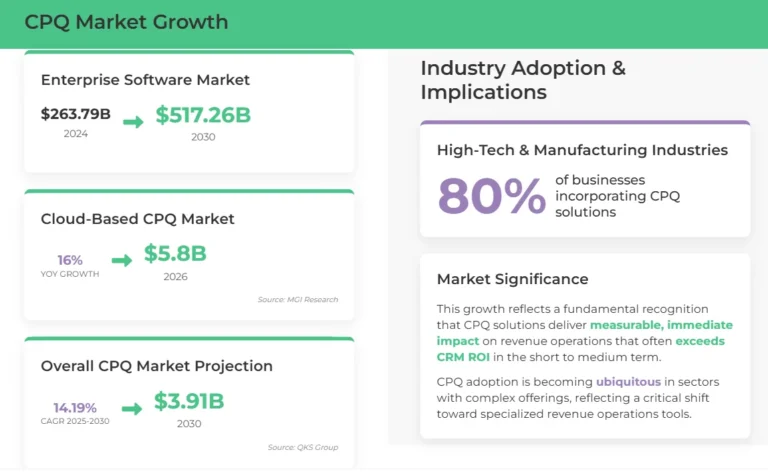
The enterprise software market is experiencing a notable shift toward specialized revenue operations tools. The global enterprise software market, valued at $263.79 billion in 2024, is projected to reach $517.26 billion by 2030, with CPQ solutions capturing disproportionate growth within this expansion.
Multiple research firms confirm this trajectory. MGI Research projects the cloud-based CPQ market to grow by 16% year over year, reaching nearly $5.8 billion in 2026. Meanwhile, QKS Group reveals a CPQ market projected valuation of $3.91 billion by 2030, growing at a CAGR of 14.19% from 2025 to 2030.
This growth isn’t merely market expansion—it reflects a fundamental recognition among enterprise leaders that CPQ solutions deliver measurable, immediate impact on revenue operations that often exceeds CRM ROI in the short to medium term. In sectors like high-tech and manufacturing, CPQ adoption is becoming ubiquitous, with up to 80% of businesses in those industries incorporating CPQ solutions.
The Performance Delta: Quantifying CPQ’s Revenue Impact
The most compelling argument for prioritizing CPQ investments lies in the quantifiable performance improvements these solutions deliver. Current market research demonstrates that CPQ software reduces sales cycle lengths by an average of 28% and time spent waiting on approvals by up to 95%.
Additional performance metrics paint an even more compelling picture:
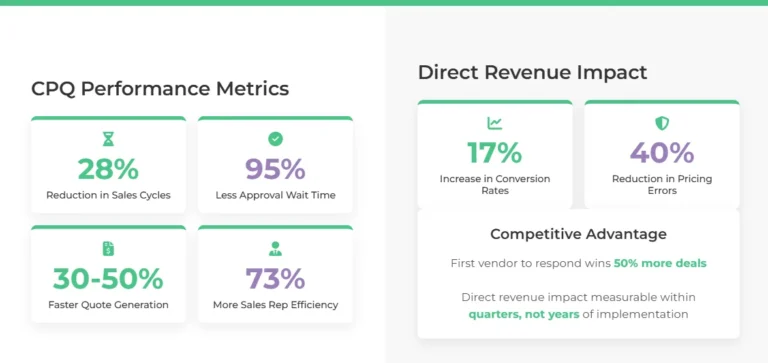
- Quote Generation Efficiency: Organizations implementing CPQ typically see 30-50% reduction in quote generation time
- Sales Productivity: Sales representatives experience 73% more efficiency in producing quotes compared to manual processes
- Conversion Optimization: Businesses using CPQ software see a 17% increase in conversion rates
- Error Reduction: CPQ software eliminates 40% of human errors in pricing and configuration
- Competitive Advantage: The first vendor to respond to prospects wins 50% more deals
These metrics represent direct revenue impact that can be measured within quarters, not years, of implementation. (Source: Valorx.com)
CPQ Supercharging CRM: A Symbiotic Relationship
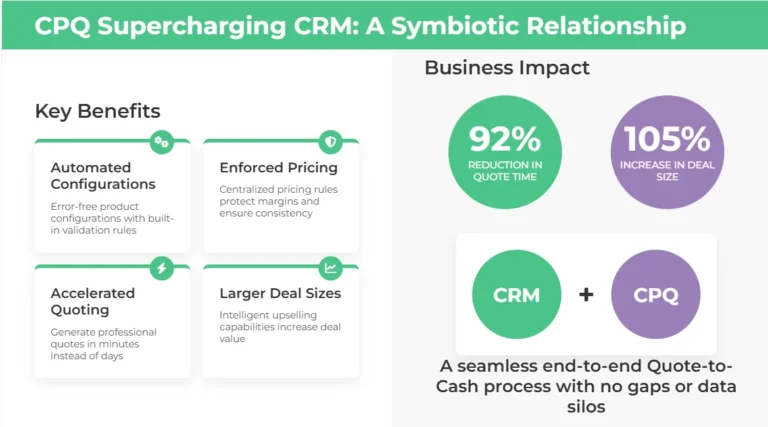
Rather than viewing it as CPQ versus CRM, high-performing organizations recognize it’s CPQ plus CRM in a symbiotic dance. Each does something unique: the CRM provides the context (customer history, contacts, pipeline) while the CPQ provides the configurations and calculations to drive deals to closure. When tightly integrated, the result is a seamless end-to-end process often called “Quote-to-Cash”: from initial lead to configured quote to signed contract to billing and revenue recognition, with no gaps or data silos in between.
Salesforce’s own sales operations guide notes that many sales teams now rely on purpose-built tools integrated into the CRM for specific functions. CPQ is a prime example. Here’s how a best-of-breed CPQ like servicePath™ supercharges your CRM and empowers your sales operations:
CPQ + CRM: A Revenue-Ops Power Duo
High-growth teams don’t pit CPQ against CRM—they wire them together.
- CRM supplies the who, when, and history.
- CPQ calculates the what and how much that close deals.
When they’re integrated, you get a friction-free Quote-to-Cash pipeline: lead → configured quote → signed contract → billing → revenue recognition—no swivel-chair data entry, no silos.
Four Ways CPQ Supercharges Your CRM
- Click-Perfect Configurations
Guided rules stop invalid combos before they start—no more “Does option A work with module B?” headaches. - Pricing Discipline Built-In
Central price books, discount guardrails, and auto-approvals keep every quote on-brand and on-margin. - Speed-of-Light Quotes & Approvals
reps spin out polished proposals in minutes, while automated workflows slash approval cycles by up to 95 %. - Bigger Baskets via Guided Upsell
Context-aware suggestions double deal size on average—think premium support, add-on bundles, and AI-driven cross-sells you’d otherwise miss.
Bottom line: CRM sets the stage; CPQ delivers the show. Together they turn your pipeline into profit, faster and fatter than either tool can alone.
servicePath™ CPQ+ – The Revenue Acceleration Engine
Stemming Hidden Costs and Scaling Efficiency
Configure-Price-Quote (CPQ) platforms address the critical gap between opportunity identification and revenue realization. Modern CPQ solutions like servicePath™ transform the quote-to-cash process through several key mechanisms, with organizations reporting measurable improvements across multiple dimensions.
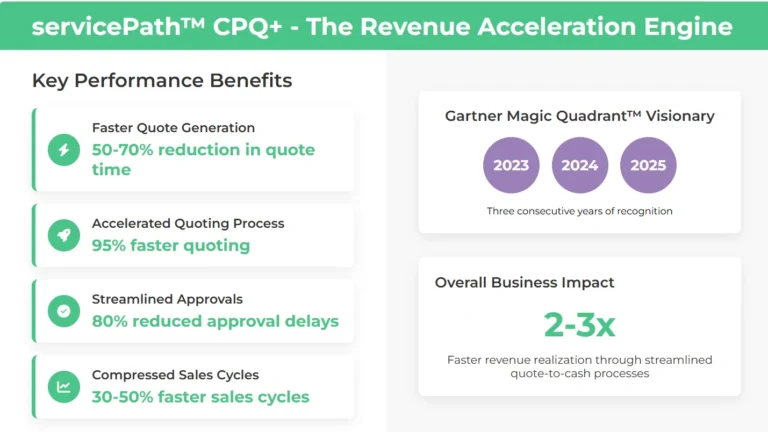
servicePath™ has been recognized as a Visionary in Gartner’s Magic Quadrant™ for CPQ Application Suites for three consecutive years (2023, 2024, and 2025), reflecting its innovation and market leadership in configure-price-quote solutions. This recognition underscores servicePath™’s strategic advances in simplifying complex quoting, driving revenue growth, and scaling across enterprise environments.
- Quotes in minutes
Guided configurations cut quote-prep time by 50–70 percent—some customers see 95 percent faster turnaround. - Pricing on autopilot
Discount guardrails and instant approvals protect margin, trimming approval delays by up to 80 percent. - Sales-cycle turbo
CRM/ERP integration kicks out branded proposals instantly, slashing cycle time 30–50 percent and lifting win rates. - Complex deals, zero chaos
Handles multi-layer SaaS bundles, hardware with thousands of SKUs, and everything in between—no errors, no rework.
Bottom line: CPQ+ plugs revenue leaks, scales effortlessly, and frees reps to sell instead of wrestling Excel. Ready to turn quote-to-cash into a competitive weapon? Let’s go.
The Quantifiable Impact of CPQ Implementation
Organizations implementing robust CPQ solutions report measurable improvements across multiple dimensions. According to Forbes research on proven CPQ metrics, companies standardizing on integrated CPQ systems achieve significant competitive advantages:
- Quote Generation Speed: 10× faster quoting processes, with some implementations reducing quote turnaround from days to minutes
- Error Reduction: Up to 40% fewer billing disputes through improved quote accuracy
- Sales Cycle Acceleration: 25% faster quote-to-cash cycles through automated workflows
- Margin Protection: 30% higher upsell capture rates through intelligent product recommendations
- Compliance Enhancement: Significantly reduced regulatory and pricing policy violations through automated validation
Post-CPQ implementation, sales representatives spend up to 60% more time selling rather than on administrative quote tasks, thanks to automated product bundling and price-book lookups. This productivity gain enables new representatives to start quoting effectively in days instead of weeks, shortening onboarding by 50%.
Real-World Impact: Enterprise Success Stories
Leading enterprises across industries have demonstrated CPQ’s transformative impact on revenue operations:
Dell Technologies: Enterprise Hardware Configuration Revolution
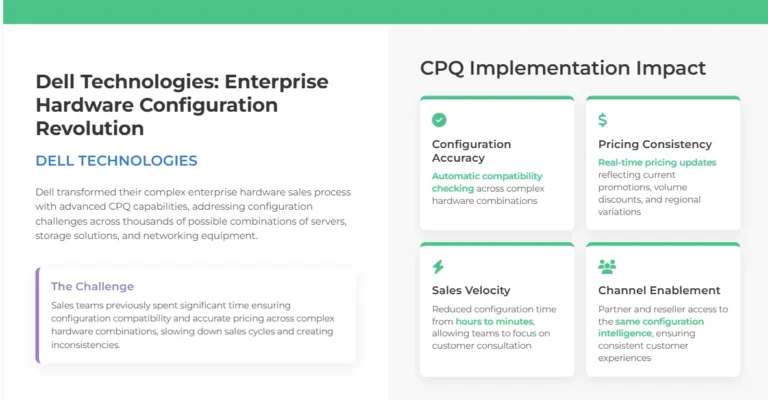
Dell’s implementation of advanced CPQ capabilities has transformed their complex enterprise hardware sales process. With thousands of possible configurations across servers, storage solutions, and networking equipment, Dell’s sales teams previously spent significant time ensuring configuration compatibility and accurate pricing.
The CPQ implementation enabled:
- Configuration Accuracy: Automatic compatibility checking across complex hardware combinations
- Pricing Consistency: Real-time pricing updates reflecting current promotions, volume discounts, and regional variations
- Sales Velocity: Reduced configuration time from hours to minutes, allowing sales teams to focus on customer consultation rather than technical validation
- Channel Enablement: Partner and reseller access to the same configuration intelligence, ensuring consistent customer experiences
Measuring the ROI: Contrasting Scenarios
To truly highlight the impact, consider two contrasting scenarios. Both scenarios assume a company that sells complex B2B solutions and uses a leading CRM like Salesforce to manage its sales pipeline.
Scenario 1: Strong CRM with Weak CPQ/Billing (The Status Quo)

In the first scenario, the company has invested in a robust CRM and has basic quoting tools (perhaps the CRM’s built-in quote module or Excel and email) and a piecemeal billing process. They’ve nailed the front-end of customer relationship management but lack a robust system for the back-end of configuring, pricing, quoting, and billing.
- Hidden Cost of Inefficiency: The CRM is humming along, the sales pipeline is full, but converting those opportunities into revenue is labor-intensive. Sales representatives spend hours each week creating quotes from scratch, checking pricing, and chasing approvals. They are highly paid, yet a significant chunk of their time is spent on what is essentially clerical work. This inefficiency is a silent killer. It’s like having a race car and asking the driver to also pave the road in front of them—their talents are wasted, and progress is slow. Moreover, the company might need more sales support staff or “deal desks” to manage this manual quoting, adding headcount cost.
- Revenue Leakage and Missed Opportunities: Without a good CPQ, pricing errors and suboptimal quotes are common. Maybe a representative gives a 20% discount when 10% was all that was needed to win; the extra margin is lost. Or perhaps a renewal opportunity slips through the cracks because there’s no automated reminder or quoting mechanism. A study by Gartner estimated that companies lose up to 5% of possible revenue due to ineffective pricing strategies and quote errors. Renewals and expansions are particularly vulnerable in a weak quote-to-cash setup: if your CRM isn’t tightly linked with billing, your sales team might not even know when a customer’s contract is up for renewal.
- Scalability Challenges: As the business grows, the quote and billing process without CPQ starts breaking. Onboarding new sales representatives is slow because they have to master a convoluted pricing spreadsheet and learn which of the 50 SKUs can be sold together—tribal knowledge that takes months or years to accrue.
- Customer Dissatisfaction: Customers experience slower quotes and likely more errors or inconsistencies in proposals. Perhaps they get Version 1 of a quote with one set of terms, then Version 2 after a week with corrections—it doesn’t inspire confidence. Research shows that 66% of customers expect companies to understand their needs and expectations; fumbling the quoting or billing makes it seem like you don’t.
Scenario 2: Salesforce CRM + Best-of-Breed CPQ & Billing (The Game-Changer)
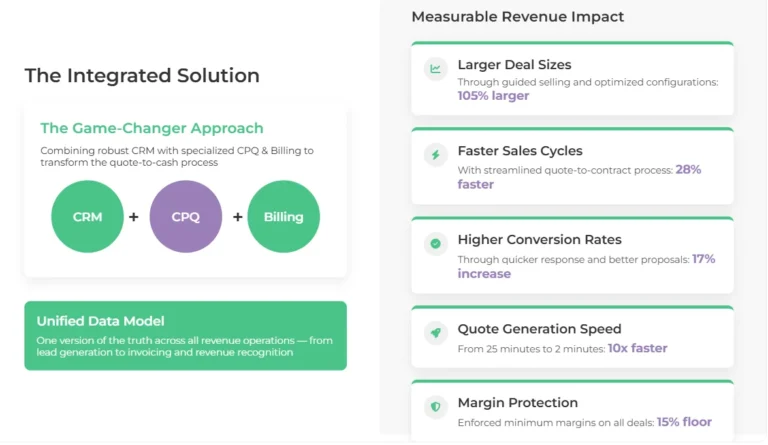
In Scenario 2, the company combines a robust CRM with best-of-breed CPQ and Billing solutions—specialized tools chosen for their powerful capabilities in handling complex sales. This addresses every pain point from Scenario 1, turning weak spots into strengths:
- Accelerated Revenue Growth: With CRM+CPQ+Billing in harmony, companies see direct improvements in top-line metrics. Deals don’t slip through the cracks—they close faster and often at higher values. Organizations using integrated CPQ can achieve significantly larger deal sizes (on average 105% larger than those without CPQ) thanks to optimized configurations and systematic upselling. They also enjoy shorter sales cycles, about 28% faster on average, because the quote-to-contract process is streamlined and no longer a bottleneck. Furthermore, a smoother sales process with quick turnaround on quotes can improve win rates—businesses using CPQ have seen around a 17% increase in conversion rates on deals.
- Massive Productivity Gains and Cost Savings: The efficiency of a best-of-breed CPQ translates into hard savings and soft savings. Sales representatives reclaim a huge portion of their day. Instead of spending two hours preparing a complex quote, they can do it in 10 minutes. One company reported making quote generation 10 times faster, cutting the time per quote from 25 minutes to 2 minutes. For an enterprise sales team, these time savings are like adding extra salespeople without the payroll—representatives now use those hours to call more prospects and follow up on more deals. Training costs also go down: with guided selling in CPQ, a new representative can be productive much faster, effectively “selling like a veteran” because the system coaches them through configuration and pricing.
- Higher Margin and Revenue Yield: Best-of-breed CPQ and Billing plug the leaks described in Scenario 1. Pricing is done with discipline—margin thresholds are enforced, and any deviation is intentional and approved.
- Operational Excellence and Visibility: In Scenario 2, the company operates with a unified data model across CRM, CPQ, and Billing. The moment a deal is closed in CRM, all the details flow into Billing for invoicing, and simultaneously into analytics for reporting. There’s one version of the truth.
The servicePath™ and LogiSense Strategic Alliance: Complete Quote-to-Cash Excellence
Bridging CPQ and Billing Through Strategic Partnership
While servicePath™ excels as a specialized CPQ solution, the complete quote-to-cash journey requires sophisticated billing capabilities. This is where the strategic alliance between servicePath™ and LogiSense creates a powerful end-to-end solution.
In November 2019, LogiSense and servicePath™ announced a strategic alliance to deliver an integrated usage-based Quote-to-Cash (QTC) solution that tightly combines LogiSense’s rating, mediation, and subscription billing platform with servicePath™’s configure-price-quote capabilities. This partnership enables enterprises to “future-proof” their monetization operations by combining best-in-breed CPQ and billing engines, reducing time-to-market and improving accuracy through configuration-not-code.
LogiSense: The Billing and Revenue Management Specialist
LogiSense specializes in usage-based billing and subscription management, providing the sophisticated billing engine that complements servicePath™’s CPQ excellence. LogiSense’s platform handles the complex billing scenarios that modern technology companies require:
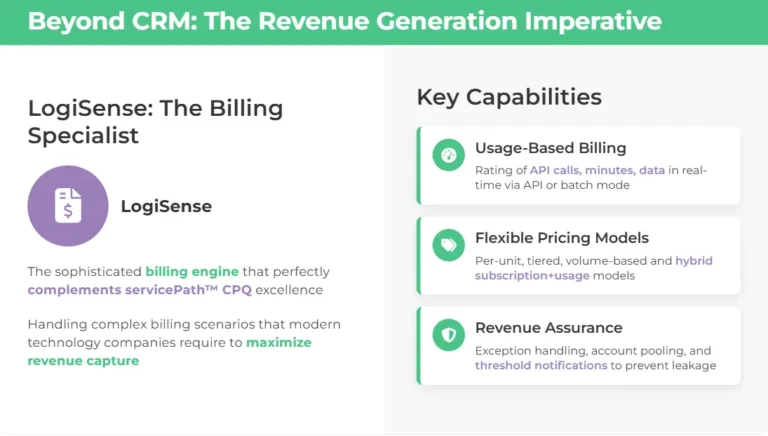
- Usage-Based Billing Capabilities: LogiSense supports rating of any measurable metric—API calls, minutes, data, currency, or any countable event—in real time via API or in batch mode. This flexibility enables companies to monetize their offerings based on actual consumption patterns.
- Flexible Pricing Models: The platform supports per-unit, tiered, and volume-based pricing structures, consumption drawdown with pre-paid pools, overage and top-up support, and hybrid subscription-plus-usage models that are increasingly common in technology services.
- Revenue Assurance Features: Built-in exception handling detects and remediates revenue leaks, while pooling and sharing capabilities across accounts ensure accurate billing for complex enterprise relationships. Threshold notifications alert customers as they approach usage limits, improving customer experience and reducing billing disputes.
The Power of Integration: CPQ + Billing Excellence
The servicePath™ and LogiSense alliance creates a seamless flow from quote to cash:
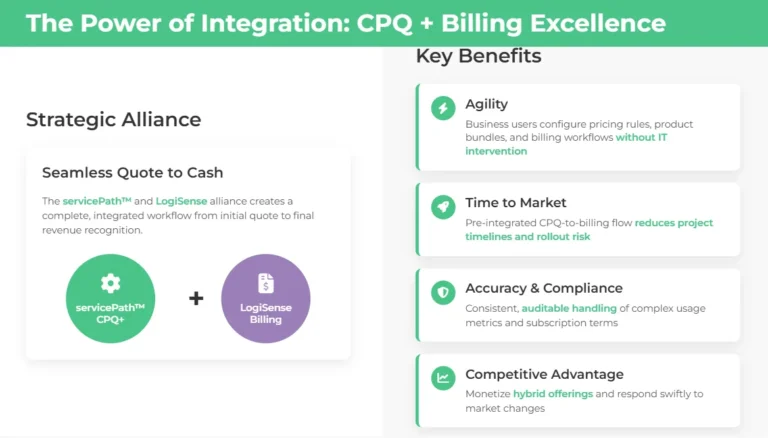
- Agility: Business users can configure pricing rules, product bundles, and billing workflows without IT intervention, enabling rapid response to market changes.
- Time to Market: The pre-integrated CPQ-to-billing flow reduces project timelines and rollout risk compared to building custom integrations.
- Accuracy & Compliance: Ensures consistent, auditable handling of complex usage metrics and subscription terms across the entire revenue lifecycle.
- Competitive Advantage: Helps technology-driven companies monetize hybrid offerings (subscription + usage) and respond swiftly to market changes while maintaining operational excellence.
Billing – Completing the Revenue Journey
From Quote to Invoice in One Unified Platform
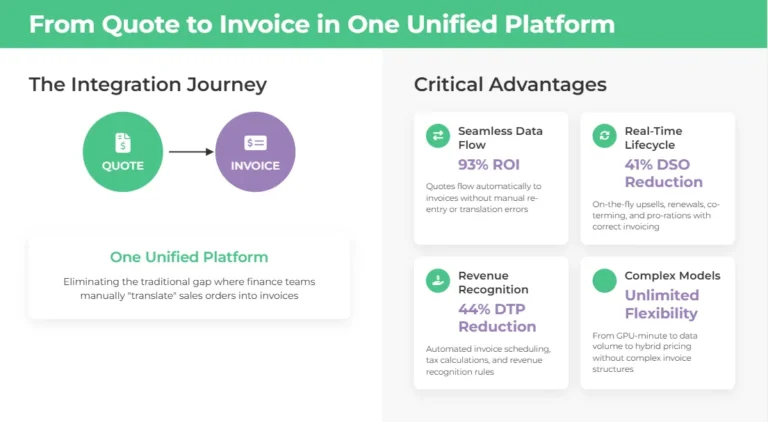
The integration of billing capabilities directly with CPQ systems eliminates the traditional gap where finance teams manually “translate” sales orders into invoices. This integration delivers several critical advantages that address the revenue leakage challenges plaguing many organizations.
- Seamless Data Flow: Orders flow automatically from approved quotes to billing systems without manual re-entry or translation errors. Research by Billtrust indicates that 93% of enterprises report their accounts receivable automation delivered expected ROI, with 100% reporting measurable benefits from their software investment.
- Real-Time Lifecycle Management: Unified CPQ-billing platforms enable on-the-fly upsells, renewals, co-terming, and pro-rations, empowering sales teams to create custom deals with confidence that invoices will generate correctly. Highly automated organizations see an average 41% reduction in Days Sales Outstanding (DSO) compared to 29% for low-automation peers.
- Automated Revenue Recognition: Invoice scheduling, tax calculations, and revenue recognition rules operate alongside sales data, dramatically reducing SG&A costs and accelerating cash flow. Organizations implementing billing automation report a 44% reduction in Days to Pay (DTP) among top automators versus 27% for minimal adopters.
- Scalability for Complex Models: Whether charging by GPU-minute, data volume, service tiers, or hybrid models, connected billing engines handle every pricing nuance without creating complex invoice structures or requiring large order management teams.
Streamlined Contracting and Billing (Quote-to-Cash)
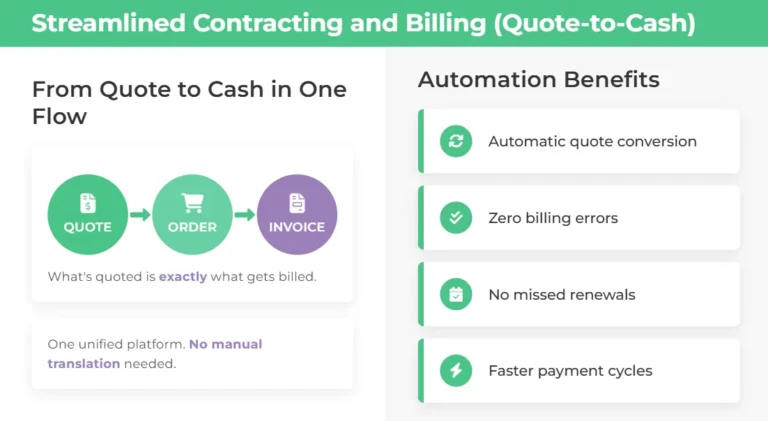
Once the deal is closed in the CRM, many companies face a new set of manual processes in finance—creating invoices, setting up subscription billing, recognizing revenue over time. An integrated Billing solution picks up right where CPQ leaves off. The approved quote can automatically convert into an order, an invoice, and a revenue schedule without re-keying data.
This automation of billing ensures that what was quoted is exactly what gets billed, with no disconnects between sales and finance. The benefits include no billing errors, no missed renewals (the system can schedule renewal quotes or invoices automatically), and faster payment cycles since invoices go out on time with correct information.
By linking Billing with CRM and CPQ, companies can reduce manual invoicing work and reduce Days Sales Outstanding (DSO)—getting cash in the door faster and improving cash flow. When finance doesn’t have to chase down errors or reconcile disparate systems, they can recognize revenue promptly and accurately, giving leadership real-time visibility into the financial health of the business.
The Revenue Leakage Recovery Opportunity
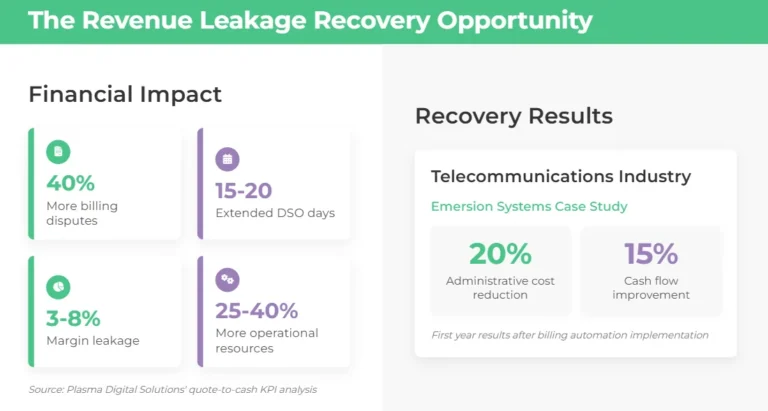
Studies indicate that organizations lose significant revenue through inefficient quote-to-cash processes. According to Plasma Digital Solutions’ analysis of quote-to-cash KPIs, poorly managed processes create substantial financial impact:
- Billing Disputes: Poor quote accuracy leads to up to 40% more billing disputes, creating customer satisfaction issues and delayed collections
- Delayed Collections: Manual processes extend DSO by an average of 15-20 days, directly impacting cash flow
- Pricing Errors: Inconsistent pricing enforcement results in 3-8% margin leakage across transactions
- Process Inefficiency: Manual quote-to-cash processes consume 25-40% more operational resources than automated alternatives
The Integration Imperative: CPQ and CRM as Complementary Powerhouses
The most successful enterprise sales operations don’t treat CPQ versus CRM as a zero-sum choice. Instead, they recognize the synergistic power of integrating best-of-breed CPQ solutions with established CRM platforms like Salesforce.
This integration approach leverages each system’s core strengths:
- CRM Excellence: Customer data management, opportunity tracking, relationship nurturing, and pipeline analytics
- CPQ Excellence: Product configuration, pricing optimization, quote generation, approval workflows, and contract automation
- Combined Impact: When properly integrated, these systems create a unified revenue engine that captures relationship intelligence from CRM and converts it into accelerated revenue through CPQ automation.
Why CPQ + Billing Can Eclipse CRM Alone
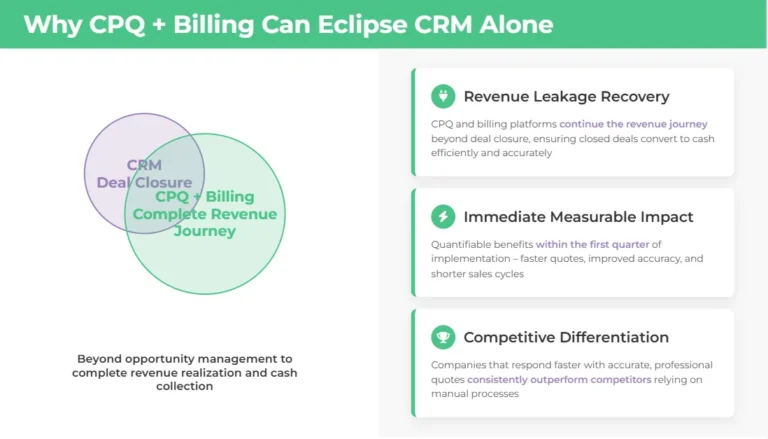
Revenue Leakage Recovery
While CRM systems excel at opportunity management, they typically stop at the point of deal closure. CPQ and billing platforms continue the revenue journey, ensuring that closed deals convert to cash efficiently and accurately. This end-to-end approach addresses the critical gap where many organizations lose revenue through manual processes, billing errors, and delayed collections.
Immediate Measurable Impact
Unlike CRM implementations that often require months or years to show ROI, CPQ solutions deliver immediate, quantifiable benefits. Organizations typically see measurable improvements in quote turnaround time, pricing accuracy, and sales cycle length within the first quarter of implementation.
Competitive Differentiation
In markets where product complexity and pricing sophistication create competitive advantages, CPQ capabilities become strategic differentiators. Companies that can respond faster with more accurate, professional quotes consistently outperform competitors relying on manual processes.
Transform Your Quote-to-Cash Operations
1.Assess Your Current State
The first step toward quote-to-cash transformation is honest assessment of your current capabilities:
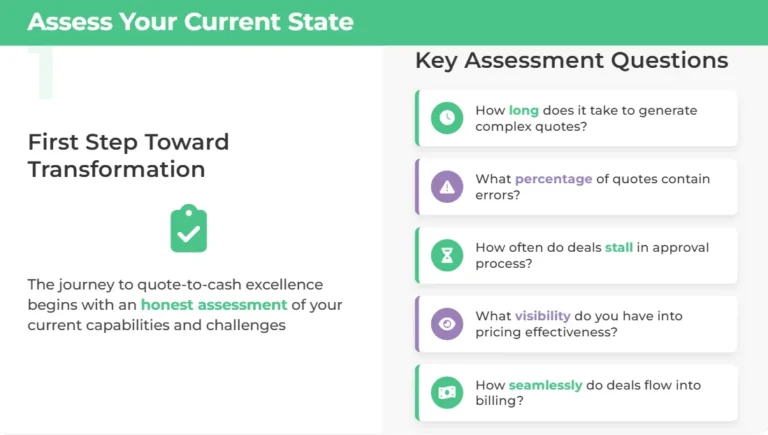
If these questions reveal significant gaps or inefficiencies, your organization may be leaving substantial revenue on the table through suboptimal quote-to-cash processes.
2.Explore Best-of-Breed Solutions
Consider the servicePath™ and LogiSense alliance as a model for how specialized platforms can work together to deliver comprehensive quote-to-cash excellence:
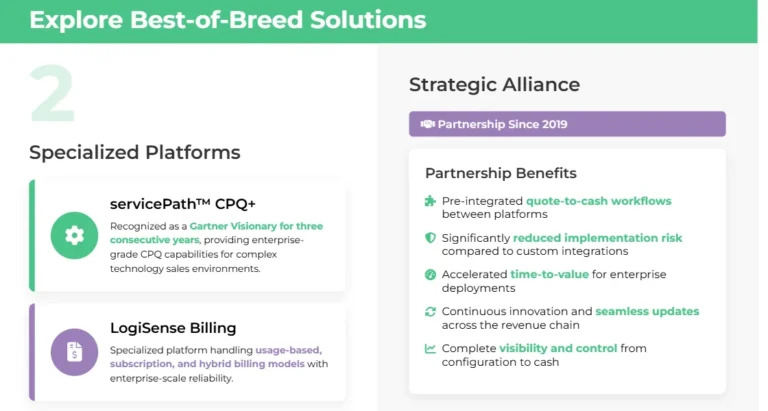
servicePath™ CPQ+: Recognized as a Gartner Visionary for three consecutive years, servicePath™ provides enterprise-grade CPQ capabilities designed for complex technology sales environments.
LogiSense Billing: A specialized billing and revenue management platform that handles usage-based, subscription, and hybrid billing models with enterprise-scale reliability.
Strategic Alliance Benefits: The 2019 partnership between these platforms provides pre-integrated quote-to-cash workflows that reduce implementation risk and time-to-value.
1. Comprehensive Revenue Operations Assessment
What You Get: Complete analysis of your current processes, identifying revenue leakage points and quantifying ROI potential with a tailored implementation roadmap.
2. Industry-Specific Success Portfolio
Key Benefits: Review documented 10× faster quote generation, 95% reduction in approval times, and 17% increase in conversion rates with 6-12 month payback periods.
3. Live Demo and Personalized CPQ Experience
Key Benefits: Experience quote generation improvements from hours to minutes and see the 60% increase in selling time when administrative tasks are automated.
4. Revenue Operations Excellence Resource Library
What You Get: Comprehensive knowledge base with implementation best practices and strategic guidance from our Gartner Magic Quadrant Visionary recognition.
5. Gartner Magic Quadrant Visionary Partnership
What You Get: Partnership with a proven market leader recognized by Gartner for three consecutive years (2023, 2024, 2025).
Bottom line: Spreadsheets patch leaks; CPQ+ prints revenue.
Book your assessment today and turn quote-to-cash into your firm’s unfair advantage.
Frequently Asked Questions
You may be interested in these articles next
Ground Truth Is the New Moat | CPQ AI Risk Framework 2026

Revenue Architecture 2.0: A Human-Led Control Plane for Enterprise Revenue in the AI Era

Commercial Excellence Is a Continuum, Not a Destination
