AI-Powered CPQ Revolution: How Enterprise MSPs Transform Operations in 2025
Learn how enterprise MSPs achieve 90% faster quotes and eliminate pricing errors with AI-powered CPQ. Discover real-world transformations, market insights, and why traditional quote-to-cash processes are failing in 2025.
The Service Operations Crisis That’s Paralyzing MSP Growth
“We think efficiency is a bad word. If I’m an efficiency-focused business, that means I’m trying to provide as much as possible with as few resources as possible, which equals burnout with technicians.”
— Brent Morris, Vice President of Business Development, Success Computer Consulting

If that sentiment sounds familiar, you’re not alone. In 2025, global MSPs and system integrators juggle thousands of SKUs, multi-currency rate cards, and ever-evolving cloud pricing. The result? Quotations that crawl through regional teams, siloed CRMs, and spreadsheet purgatory—costing deals and crushing margins.
In boardrooms across leading Managed Service Providers (MSPs), this troubling pattern emerges during quarterly reviews. MSP sales teams consistently miss revenue targets not due to lack of demand, but because of operational inefficiencies that plague the quote-to-cash process for complex managed services. The statistics paint a stark picture: Enterprise MSPs lose an average of 14% of annual revenue to manual pricing errors, while MSP sales teams spend 65% of their time on administrative tasks rather than actual selling to prospective clients.
According to Gaidar Magdanurov, Chief Success Officer at Acronis, writing for Forbes Business Council, MSPs are drowning in a perfect storm of challenges—from the “growing complexity of IT infrastructure” and “rising adoption of the cloud” to “constantly multiplying security threats” and unprecedented customer demands for compliance across multiple regulatory frameworks.
This operational crisis has reached a tipping point for Enterprise MSPs. As Gartner research indicates, 83% of buyers abandon MSP vendors who respond slowly to service pricing requests, while complex B2B managed service sales cycles continue to lengthen. IDC reported that roughly 3,000 managed services deals worth more than $150 billion were up for renewal, creating massive opportunity that has now materialized into intense market competition.
Why Traditional CPQ Falls Short
Legacy CPQ tools were built for single-product catalogs and linear approval flows. They melt when confronted with multi-tower managed-service deals that span cloud, network, security, and workplace. Worse, they ignore your biggest operational reality: inherited client infrastructure that must be extended, not replaced.
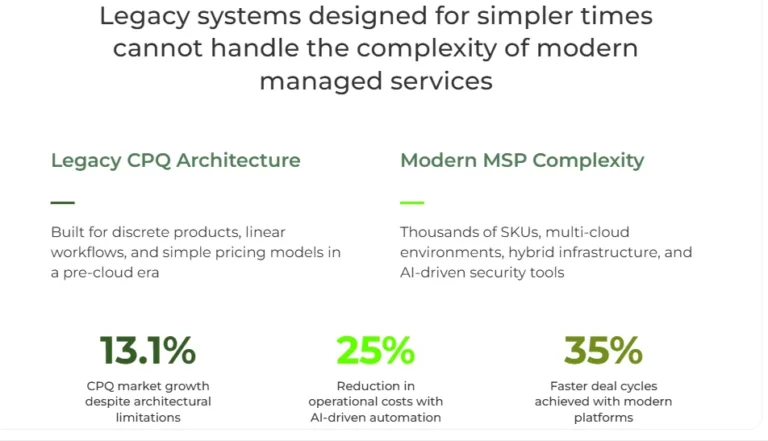
The problem runs deeper than most MSP executives realize. Traditional configure-price-quote (CPQ) systems were architected for simpler times—when businesses sold discrete products through linear sales channels. Today’s MSPs juggle thousands of SKUs across multi-cloud environments, navigate hybrid infrastructure deployments, and must bundle everything from AI-powered security tools to compliance consulting services.
According to Gartner, the CPQ market grew 13.1% to $1.72 billion in 2022, yet most platforms still struggle with the service complexity that defines modern managed services operations. The result? Quote cycles that crawl through approval chains, pricing errors that evaporate margins, and deal complexity that overwhelms even experienced sales teams.
A study by Kaptius found that MSPs using AI-driven automation achieved “on average a 25% reduction in operational costs and 35% faster” deal cycles compared to traditional approaches. Yet many MSPs remain trapped in what industry analysts call “spreadsheet purgatory”—manual processes that consume more time and resources than actual service delivery.
Real-World MSP Transformation:
Telent’s £60 Million Quote Revolution
The Challenge: Managing MSP Complexity at Scale

Telent, a leading UK ICT infrastructure MSP, faced a challenge familiar to many Enterprise MSPs: managing massive quote volumes for managed services across fragmented systems. With over £60 million in annual quotes for managed services distributed across 50+ spreadsheets, the MSP struggled with pricing accuracy, compliance tracking, and operational efficiency in their service delivery operations.
“Most CPQ solutions aren’t built for constant change. servicePath™ handles complexity effortlessly.”
— Hannah Buckley, Sales Operations Manager, Telent
This statement reflects a critical insight for Enterprise MSP leaders—the need for CPQ platforms that can adapt to dynamic managed service requirements without requiring extensive customization or technical resources.
The MSP Transformation Process
Telent’s CPQ transformation followed a strategic approach that Enterprise MSP leaders can replicate:
- Phase 1: MSP Process Standardization – The company began by standardizing managed service quote templates and approval workflows across all MSP business units, eliminating the inconsistencies that plagued their spreadsheet-based system.
- Phase 2: MSP Data Integration – Telent integrated their existing CRM and ERP systems with servicePath™, creating a single source of truth for client data, managed service pricing information, and service configurations.
- Phase 3: MSP Automation Implementation – The company implemented automated pricing rules for managed services, approval workflows, and compliance checks, reducing manual intervention and eliminating human error in their MSP operations.
- Phase 4: MSP Analytics and Optimization – With clean data flowing through the system, Telent gained unprecedented visibility into MSP sales performance, service pricing trends, and operational bottlenecks across their managed service portfolio.
Quantifiable Business Impact for MSPs
The results of Telent’s CPQ transformation demonstrate the tangible value that Enterprise MSP leaders can expect:
- 90% faster quote generation: Complex managed service quotes that previously required days of manual work now generate in minutes
- Zero pricing errors: Automated pricing rules and validation checks eliminated formula-based errors that previously cost the MSP significant revenue
- Real-time compliance tracking: Automated audit trails ensure regulatory compliance without manual oversight for managed service contracts
- Enhanced MSP sales productivity: Sales teams now focus on client relationship building and strategic managed service selling rather than administrative tasks
Dell’s MSP Partner Ecosystem Revolution

The Strategic Context for MSPs
Dell’s transformation story illustrates how CPQ can revolutionize MSP partner ecosystems and channel sales operations for managed service providers. As a global technology leader serving MSPs across 180 countries, Dell EMC faced the challenge of enabling thousands of MSP partners to sell complex solutions without overwhelming internal resources.
“Solution Engineers don’t want to be quote jockeys. They want to be whiteboarding solutions architectures with clients. They want to help solve tough technical problems. The last thing they want to do is come to the office and grind through creating complex quotes using a spreadsheet.”
— Brandon DaCosta, Consultant Product Manager, Dell EMC
This insight reveals a critical strategic consideration for Enterprise MSP leaders: CPQ transformation isn’t just about operational efficiency—it’s about optimizing human capital and enabling high-value activities that drive competitive advantage for managed service providers.
Transformational Results for MSPs
Dell EMC’s CPQ transformation delivered results that directly impact strategic objectives for MSPs:
- 98% faster proposal generation: MSP partners now generate proposals in minutes rather than days
- Eliminated manual intervention: The majority of MSP partner pricing requests no longer require internal resources
- Strategic resource reallocation: Solution engineers and account executives now focus on high-value activities
- Improved MSP partner satisfaction: MSP partners report significantly higher satisfaction with the sales support process
“servicePath™ let partners self-serve, freeing us to focus on the strategic challenges that drive our business forward.”
— Brandon DaCosta, Consultant Product Manager, Dell EMC
Turning CRM Sprawl into One Revenue Story
Every time your business acquires a new region, inherits a niche workflow, or bends to a client mandate, another CRM instance sneaks onto the tech stack. What starts as a “temporary workaround” soon becomes a maze of disconnected data, duplicate contacts, and teams who can’t see—let alone sell to—the same customer. Cross‑sell stalls, reporting turns into forensic science, and even the flashiest AI has nothing coherent to learn from. In short: multiple CRMs aren’t just an IT headache; they’re a drag strip glued with molasses.
The Challenge of Multiple CRMs — Why It Hurts
Global CRM spend topped $62 billion in 2024—yet a surprising share of enterprises still juggle multiple instances across regions or business units, creating data silos instead of customer insight JISEMVertify. This fragmentation drags revenue in three predictable ways:

- Cross‑sell gridlock. When teams sit in different CRMs, they can’t see each other’s accounts, so they don’t collaborate. As PartnerTap notes, reps “use different CRM systems, work in different territories, and don’t trust each other yet,” stalling joint opportunities after M&A partnertap.com. McKinsey quantifies the result: fewer than 20 % of mergers ever hit their cross‑selling targets McKinsey & Company.
- Lost operational time. Disconnected data forces humans to reconcile SKUs, price books, and approval chains by hand. Tamr calls out scattered records and duplicate customers as prime culprits in stalled sales cycles tamr.com, while CapellaSolutions ties misquotes directly to siloed data Capella Solutions.
- AI that can’t see. Even next‑gen agentic AI falls into the same silo trap if it can’t traverse every CRM, limiting ROI and governance TechRadar.
Why Full‑Scale Consolidation Often Fails
C‑suite logic says “merge the CRMs,” but board pressure for quick synergies says “ship revenue now.” McKinsey finds most companies delay deep consolidation for 3–5 years to avoid paralyzing sales McKinsey & Company—and Forrester shows 57 % will still increase CRM spend in that window, compounding the mess Forrester. Meanwhile, MSP leaders surveyed by Kaseya list vendor consolidation as a top 2025 priority, signalling fatigue with bloated stacks Kaseya.

- Lay down one quoting brain across every CRM
A unified pricing‑and‑approval layer gives reps the same rules everywhere, ending the “my data vs. your data” stalemate. Capgemini positions this as the first leap from fragmentation to an AI‑ready ecosystem Capgemini. - Scrub the data before anything moves
Duplicate accounts spawn like rabbits across siloed apps; cleaning them early keeps forecasts honest. Deloitte stresses that data hygiene and integration quality are non‑negotiable for clean reporting Deloitte. - Migrate in waves that respect the fiscal calendar
Shift low‑volume regions first, then tackle revenue heavyweights after quarter‑end. PwC’s integration playbooks highlight structured sequencing to protect deal value Viewpoint, and McKinsey notes smart acquirers deliberately stage IT moves to avoid disrupting short‑term sales McKinsey & Company. - Instrument adoption and celebrate quick wins
Track usage, cycle‑time cuts, and margin lift from day one—then broadcast the numbers. Accenture’s post‑merger teams cite momentum tracking as vital to sustain integration energy Accenture. - Stick to a “vendor‑diet” roadmap
Once workflows are unified, start trimming duplicate tools. The 2025 Kaseya MSP Benchmark lists vendor consolidation among the industry’s top priorities Kaseya, and Forrester argues fewer, better‑integrated systems unlock true omnichannel agility Forrester.
Bottom line: CRM sprawl isn’t just an IT nuisance—it’s a revenue choke point. Federate your quote logic, clean the data, and migrate on your timetable. Do that, and suddenly every cross‑sell pitch, renewal push, and AI insight is pulling in the same direction, not fighting upstream.
The MSP Market Evolution: From Reactive to Predictive

The managed services landscape is undergoing a fundamental transformation. According to JumpCloud, the MSP market “grew in 2024 and shows no signs of slowing down anytime soon. The market is expected to reach almost $350 billion globally by the end of the” current forecast period.
Sherweb identifies “the rise of AI-driven solutions to hybrid cloud dominance” as key factors that “will challenge and empower MSPs to deliver more value than ever” in 2025. Meanwhile, Channel E2E indicates that MSPs are currently navigating “advanced automation to artificial intelligence (AI) to the tech talent gap.”
The New Service Delivery Paradigm
The traditional MSP model—reactive support with standardized service packages—is giving way to what analysts call “intelligent service orchestration.” This evolution is driven by several converging trends:
- Cloud Complexity Explosion: According to IDC, “worldwide spending on public cloud services is forecast to reach $805 billion in 2024 and double in size by 2028.” As we progress through 2025, this massive cloud adoption is creating both opportunity and complexity for MSPs.
- Security Integration Imperative: According to Magdanurov’s research for Forbes, “The 2022 MSP Threat Report by ConnectWise shows that 39% of all ransomware attacks targeted service providers, followed by 12% for healthcare,” making integrated security service delivery a business necessity.
- AI-Powered Service Categories: The rise of artificial intelligence in business operations has created new service categories that barely existed two years ago. From AI-powered help desk automation to machine learning-driven network optimization, MSPs are now rapidly productizing emerging technologies.
The Rise of Intelligent CPQ Solutions
Enter the next generation of AI-powered CPQ platforms, designed specifically for the complexity and scale demands of modern enterprise service providers. These intelligent solutions represent a fundamental shift from traditional configure-price-quote to what Frost & Sullivan terms “intelligent guided selling”—platforms that don’t just automate existing processes but reimagine how complex services are configured, priced, and delivered.
AI-Powered Pricing Intelligence
Machine learning algorithms now handle complex pricing calculations, configuration validation, and margin optimization that previously required manual intervention. According to ByteBridge, MSPs have reported “operational cost reductions of up to 30–50% by implementing AI-managed services compared to maintaining traditional” approaches while dramatically improving pricing accuracy.
“AI isn’t just another tool. Its a lever for radical change – if you know how to harness it safely. The ability now to treat a formerly static quote interface into a dynamic value-add analysis and discussion enables the sales teams to quickly modify and understand the different dynamics in the quote to maximize the value to the business.”
— Daniel Kube, CEO, servicePath™
News Spotlight: The Acceleration Imperative
CrowdStrike’s expansion of agentic AI security tools in the AWS Marketplace shows how fast MSP clients are productizing AI-powered services—and why quoting new bundles in hours, not weeks, is a competitive imperative. This development underscores the urgency for MSPs to modernize their quote-to-cash processes to capture emerging AI service opportunities.
For MSPs, this represents both opportunity and challenge: the ability to quote new AI-enhanced service bundles in hours rather than weeks has become a competitive imperative. The organizations that can rapidly productize and price these emerging services will capture disproportionate market share in the AI services revolution.
Market Forces Reshaping MSP Operations
The Talent Shortage Crisis
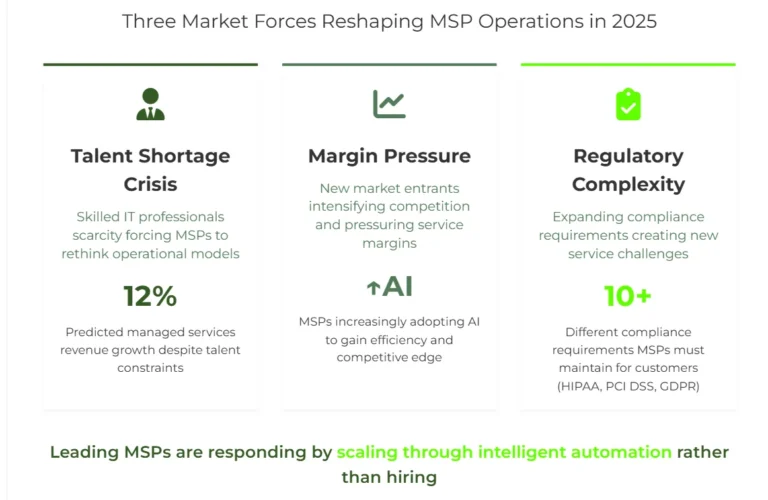
According to Canalys research, managed services revenue was predicted to “grow 12% or more in 2024, pointing to cloud infrastructure, AI solutions, cybersecurity” as key growth drivers. This growth has materialized in 2025, but is constrained by what Magdanurov identifies as the “lack of skilled IT professionals in the workforce.”
The talent shortage is forcing MSPs to rethink their operational models. Rather than scaling through hiring, leading MSPs are scaling through intelligent automation—using AI-powered tools to amplify the capabilities of existing teams.
Margin Pressure and Competitive Dynamics
The MSP market’s rapid growth has attracted new entrants, intensifying competition and pressuring margins. MSP360 indicates that MSPs are “making AI a bigger part of your business” to “achieve efficiency and gain a competitive edge” in an increasingly crowded marketplace—a trend that has accelerated throughout 2025.
Regulatory Compliance Complexity
Modern MSPs must navigate an increasingly complex regulatory landscape. According to Magdanurov’s Forbes analysis, MSPs now need to “maintain over 10 different compliance requirements for their customers,” including HIPAA, PCI DSS, and GDPR. This compliance complexity requires sophisticated service modeling and pricing capabilities that traditional CPQ systems simply cannot handle.
The Future of Enterprise Service Delivery
Looking ahead, the trends driving CPQ evolution are accelerating. According to IDC’s FutureScape predictions, 75% of enterprises will use AI-enabled cloud APIs by 2026, and 60% will adopt “as-a-service” models for SD-WAN by the same timeframe.
The Everything-as-a-Service (XaaS) Revolution
The emergence of what analysts call “everything-as-a-service” business models is forcing MSPs to rethink fundamental assumptions about service delivery and pricing. Traditional project-based engagements are giving way to outcome-based, consumption-driven relationships that require sophisticated usage tracking and dynamic pricing capabilities.
According to Forrester on configure, price, quote solutions, successful organizations can “use configure, price, quote (CPQ) solutions to increase seller productivity and effectiveness in configuration, pricing, and quoting.” This shift requires platforms that can handle complex subscription models, usage-based pricing, and outcome-driven SLAs.
The XaaS model presents both opportunities and challenges for MSPs:

Opportunities:
- Recurring Revenue Streams: XaaS models create predictable, recurring revenue that improves cash flow and business valuation
- Customer Stickiness: Service-based relationships create deeper customer engagement and higher switching costs
- Scalable Growth: Digital service delivery models can scale without proportional increases in headcount
- Data-Driven Insights: Consumption-based services generate rich data streams that enable predictive analytics and proactive service optimization
Challenges:
- Complex Pricing Models: XaaS requires sophisticated pricing engines that can handle usage tiers, overage charges, and dynamic service configurations
- Real-Time Billing: Consumption-based services demand real-time usage tracking and automated billing capabilities
- Service Level Management: Outcome-based contracts require continuous monitoring and automated SLA compliance reporting
- Integration Complexity: XaaS delivery often requires integration with multiple third-party platforms and APIs
AI Integration Across the Service Stack
The integration of AI across the entire MSP service stack is creating new opportunities for differentiation and efficiency. From predictive maintenance and automated threat detection to intelligent resource optimization and proactive customer engagement, AI is becoming the nervous system of modern MSP operations.
This AI integration requires CPQ platforms that can model and price AI-enhanced services, handle the complexity of hybrid human-AI service delivery, and provide real-time visibility into the economics of AI-powered operations.
Why servicePath™: Built for the MSP Reality
Transform Your MSP Operation with Purpose-Built CPQ Excellence
Against this backdrop of market complexity and technological evolution, servicePath™ emerges as a purpose-built solution designed specifically for enterprise service providers and MSPs. Unlike generic CPQ platforms retrofitted for services, servicePath™ was architected from the ground up to address the unique operational challenges of modern managed service delivery.

Enterprise Integration Hub: Connecting 2,000+ Systems
Enterprise Integration Hub connects 2,000+ systems—mainframes, CMDBs, custom ERPs—so your quote engine respects the past and the future. This integration breadth ensures that quote engines respect both existing client infrastructure and future expansion plans, eliminating the “rip and replace” mentality that often derails complex MSP deals.
The platform’s integration philosophy reflects a deep understanding of enterprise IT reality: successful MSPs don’t just sell new technology—they extend, enhance, and optimize existing client environments.
Multi-CRM Mode: Unified Intelligence
Multi-CRM Mode unifies Salesforce, Dynamics, HubSpot, and home-grown CRMs under one CPQ brain—no disruptive migrations required. Enterprise service providers often inherit multiple CRM systems through acquisitions, regional operations, or client requirements. Rather than forcing costly consolidation projects, servicePath™’s Multi-CRM Mode creates a unified CPQ intelligence layer.
This approach addresses what IDC identifies as a critical pain point for growing MSPs: the need to maintain operational consistency across diverse technology stacks without disrupting established sales processes.
Domain Expertise Packs: Accelerating Time-to-Value
Domain Expertise Packs ship with ITIL-aligned service blocks, regional labour tables, and pre-approved SLA clauses curated by former IBM and Atos leaders. Build complex quotes in minutes, not weeks. These expertise packs represent years of accumulated knowledge distilled into actionable configurations that can transform quote cycles from weeks to minutes.
Service Wrapping & Cost-to-Serve Governance
Service Wrapping & Cost-to-Serve Governance lets you blend third-party cloud, telco, and OEM offers with your own IP. Real-time cost modelling ensures every bundle drives good margin, flagged automatically if it doesn’t. This capability enables MSPs to seamlessly blend third-party cloud services, telecommunications offerings, and OEM products with their own intellectual property and managed services.
Business Impact: Measurable Results
The quantifiable benefits that Enterprise MSPs achieve with servicePath™:
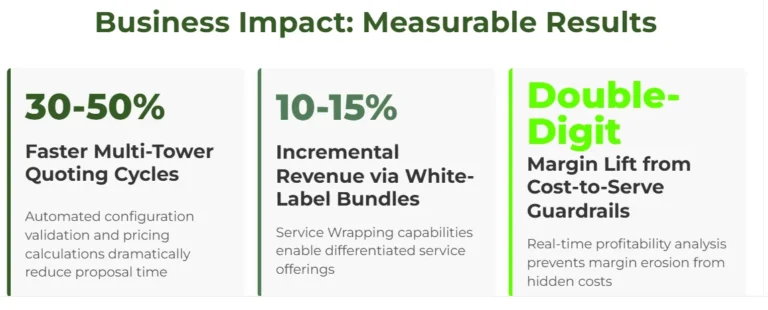
- 30-50% faster multi-tower quoting cycles: By automating configuration validation and pricing calculations, MSPs dramatically reduce the time required to generate complex service proposals
- 10-15% incremental revenue via white-label bundles: servicePath™’s Service Wrapping capabilities enable MSPs to create differentiated service offerings
- Double-digit margin lift from cost-to-serve guardrails: Real-time profitability analysis prevents margin erosion from hidden costs, configuration errors, and pricing mistakes
Addressing MSP Pain Points
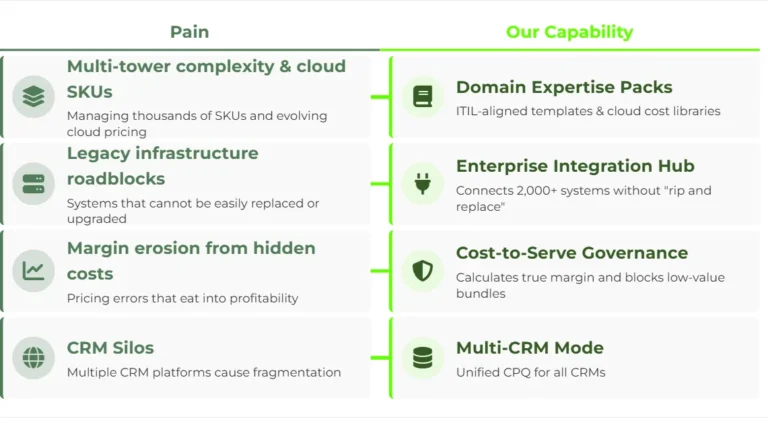
Frequently Asked Questions
Q: How long does a typical Enterprise MSP CPQ implementation take?
A: Enterprise MSP CPQ implementations typically take 3-9 months, depending on complexity and integration requirements. MSPs like Dell EMC and Telent saw initial value within the first quarter of implementation, with servicePath™’s pre-built integrations significantly accelerating deployment timelines.
Q: What’s the typical ROI timeline for MSP CPQ investments?
A: Most Enterprise MSPs see positive ROI within 6-12 months of implementation, with full value realization occurring within 18-24 months. Industry research shows MSPs typically achieve 25-35% reduction in operational costs, 30-50% faster quote cycles, and 10-15% incremental revenue through improved pricing accuracy.
Q: How do AI-powered CPQ solutions differ from traditional CPQ platforms?
A: AI-powered CPQ solutions incorporate machine learning algorithms for dynamic pricing, predictive analytics for deal forecasting, and intelligent automation for configuration validation. Unlike traditional platforms that rely on static rules, AI-powered solutions continuously learn and adapt to market conditions and customer behavior patterns.
Q: What integration capabilities should MSPs look for in CPQ solutions?
A: Look for platforms that offer pre-built connectors to major CRM systems, billing platforms (ConnectWise, Autotask, ServiceNow), and ERP systems. The best solutions support extensive integrations without requiring custom development, with servicePath™ offering over 2,000 system integrations.
Q: How do you ensure user adoption of new CPQ systems within MSPs?
A: Successful user adoption requires comprehensive change management, including executive sponsorship, user-centric design, comprehensive training, and clear communication of benefits. MSPs that involve users in the design process see significantly higher adoption rates, as demonstrated by Telent and Dell EMC’s implementations.
Ready to Accelerate Every Tower?
The managed services landscape has never been more complex—or more opportunity-rich. While your competitors struggle with legacy tools and manual processes, AI-powered CPQ solutions provide the intelligence and automation needed to win in today’s market.
Book a Service Transformation Assessment and watch us configure a 50,000-line quote live. Experience how purpose-built CPQ technology transforms complex service quoting from a time-consuming challenge into a competitive advantage. Discover how intelligent guided selling, automated deal governance, and real-time profitability insights can revolutionize your sales process.
- Book a Live Demo — See It in Action
Watch us spin up a 50 k‑line quote in real time and spot margin leaks before your coffee cools. Fifteen‑minute walkthrough, zero commitment—just clarity. - Explore Insights Hub- Gather more insights from our weekly blogs
- Raid the Whitepaper & Guide Library — Arm Yourself with Insights
From AI‑driven pricing tactics to multi‑CRM harmonization playbooks, our knowledge vault turns your late‑night research into board‑ready strategy fuel. - Download the Case‑Study Pack — Proof in High‑Def
Telent’s 90 % quote‑time slash, Dell’s 98 % proposal acceleration, a $180 M deal closed in half the cycle—grab the receipts and silence skeptics fast. - Visionary Partnership — Gartner‑Certified Credibility
Join forces with a three‑year Gartner MQ Visionary (2023‑2025). Instant trust signals that melt procurement red tape and land you in the C‑suite’s good books. - Explore the MSP Glossary — Decode the Jargon
AI, XaaS, MTTR, cost‑to‑serve… our plain‑English glossary turns buzzwords into battle plans so every stakeholder speaks the same revenue‑driving language.
The future of managed services belongs to organizations that can quote complex services faster, more accurately, and more profitably than their competition. Join industry leaders like Telent and Dell EMC who have already transformed their operations. The transformation starts today.
servicePath™ is a trademark of servicePath Ltd. All research citations are sourced from publicly available industry reports, analyst publications, and executive commentary from recognized business publications including Forbes, IDC, Gartner, Forrester, CRN, and other industry authorities.