Beyond the Horizon: Why Your Strategic Planning Needs a Sprint, Not a Marathon
Replace 90-day planning marathons with 30-day strategic sprints to boost agility, revenue, and profit—powered by AI-native, codeless CPQ.
For too long, strategic planning has been synonymous with the arduous 90-day marathon. Boards and executive teams vanish into war rooms, emerging months later with binders full of plans that often feel dated before the ink is dry. In today’s hyper-accelerated business landscape, this traditional approach is not just inefficient; it’s a liability. It’s time to embrace a new paradigm: the strategic sprint.
The Problem with the 90-Day Marathon
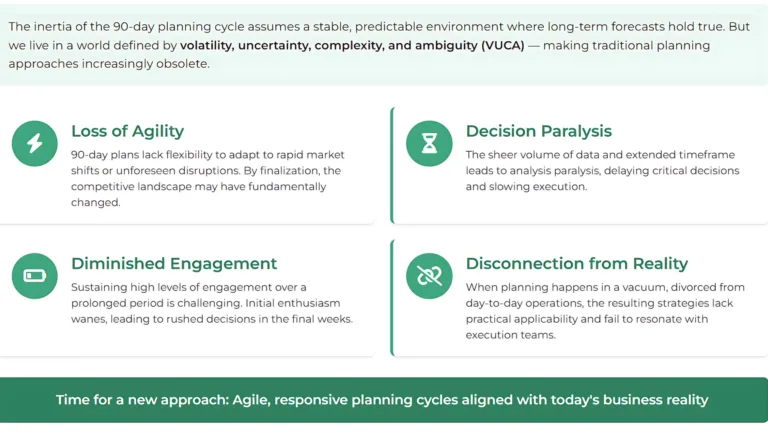
The inertia of the 90-day planning cycle is a relic of a bygone era. It assumes a stable, predictable environment where long-term forecasts hold true. But we live in a world defined by volatility, uncertainty, complexity, and ambiguity (VUCA). As the U.S. Army War College first articulated this concept, it’s become a cornerstone for understanding modern strategic environments.
- Loss of Agility: A 90-day plan, by its very nature, lacks the flexibility to adapt to rapid market shifts, emerging technologies, or unforeseen disruptions. By the time your plan is finalized, the competitive landscape may have fundamentally changed. McKinsey’s research on enterprise agility demonstrates that “agility across a whole enterprise combines speed and stability” and directly correlates with superior business outcomes.
- Decision Paralysis: The sheer volume of data and the extended timeframe can lead to analysis paralysis, delaying critical decisions and slowing down execution. Research by McKinsey & Company has repeatedly highlighted that faster, data-driven decision-making correlates with superior organizational performance. Their analysis shows that “the quality and speed of decision making are both strongly associated with overall company performance.”
- Diminished Engagement: Sustaining high levels of engagement and focus over a prolonged period is challenging. The initial enthusiasm can wane, leading to rushed decisions in the final weeks. Harvard Business Review’s research on strategic planning emphasizes that “true strategy is about placing bets and making hard choices,” not sustaining energy through extended deliberation periods.
- Disconnection from Reality: When planning happens in a vacuum, divorced from day-to-day operations, the resulting strategies can lack practical applicability and fail to resonate with the teams responsible for execution.
Why the Sprint is Your New Strategic Advantage
Imagine a strategic planning process that is dynamic, iterative, and responsive. This is the essence of the strategic sprint. Instead of a drawn-out 90-day cycle, we advocate for a highly focused, intense period – perhaps 30 days – that yields actionable strategies with remarkable speed and precision.
Consider the analogy of a high-growth tech company preparing for a major product launch. They don’t spend three months in isolated meetings to define their go-to-market strategy. They use agile methodologies, daily stand-ups, and rapid iteration cycles to bring their product to market, constantly adapting to user feedback and market response. Your strategic planning should operate with the same velocity.
The Value of Extra Execution Time: Beyond Just Speed
Switching to a 30-day sprint from a 90-day program doesn’t just save you two months; it unlocks significant extra execution time per quarter.
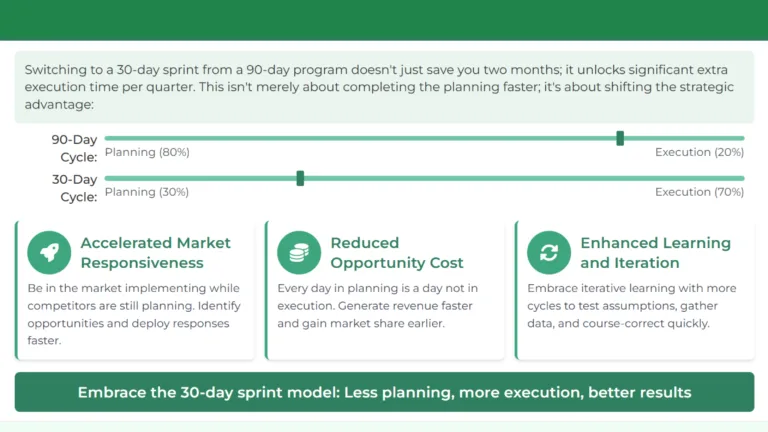
This isn’t merely about completing the planning faster; it’s about shifting the strategic advantage:
- Accelerated Market Responsiveness: Those additional weeks allow you to be in the market, implementing and learning from your strategy, while your competitors are still in the planning phase. Imagine identifying a new market opportunity, developing a response, and deploying it before your rivals even finalize their internal discussions. This is a tangible competitive edge.
- Reduced Opportunity Cost: Every day spent in planning is a day not spent in execution. By compressing the planning cycle, you significantly reduce the opportunity cost associated with delayed action. This translates directly to faster revenue generation, quicker market share gains, and earlier realization of strategic goals.
- Enhanced Learning and Iteration: The traditional model assumes a “perfect” plan will emerge. The sprint model embraces iterative learning. With additional execution time, you have more cycles to test assumptions, gather real-world data, and course-correct. This agile approach leads to more robust and resilient strategies over time.
A Story to Resonate with Executives
Consider the case of a large financial institution facing disruption from fintech startups. Traditionally, their strategic refresh took a full quarter. By adopting a 30-day sprint for their digital transformation strategy, they were able to pivot their mobile banking features and launch a new AI-powered customer service bot two months ahead of their initial schedule. This early deployment allowed them to capture significant market share in a rapidly evolving segment, directly impacting their quarterly earnings and investor confidence. The CEO later credited this agility as a key factor in fending off aggressive new entrants.
Delivering Tangible Lift at Every Phase: Revenue & Profit Performance
The true power of the strategic sprint lies in its ability to generate measurable “lift” across the entire strategic lifecycle, directly impacting revenue and profit performance. It’s not just about efficiency; it’s about effectiveness that translates to the bottom line.
Discovery Phase (Faster Insights, Better Targeting)
In a sprint, the discovery phase is intensely focused. Instead of exhaustive research that can lead to diminishing returns, you quickly identify the most promising opportunities and critical challenges.
- Revenue Lift: By rapidly pinpointing underserved market segments or emerging customer needs, you can accelerate new product/service development or pivot existing offerings, capturing revenue streams before competitors. For example, identifying a niche demand for a specific SaaS feature and being the first to market can lead to a 10-15% initial market share gain.
- Profit Lift: Streamlined discovery avoids wasting resources on less viable ideas. By focusing on high-potential areas, you optimize R&D spend and go-to-market investments, improving profitability per initiative.
Strategy Formulation Phase (Decisive Action, Optimized Allocation)
The compressed timeframe forces decisive action and prioritization, ensuring resources are immediately channeled to the highest-impact strategic initiatives.
- Revenue Lift: Quicker decision-making on market entry, product launches, or pricing strategies means faster time-to-market. For a consumer electronics company, launching a new product two months ahead of competitors can translate to capturing a 5% higher share of initial sales in a launch quarter, significantly boosting early revenue.
- Profit Lift: Optimized resource allocation (capital, talent, technology) to strategic priorities reduces waste and improves the return on investment (ROI) for each strategic dollar spent. This directly enhances profit margins.
Execution & Scaling Phase (Accelerated Realization, Continuous Optimization)
The additional execution time means your strategies are in the market, generating results, much faster.
- Revenue Lift: The most significant revenue impact comes from accelerated execution. If a strategic initiative is projected to add substantial annual revenue, launching it weeks earlier can mean realizing significant additional returns in that fiscal year, directly contributing to top-line growth. For a company with a $100M annual revenue target from a new market, early deployment could translate to millions in additional revenue.
- Profit Lift: Early market feedback and rapid iteration enable continuous optimization of pricing, marketing spend, and operational efficiencies. This dynamic adjustment reduces costs and maximizes profitability throughout the execution phase. Furthermore, reaching critical mass or profitability benchmarks sooner reduces the “burn rate” of new initiatives.
What if You Really Like Your 90-Day Program? Modify, Don’t Abandon
For organizations deeply entrenched in the 90-day planning cycle, a complete overhaul can feel daunting. However, you can still infuse the spirit of the sprint into your existing framework:

- Front-Load the Core Decisions (Days 1-30): Dedicate the first 30 days to the most critical strategic choices. Focus on defining the overarching objectives, key initiatives, and resource allocation at a high level. Use intensive, focused workshops and decision-making sessions.
- Iterate and Refine in Shorter Cycles (Days 31-90): The remaining 60 days should not be a continuous planning exercise. Instead, break them into two or three mini-sprints (e.g., 20-day cycles). Each mini-sprint focuses on a specific element of the strategy, such as detailed operational plans for a key initiative, market validation of a new product, or technology roadmapping. This allows for continuous feedback and refinement.
- Prioritize Actionable Outcomes: Every planning session, regardless of its length, should conclude with clear, actionable outcomes and assigned responsibilities. The goal is progress, not just discussion.
Codeless Infrastructure: Further Accelerating Your Sprint
Beyond agile planning, the speed at which your organization can implement strategic changes is paramount. This is where the power of servicePath™’s codeless infrastructure becomes a game-changer, further accelerating your strategic sprint.
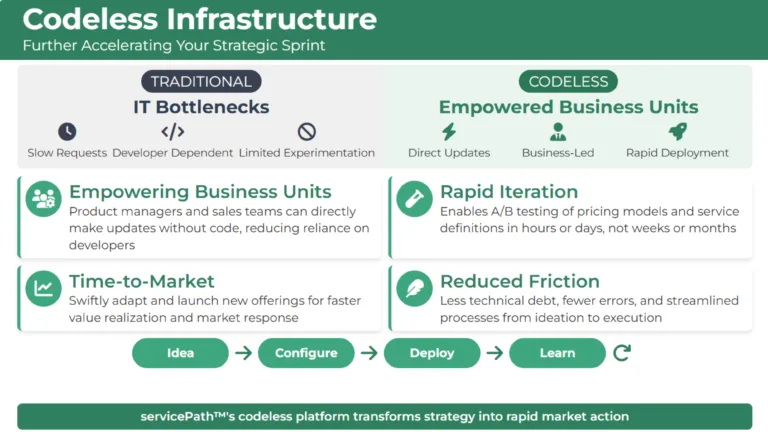
Traditionally, implementing changes to sales processes, product configurations, or service offerings meant submitting requests to overstretched IT departments or reliance on scarce developer resources. This creates bottlenecks, delays experimentation, and slows down time-to-market.
With servicePath™’s codeless environment, the power shifts directly to your business units (BUs):
- Empowering Business Units: Your product managers, sales operations teams, and service delivery specialists can directly make updates, changes, and experiments within the platform. They don’t need to write a single line of code. This dramatically reduces reliance on developers, freeing up valuable IT resources for core innovation.
- Rapid Iteration and Experimentation: Strategic initiatives often require adjustments based on market feedback or operational realities. A codeless platform enables rapid A/B testing of pricing models, new bundles, or service definitions. If a strategic hypothesis needs to be tested in the market, your BU can configure and deploy the experiment in hours or days, not weeks or months. This accelerates learning cycles and reduces the cost of failure.
- Maximizing Value and Time-to-Market: The ability to swiftly adapt and launch new offerings or modify existing ones translates directly into faster value realization. When your strategic plan calls for a new market approach, the tools for its execution are immediately accessible to those closest to the business problem. This ensures that the momentum gained in your strategic sprint isn’t lost in the implementation phase.
- Reduced Operational Friction: Codeless means less technical debt, fewer errors introduced by manual coding, and a more streamlined process from ideation to execution. This operational efficiency directly contributes to profit performance by reducing overhead and accelerating revenue capture.
A Story to Resonate
A major telecommunications provider was losing ground to nimble competitors who were launching new service bundles every few weeks. Their internal process for updating pricing and product catalogs was bogged down by a multi-week development cycle. By adopting servicePath™’s codeless infrastructure, their product marketing team gained the ability to define and launch new bundles, promotions, and pricing experiments independently. This cut their time-to-market for new offers from 6 weeks to under a week. The result? A significant uptick in new customer acquisition and an immediate reduction in customer churn, directly impacting their quarterly subscriber growth metrics and delighting shareholders.
The Non-Negotiable: AI, Deeply Embedded, Not Just a Fancy Feature
As you embrace a more agile, data-driven strategic planning approach, the tools and vendors you choose are paramount. It’s no longer enough for your technology partners to offer “AI features.” The future of your organization’s agility and competitive edge hinges on AI being deeply embedded, or “AI-native,” within the very fabric of the solutions you use.
Many vendors bolt on AI as an afterthought – a new dashboard here, a predictive analytics report there. While these can be helpful, they lack the foundational power of truly embedded AI. Forrester’s research on AI-native enterprise solutions emphasizes that “AI-native applications deliver outcomes that break traditional constraints of speed, scale and cost, enabling entirely new possibilities.”
servicePath™, built on a document database with native embeddings, is designed for this future. This architecture ensures that all your data and assets are contextually linked from the ground up. This is a critical distinction and why this level of AI-native architecture is so important for your organization’s future:
Contextual Intelligence for Sales and Strategy
When your sales teams engage with customers, they need more than just a list of products. servicePath™ enables a more intelligent sales process where:
- Salespeople ask relevant business questions and understand performance expectations. This crucial human input becomes the foundation for the system’s intelligence.
- The system then interrogates historical records, especially the service contract. This service contract acts as a living, historical record of a client’s past infrastructure, licensing, and purchasing patterns. Because it is fully searchable via servicePath™’s architecture, it provides invaluable context.
- Business rules currently, and AI in the near future, leverage this contract data. For example, the system can determine what infrastructure and licenses already exist, identify available unused licenses or extra servers, and even flag if current licensing thresholds might be exceeded with new requirements. This proactive insight ensures optimal configuration.
Avoiding “Massive Mis-Sell Challenges”

A quote generated without context is a significant risk. servicePath™ ensures that:
Pricing and performance are optimized : based on existing infrastructure alignment. A permutation engine currently works to find the best balance between price and performance, and our AI advancements will further enhance this, allowing for even more sophisticated optimization.
- The system understands if the client is solving for price or performance, or both. This crucial alignment ensures suggested solutions are not just viable but truly optimized for the client’s strategic goals.
- The rate card is intelligently referenced for discounts and relationships, often integrated with the service contract data. This ensures that pricing reflects historical relationships and potential volume discounts, preventing both overcharging and leaving money on the table.
- A “substitute feature” can be leveraged if brand sensitivity is not an issue, offering alternative solutions that meet requirements while potentially optimizing cost or performance. This prevents costly mis-sells and improves customer satisfaction.
Proactive Insights & Anomaly Detection: Truly embedded AI doesn’t just react; it anticipates. It can flag potential issues or opportunities before they become critical, based on subtle patterns across your entire asset landscape. This empowers executive teams with foresight, allowing them to make proactive adjustments to strategic initiatives rather than reactive fixes.
Dynamic Resource Optimization: Imagine an AI that can continuously analyze the performance of your strategic assets (e.g., sales pipelines, marketing campaigns, R&D projects) and recommend dynamic re-allocations of resources to maximize strategic outcomes. This isn’t a static report; it’s an intelligent, adaptive system.
Enhanced Decision Support: For executives and boards, this means access to richer, more reliable, and constantly updated intelligence. Strategic decisions can be made with a deeper understanding of cause-and-effect relationships across the organization, driven by a unified intelligence layer. This moves you from gut-feel decisions to data-informed confidence.
The Unseen Erosion: Symptoms of CPQ Distress in the Enterprise
As an executive, you might recognize the symptoms: Board meetings are getting tougher. You’re constantly being asked why margins are eroding, despite what seems like healthy sales activity. The sales teams are working harder, but the deals feel like a “race to the bottom” on price. There’s a persistent frustration that new, innovative products and complex service bundles can’t be launched quickly enough to capture fleeting market opportunities. Your strategic vision feels out of sync with your operational reality.
This isn’t just about a technology platform reaching an “End-of-Sale” status, like many legacy CPQ solutions (e.g., Salesforce CPQ, which is no longer being enhanced). The real danger is far more profound: a product that is not being enhanced means your ability to compete is actively diminishing.
A Story of Latent Sniping in Action
Imagine “OmniCorp,” a diversified services giant. Their strategic plan called for a rapid shift to X-as-a-Service (XaaS) models, requiring intricate usage-based pricing, dynamic bundling, and seamless subscription management. Their legacy CPQ system, let’s call it “QuoterPro 2000” (a reflection of the un-enhanced Salesforce CPQ), was a bottleneck.

- Revenue Leakage: Sales reps, unable to easily configure complex XaaS offerings or apply multi-layered discounts, resorted to manual overrides or simply offered flat rates to close deals quickly. This led to significant revenue leakage – not just from discounting too much, but from failing to capture potential upsells and cross-sells embedded in dynamic bundles.
- Race to the Bottom: When new market entrants arrived with agile pricing and tailored offerings, OmniCorp’s reps could only respond by cutting price. Their system couldn’t support rapid experimentation with performance-based pricing or innovative bundles. This forced them into a destructive “race to the bottom” on price, sacrificing profitability simply to compete.
- No Innovation in Product & Combos: The product team, despite identifying lucrative new market opportunities for combined offerings, faced a crippling challenge: getting these new product definitions into QuoterPro 2000 took months, requiring complex, expensive custom coding. By the time a new bundle was ready, the market opportunity had either shifted or been seized by a more agile competitor. This meant no innovation in product offerings in the very areas where market demand was exploding.
The CEO of OmniCorp eventually realized that their legacy CPQ wasn’t just a sales tool; it was a strategic impediment. It wasn’t merely the “end-of-sale” of a product; it was the end-of-growth for their strategic initiatives if they didn’t act. They were being “sniped” in the market by competitors whose systems allowed them to be infinitely more agile and commercially intelligent. The board, finally seeing the direct impact on enterprise value, greenlit a transition to a modern, AI-native, codeless platform that could support their forward-looking strategy.
Enterprise Agility as Competitive Advantage
Bain & Company’s research on enterprise agility demonstrates that “decentralised decision-making can lead to a 25% increase in organisational performance.” Their analysis reveals that organizations embracing agile methodologies across strategic planning achieve superior results through improved time-to-market, enhanced quality, and increased organizational morale.
The consulting firm’s findings align with broader market trends showing that agile organizations consistently outperform traditional hierarchical structures in VUCA environments. This competitive advantage becomes particularly pronounced in technology-driven industries where speed and adaptability determine market leadership.
The Strategic Technology Imperative
Modern strategic sprints require technology infrastructure that matches their velocity. Legacy systems that require extensive IT involvement for changes, complex coding for new product configurations, or weeks of development time for pricing adjustments cannot support strategic agility.
Organizations succeeding with strategic sprint methodology consistently choose platforms that eliminate implementation bottlenecks. They prioritize solutions where business units can rapidly test strategic hypotheses, deploy new market approaches, and iterate based on real-world feedback—all without waiting for IT resources or developer availability.
This technology transformation isn’t optional—it’s foundational to strategic sprint success. Companies attempting to implement agile strategic planning while maintaining legacy operational systems discover that implementation delays negate planning advantages.
Implementation Framework for Strategic Sprint Success
Organizations ready to embrace strategic sprint methodology should follow a structured approach:

- Phase 1: Leadership Alignment: Secure executive commitment to sprint principles, emphasizing competitive advantages over comfortable but outdated approaches. This requires board-level understanding of the competitive implications of maintaining status quo planning cycles.
- Phase 2: Framework Development: Create sprint-specific decision-making processes that maintain strategic rigor while accelerating timelines. Establish clear criteria for strategic priorities, resource allocation parameters, and success metrics that emphasize speed without sacrificing strategic depth.
- Phase 3: Technology Infrastructure: Implement AI-native, codeless platforms that eliminate implementation bottlenecks and enable rapid strategic execution. This technological foundation is critical for translating strategic decisions into market action.
- Phase 4: Cultural Transformation: Train teams in sprint methodologies while maintaining focus on strategic outcomes rather than process comfort. This includes intensive workshop techniques, rapid decision-making processes, and stakeholder engagement approaches optimized for compressed timeframes.
- Phase 5: Continuous Optimization: Establish feedback loops that continuously improve sprint effectiveness based on market results and organizational learning. Measure success through time-to-market improvements, decision quality indicators, and competitive response capabilities.
Measuring Strategic Sprint Impact
Successful strategic sprint implementation requires comprehensive success metrics that capture both speed and strategic effectiveness:
- Time-to-Market Acceleration: Measure reduction in strategic initiative deployment time. Target 40-50% improvement in time from strategic decision to market implementation, with specific benchmarks for different types of strategic initiatives.
- Decision Quality Maintenance: Track strategic decision accuracy through market response and financial performance. Sprint methodology should maintain or improve decision quality while accelerating timelines, avoiding the trap of speed at the expense of strategic rigor.
- Competitive Response Velocity: Monitor organizational ability to respond to competitive moves or market opportunities. Strategic sprints should enable response times measured in weeks rather than quarters, creating sustainable competitive advantages.
- Financial Performance Enhancement: Measure revenue acceleration and profit improvement from faster strategic implementation. Target quantifiable improvement in strategic initiative ROI, with particular attention to early revenue capture and market share gains.
- Organizational Engagement Elevation: Assess leadership and team engagement throughout strategic planning processes. Sprint methodology should increase rather than diminish strategic planning quality and participation, creating energy rather than exhaustion.
The Future of Strategic Leadership

The era of leisurely strategic planning has ended permanently. In markets demanding speed and agility, strategic sprints offer powerful alternatives to traditional marathon planning. By embracing focused planning cycles, prioritizing execution time, and demanding AI-native solutions built on foundational technologies like servicePath™’s document database with native embeddings and codeless infrastructure, organizations move beyond reactive change management to proactive future shaping.
The additional execution time gained through strategic sprints isn’t operational luxury—it represents strategic imperative for sustained competitive success. Organizations that master strategic sprint methodology will consistently outmaneuver competitors trapped in extended planning cycles, capturing market opportunities while others deliberate.
This transformation requires more than process changes—it demands fundamental shifts in how senior executives approach strategic decision-making. The rewards, however, are substantial: accelerated market responsiveness, enhanced competitive positioning, and sustainable revenue growth advantages that compound over time.
Your Strategic Sprint Imperative
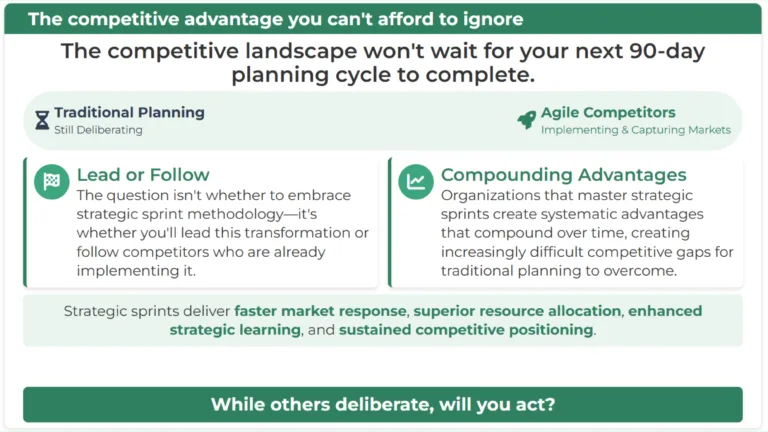
servicePath™ provides the AI-native, codeless infrastructure that transforms strategic sprint concepts into competitive reality. Our platform eliminates implementation bottlenecks that constrain strategic agility, enabling your organization to maintain strategic momentum from planning through execution. We understand that strategic advantage comes not just from superior planning, but from superior implementation velocity.
The strategic sprint revolution is underway. Your board, shareholders, and market position depend on your response speed. Organizations that embrace this methodology today will establish competitive advantages that become increasingly difficult for traditional planners to overcome. The choice is clear: evolve your strategic approach or watch agile competitors capture the opportunities you’re still planning to pursue.
Ready to accelerate your strategic advantage? Contact servicePath™ today to discover how AI-native, codeless infrastructure can transform your strategic sprint capability and deliver the competitive edge your organization demands.
Ready to Take the Next Step?
-
Read More: Explore additional blogs and insights on CPQ, quoting transformation, and digital sales enablement.
-
Download Our Case Studies: See how leading enterprises have transformed revenue operations with servicePath™.
-
Check Out Our G2 Reviews: Discover what real users love about servicePath™.
-
Recognized by Gartner: Find out why we’ve been named a Visionary in the Gartner Magic Quadrant for CPQ Application Suites three years in a row.
- Download our Whitepapers: Download our expert whitepapers to fast-track smarter CPQ decisions and watch your revenue ops run like clockwork.
-
Book a Virtual Coffee ☕ : Let’s chat about your challenges and explore how servicePath™ can help. No pressure—just insights.
Let’s grow revenue together—one smart quote at a time.
You may be interested in these articles next
Ground Truth Is the New Moat | CPQ AI Risk Framework 2026

servicePath™ Recognized as 2026 CPQ Data Quadrant Champion by Info-Tech — Top-Rated for Business Value and Governance by Enterprise Users