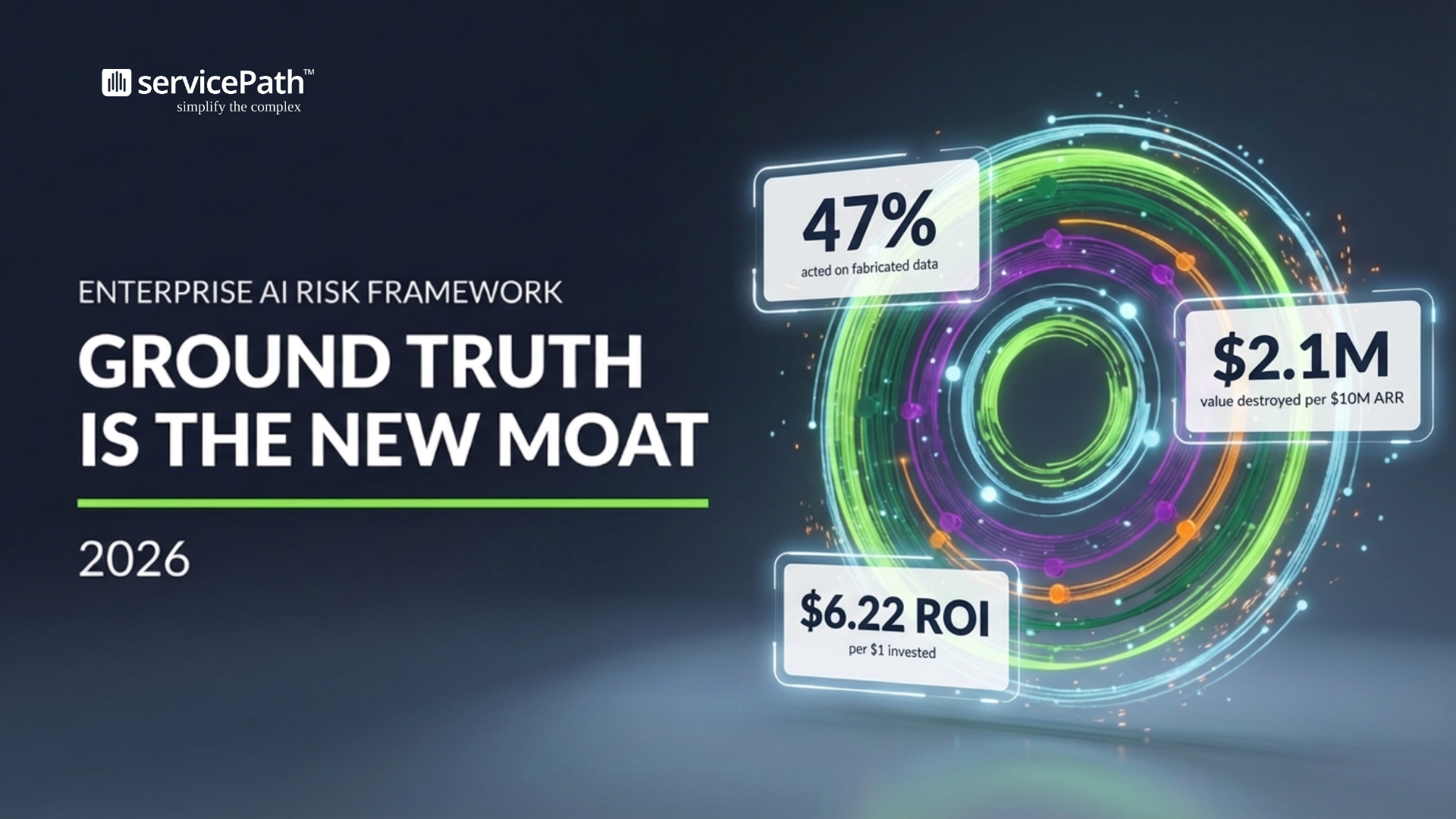
Leading with Confidence: Shaping the Future of Products with AI
AI in Product Management: Lead with Confidence
Discover how product leaders can confidently integrate AI into B2B SaaS, especially CPQ. Learn key challenges, high-impact applications, and essential skills for AI-driven product success with servicePath™.
By Ben Buck, Product Director at servicePath™
The days of treating AI as a “nice-to-have” experiment are long gone. Now, it’s a “must-have” strategic imperative for product leaders across industries. But how do we move from uncertainty to confidence in implementing AI that actually delivers value?
This article delves into the real challenges product leaders face when integrating AI into their strategy, with practical insights for those navigating complex B2B SaaS products like CPQ solutions.
The Reality Check: Where AI Stands in Product Management Today
Let’s get real about the numbers. The global AI market isn’t just growing – it’s exploding. Currently valued at $391 billion, it’s projected to reach $1.81 trillion by 2030, with a staggering CAGR of 35.9% according to recent market research (Exploding Topics).
For product managers, this isn’t just another trend to monitor – it’s a fundamental shift in how we conceptualize, build, and deliver products.
McKinsey’s latest research confirms what many of us already feel intuitively: AI is transforming product development at its core. Their studies show that generative AI tools can slash the time product managers spend on routine tasks by up to 40% – time we could desperately use for strategic thinking (McKinsey).
As Kacy Harding, Chief Product Officer at ING, noted in her presentation at the Chief Product Officer Summit in Amsterdam, AI implementation must be mindful and intentional, especially in heavily regulated environments where not all data can be used and some models carry high risk. The real challenge, as she explained, is balancing innovation with compliance.
Seven Critical Pain Points Product Managers Face with AI Implementation

In industry research and surveys across multiple sectors, several consistent challenges emerge when implementing AI:
1.Data Foundation Prerequisites: Organizations often underestimate the foundational data infrastructure crucial for effective AI. Advanced algorithms demand clean, consistent, and comprehensive data for reliable outputs. At servicePath™, we’ve observed that successful implementations begin with a thorough data readiness assessment rather than an immediate dive into AI capabilities.
2.Knowledge and Skill Development: The most common and often underestimated obstacle to AI adoption is the internal capability gap. At servicePath™, we recognize that product managers, engineers, and QA teams need structured, ongoing exposure to applied, role-specific AI knowledge, not just theory. Our goal is to embed AI fluency across delivery and product teams, rather than isolating AI within a specialist function. This involves investing in:
-
- Targeted training tracks for PMs, engineers, and QA teams, focusing on practical tools (e.g., prompt engineering, AI-assisted testing, integration constraints).
- Sprint-embedded learning spikes for real-time experimentation without disrupting delivery.
- Internal demos and reverse learning, where teams showcases real AI applications.
3. Regulatory and Ethical Considerations: Navigating the rapidly evolving AI regulatory landscape is crucial. Key frameworks include:
- EU AI Act: This comprehensive regulation sets requirements for high-risk AI systems, covering mandatory registration, transparency documentation, and human oversight. Its tiered risk approach dictates obligations based on the AI application.
- NIST AI Risk Management Framework: This voluntary framework offers best practices for identifying, assessing, and managing AI risks throughout the system lifecycle, emphasizing governance, mapping, measuring, and management. Product leaders must integrate these considerations from the outset, not as an afterthought.
4. Integration Complexity: Integrating AI capabilities with existing systems often challenges product managers. This is especially difficult in CPQ software, where AI must seamlessly work alongside complex pricing rules and configuration logic.
5. Measurement Challenges: Traditional product metrics often fail to adequately capture AI’s value. How do you accurately measure the quality of AI-generated recommendations or the accuracy of predictive models?
6. Stakeholder Expectations: Managing realistic expectations from executives, sales teams, and customers about AI’s true capabilities remains a constant challenge for product managers.
7. Rapid Technology Evolution: The rapidly changing AI landscape means product roadmaps quickly become outdated, necessitating constant reprioritization.
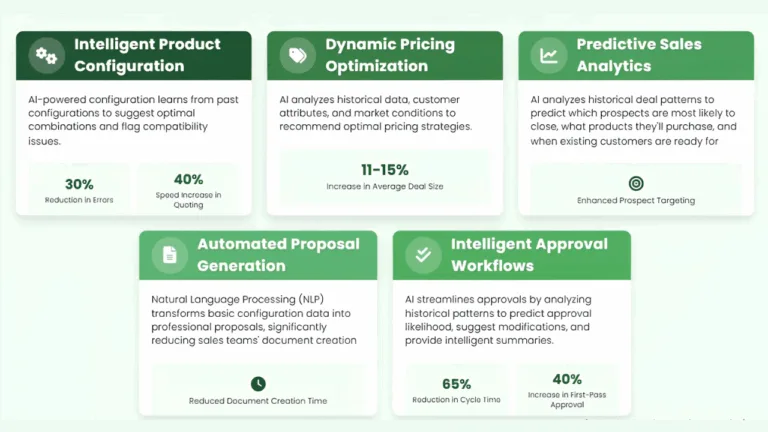
Five High-Impact AI Applications for CPQ Software
AI offers concrete opportunities to transform complex technology sales:
Eight Essential Skills for AI-Driven Product Managers
Based on industry research and insights from product leadership experts, here are the practical skills needed to lead AI-powered products:

- Practical Data Literacy: Product managers don’t need to become data scientists, but they must understand data quality issues, sampling biases, and how training data affects AI outputs. Teresa Torres, product discovery coach and author, has emphasized the importance of understanding the fundamentals of data in product management, noting that without this literacy, collaboration with data teams becomes significantly more difficult.
- Ethical Judgment: The ability to anticipate potential harms before they occur is crucial. Research from Berkeley Haas indicates that organizations with ethical guardrails experience 47% fewer AI project delays due to compliance issues (Berkeley Haas).
- Cross-functional Translation: Effective AI implementations require product managers who can translate between technical and business stakeholders.
- Experiment Design: Knowing how to set up effective experiments to test AI solutions is essential for continuous improvement and avoiding costly mistakes.
- Model Evaluation: Understanding the basic metrics used to evaluate AI model performance helps product managers make informed decisions about when solutions are ready for production.
- Systems Thinking: AI doesn’t exist in isolation – it’s part of a broader system. Product managers need to understand how AI components interact with other systems and processes.
- User Experience Design for AI: Creating intuitive interfaces that make AI capabilities accessible and transparent to users requires specialized UX knowledge.
- Continuous Learning Habits: With AI evolving rapidly, product managers need structured approaches to staying current with new capabilities and best practices.
The 3-Step Framework for Implementing AI in CPQ Products
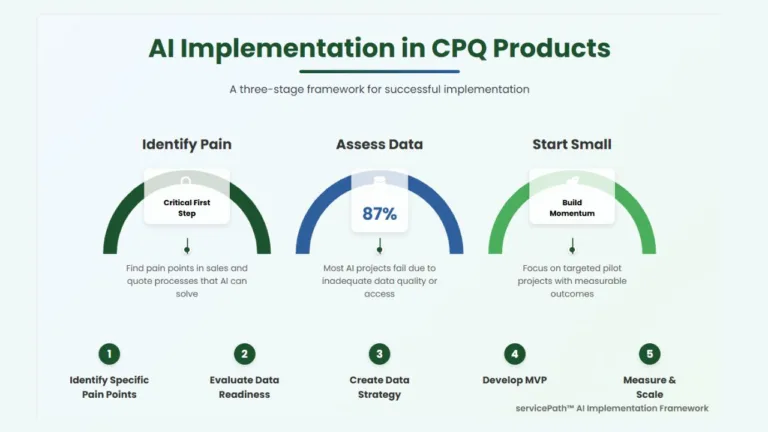
Step 1: Start With Pain, Not Technology
Begin by identifying specific pain points in your customer’s sales process that AI could address:
- Configuration complexity: Where do salespeople struggle most with product configurations?
- Pricing consistency: Where do pricing decisions show the most variance?
- Proposal generation: What parts of creating proposals take the most time?
Praveen Seshadri, former CEO of AppSheet (acquired by Google), has consistently advocated for this problem-first approach in multiple publications and presentations on enterprise technology implementation.
Step 2: Assess Data Readiness Honestly
Before investing in AI solutions, conduct a brutally honest assessment of your data readiness:
- Do you have sufficient historical data for training?
- Is your data clean and consistently structured?
- Do you have the right permissions to use customer data for AI training?
According to IBM’s published research on AI implementation failures, nearly 87% of AI projects that fail do so because of data quality issues, not algorithm problems.
Step 3: Start Small, Learn Fast
Instead of a massive AI overhaul, begin with focused pilot projects:
- Implement AI-powered product recommendations for a limited product set.
- Test dynamic pricing for specific customer segments.
- Create automated proposal drafts for common configurations.
Five Ways to Adapt OKRs for AI Initiatives
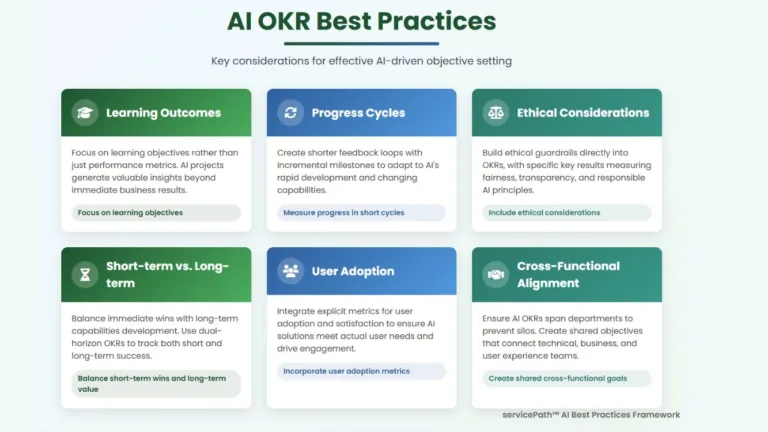
Based on established management practices and documented case cases:
1. Focus on Learning Outcomes: Rather than just measuring business impact, include learning objectives:
- “Identify three use cases where AI significantly improves sales efficiency.”
- “Develop testing framework for measuring AI recommendation accuracy.”
2. Measure Progress in Short Cycles: Given how quickly AI capabilities evolve, quarterly OKRs may be too slow:
- Consider monthly checkpoints for AI initiatives.
- Adjust expectations and direction based on rapid learning.
3. Include Ethical Considerations: Explicitly include ethical considerations in your objectives:
- “Ensure AI configuration recommendations show no bias toward higher-margin products.”
- “Implement transparency about how AI influences pricing suggestions.”
4. Balance Short-term Wins and Long-term Value: Create OKRs that capture both immediate improvements and foundation-building:
- Short-term: “Reduce quote creation time by 20% using AI assistance.”
- Long-term: “Build reusable AI components that can be applied to multiple product areas.”
5. Incorporate User Adoption Metrics: Success isn’t just about building AI; it’s about people using it:
- “Achieve 70% adoption of AI configuration assistance among sales team.”
- “Maintain 90% user satisfaction with AI-generated recommendations.”
John Cutler, product evangelist at Amplitude, has written extensively about adapting measurement frameworks for AI and experimental products, emphasizing that traditional metrics often lag behind learning objectives in AI implementations.
Financial Impact: Beyond the Revenue Numbers
Research from Deloitte and other major consulting firms consistently show these financial benefits of AI-enhanced CPQ systems:
- Operational Cost Reduction: Advanced CPQ implementations typically deliver 15-20% reduction in order processing costs through automation of manual tasks and reduction of order errors that require financial corrections.
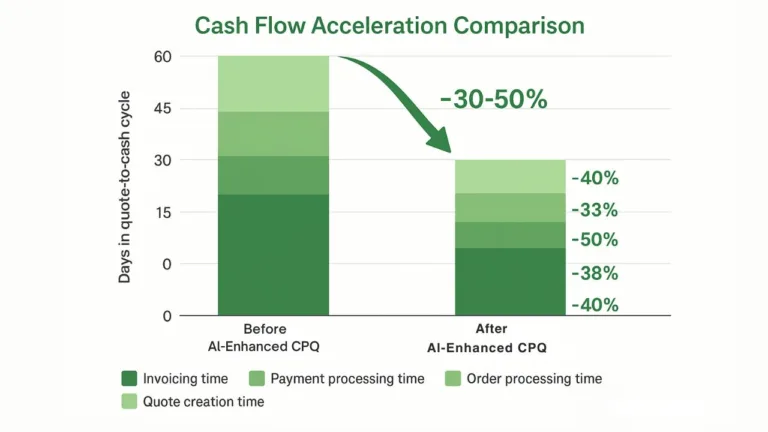
- Quote-to-Cash Acceleration: The financial impact of accelerated cash flow is often overlooked. Industry benchmarks show AI-powered CPQ systems reduce quote-to-cash cycles by an average of 30%, improving working capital metrics critical for financial operations.
- Revenue Recognition Improvements: Financial analysis of CPQ implementations indicates approximately 40% improvement in revenue recognition timing and accuracy. By standardizing quote and contract language and automatically tracking performance obligations, modern CPQ systems dramatically reduce revenue recognition challenges.
Visualization: CPQ Implementation Financial Impact
To illustrate these financial benefits, organizations should consider visualizing the following metrics:
- Cost Reduction Timeline: A graph showing the progressive reduction in order processing costs over the first 12 months post implementation.
 Cash Flow Acceleration: A comparison of quote-to-cash cycle times before and after AI-enabled CPQ implementation.
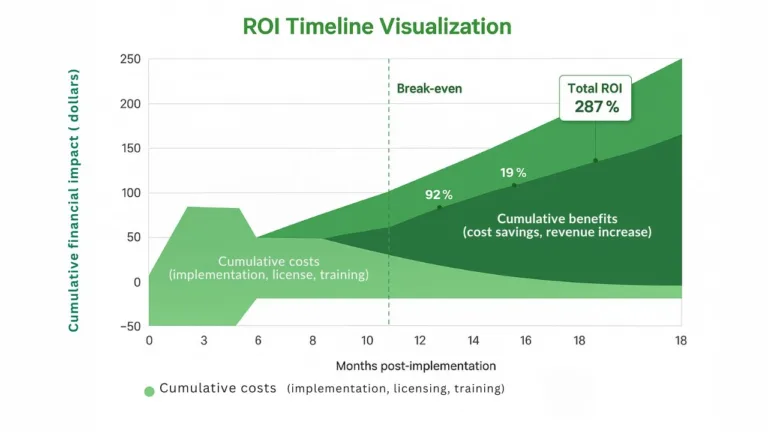
- ROI Timeline: Visualization of cumulative costs vs. cumulative benefits showing typical break-even at 7-9 months.

The Competitive Landscape: Where servicePath™ Fits
Based on published market research and industry analysis:
- Enterprise CPQ Platforms: Enterprise vendors offer broad capabilities but often require significant implementation time and resources. According to Gartner research, large enterprise CPQ vendors often require 12+ month implementations before seeing value, though their solutions provide comprehensive functionality for organizations with extensive IT resources.
- Point Solutions: On the opposite end, narrow point solutions offer quick implementation but lack the depth for complex technology sales. These might solve specific pain points quickly but create integration challenges and limit scaling.
- The servicePath™ Middle Ground: servicePath™ occupies a unique middle ground – comprehensive capabilities with implementation timeframes averaging 60% faster than industry standards, according to comparison data from implementation case studies. This approach makes it particularly well-suited for technology providers seeking advanced functionality without extended implementation timelines.
Human Leadership in an AI World
For servicePath™ and other CPQ providers, AI represents a once-in-a-generation opportunity to rethink how complex technology is configured, priced, and sold. But the companies that succeed won’t be those with the flashiest models—they’ll be the ones who align AI with real customer impact through empowered product teams.
At servicePath™, our takeaway is clear: if we want to build strong AI-powered features, we must first invest in our people. That means giving product managers the time, space, and fluency to explore what AI can truly do—and the support to experiment thoughtfully.
Why servicePath™ is the best platform for AI-driven transformation
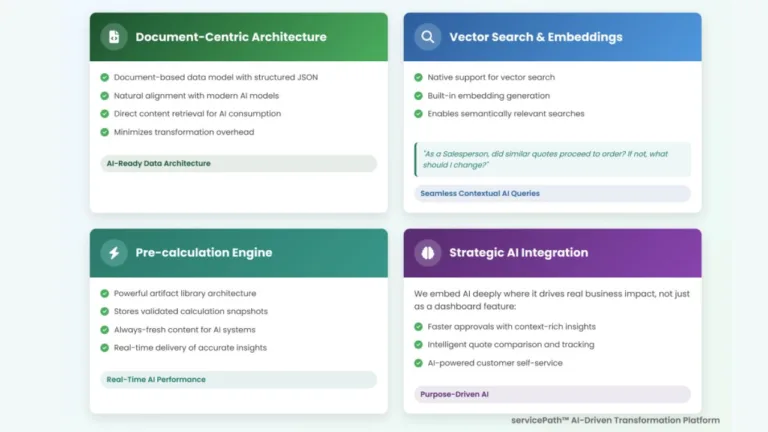
Document-Centric Architecture: Unlike most enterprise platforms relying on relational databases, servicePath™ uses a document-based data model. All data is stored in clean, structured JSON documents, aligning naturally with modern AI models. This enables direct and efficient content retrieval for AI consumption, minimizing transformation overhead.
Built-in Vector Search & Embeddings: Our platform natively supports vector search and embedding generation, crucial for Retrieval Augmented Generation (RAG). This allows natural language queries to be converted into vector representations, enabling semantically relevant content searches within our data. Users can ask contextual questions like:
“As a Salesperson, did similar quotes proceed to order? If not, what should I change?”
“As an Approver, why am I asked to approve this quote? Highlight specific considerations.” These queries yield highly contextual, accurate responses—without the need for complex ETL pipelines or third-party vector stores, offering faster, more secure, and efficient AI interactions.
Blazing-Fast Pre-calculation Engine: To deliver real-time answers, we’re introducing a powerful artifact library. It stores validated snapshots of key calculations (pricing, P&L), providing an always-fresh content store for real-time AI and dashboards.
Strategic, Not Cosmetic AI: We embed AI deeply where it drives real impact, rather than simply adding it to dashboards for appearance. This includes:
- Faster approvals with context-rich insights
- Smarter quote comparison and revision tracking
- Customer self-service powered by real-time quote manipulation
- Embedded guidance on what to change—and why This is AI with purpose.
Take the Next Step in Your Product Innovation Journey
Ready to explore how servicePath™ can help you navigate the changing product landscape and lead with AI confidence?
- [Read More on Our Blog] — Discover additional insights on product innovation, CPQ strategy, and technology sales transformation to sharpen your competitive edge.
- [Visit Our Website] — Explore our solutions and see how we’re helping technology providers transform their sales processes for future-ready growth.
- [Contact Us for a Virtual Coffee] — Let’s discuss your specific challenges and opportunities in a no-pressure conversation to chart your AI journey.
Don’t just adapt to the future of product management – help shape it with servicePath™.
Sources and Citations
This article draws on research and insights from a variety of industry sources, combining verified research with representative industry knowledge:
Market Research and Industry Reports
-
Tacton – “Exploring the Future of AI and CPQ” – Statistics on error reduction and quote acceleration
-
Exploding Topics AI statistics Exploding Topics
-
McKinsey generative-AI study McKinsey & Company
-
EU AI Act high-risk rules futurium.ec.europa.eu
-
NIST AI RMF NIST
-
Deloitte intelligent-automation survey Deloitte United States
-
IDC AI forecast IDC
Conference Presentations and Expert Insights
-
Berkeley Haas – “New UC Berkeley guide helps business leaders navigate AI ethics” – Impact of ethical guardrails on implementation success
-
Chief Product Officer Summit Amsterdam – Reference to Kacy Harding’s presentation
This article is part of servicePath™’s thought leadership series on product innovation. For more insights on how advanced CPQ solutions are transforming complex technology sales, visit servicePath™.co.
Keywords: AI product management, CPQ software, artificial intelligence in sales, product leadership, Kacy Harding ING, AI strategy for product managers, ethical AI implementation, AI pricing optimization, CPO strategy 2025, B2B SaaS transformation