The Nightmare in Product-Ville: How Ignoring Product Monsters Can Drain Your Revenue and Destroy Agility

As Halloween approaches, we’re reminded that not all monsters are found in haunted houses—some lurk within our product development processes. These ‘Product Monsters’ drain resources, slow down growth, and wreak havoc on profitability. But just like every good Halloween story, there’s a way to conquer these nightmares and emerge with powerful, market-defining solutions.
In today’s fast-paced, ever-evolving market, businesses face the challenge of creating products that meet customer demands and are scalable, flexible, and adaptable to changing market dynamics. Unfortunately, many organizations unintentionally create Product Monsters—products burdened by technical debt, inflexibility, and inaccurate pricing models. These products slow down the organization, create inefficiencies, and cause frustration among teams, eventually leading to the dreaded zombie spreadsheet death spiral.
This blog will explore how businesses can avoid this fate by creating Monster Products that thrive under changing conditions and deliver consistent value. Leveraging servicePath™ CPQ+, we’ll show how companies can streamline product development, enhance flexibility, and ultimately build solutions that drive efficiency and support ongoing growth.
Goal: Building Monster Products vs. Avoiding Product Monsters
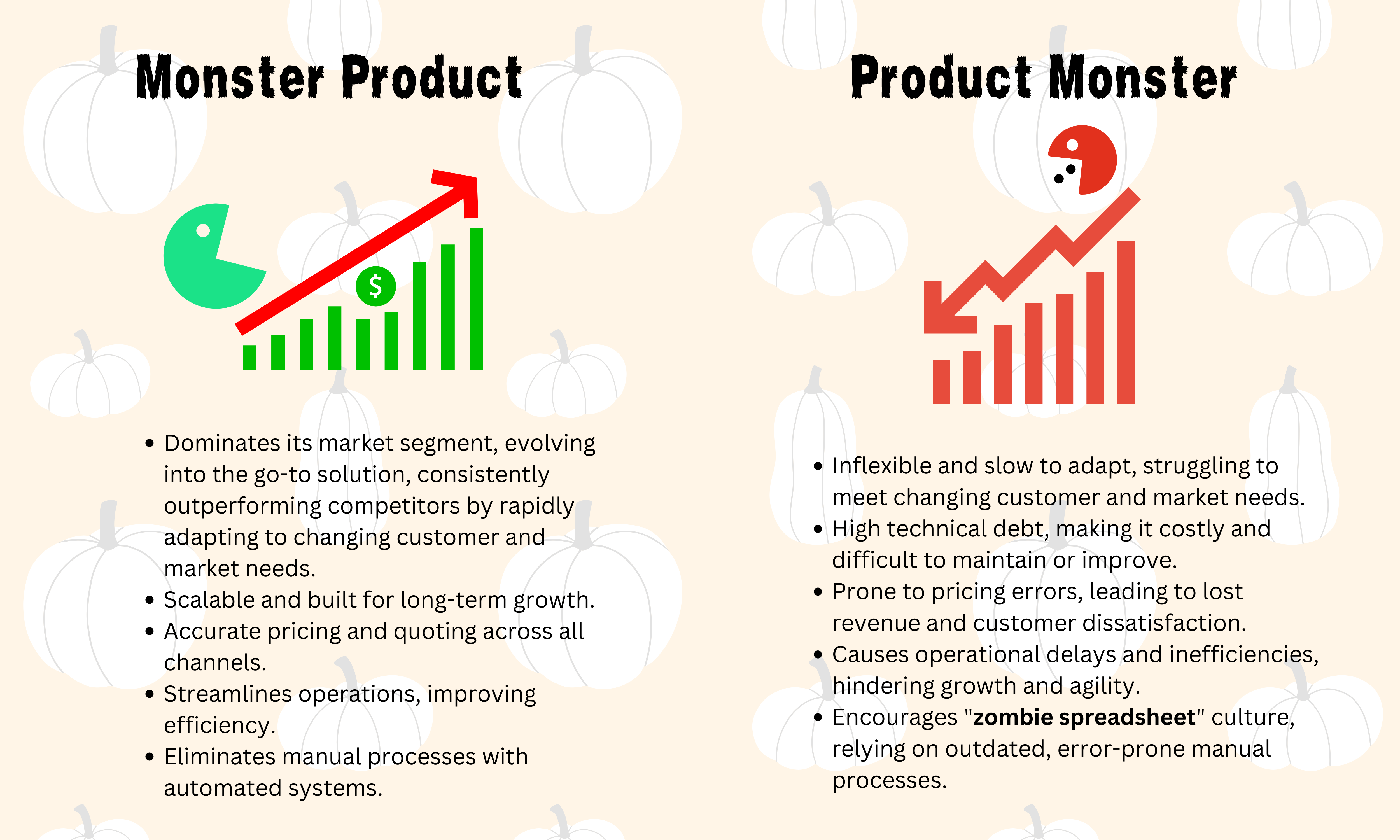
The goal is clear: businesses must focus on building Monster Products—the ones that continue to add value, remain flexible, and allow organizations to respond to new market opportunities swiftly. On the other hand, Product Monsters are problematic, leading to inefficiencies that cascade through the organization, negatively affecting everything from operations to customer satisfaction.
Characteristics of a Product Monster:
- Inflexibility: Hard to update, impossible to scale with market needs.
- Technical Debt: Over time, product complexity grows, leading to outdated technology, expensive maintenance, and limited innovation.
- Inaccurate Pricing & Costing: Misaligned pricing models lead to revenue loss and customer churn.
- Operational Bottlenecks: This creates delays, hampers market adaptability, and reduces overall efficiency.
- Zombie Spreadsheet Culture: Teams bypass systems and revert to manual processes in Excel, creating silos and inefficiencies.
In contrast, a Monster Product is agile, scalable, and highly adaptable. It is a product that can change with market demands, evolving based on customer needs while maintaining internal governance and efficiency.
Creating Monster Products with servicePath™
Avoiding Product Monsters requires the right strategy and tools. servicePath™ offers a comprehensive solution by enabling businesses to build flexible, scalable products quickly. Here’s how servicePath™ empowers organizations to turn the tide and create Monster Products:
- Agilitization: Codeless Configuration for Speed and Flexibility: In today’s market, speed is critical. servicePath™ CPQ+ offers a codeless platform that allows businesses to quickly configure new products, pricing models, and solutions without needing extensive technical resources. Product managers can respond to changing market conditions in real time, building Monster Products that capitalize on new opportunities.
- Solution Selling for Enhanced Customer Value: Rather than simply selling products, today’s market demands solution selling. servicePath™ CPQ+ enables businesses to bundle products and services into comprehensive solutions that meet customer needs. By offering end-to-end solutions, companies can increase customer satisfaction, improve retention rates, and maximize revenue.
- Managing Complexity Without Sacrificing Flexibility: A key feature of Monster Products is their ability to evolve while maintaining internal controls and governance. servicePath™ CPQ+ provides built-in rules and governance that ensure pricing, configurations, and product structures are adhered to, all while allowing the necessary flexibility to adapt to new market conditions.
- Streamlined Pricing & Quoting for Accuracy: One of the major challenges of a Product Monster is inaccurate pricing and costing, which often leads to revenue leakage. With servicePath™ CPQ+, organizations can eliminate this risk by ensuring that all pricing and quoting are automated, accurate, and consistent. This removes the need for spreadsheets, improving operational efficiency and reducing human error.
- Leveraging Customer Feedback for Continuous Improvement: Monster Products don’t just exist—they evolve. With servicePath™ CPQ+, organizations can incorporate customer feedback in real-time, allowing product managers to tweak offerings and ensure the product remains relevant, competitive, and valuable to customers over time. Continuous customer engagement and data-driven decision-making keep products from turning into monsters.
The Zombie Spreadsheet Death Spiral
In many organizations, when systems become too complex or outdated, teams revert to using spreadsheets to manage critical processes. However, spreadsheets are notoriously error-prone, and these errors often lead to costly financial mistakes and inefficiencies. A recent article from The Conversation explains, “Spreadsheets are surprisingly prone to errors. Studies have shown that nearly 90% of spreadsheets contain mistakes, and these errors can cost businesses millions” (The Conversation, 2023).
This phenomenon—”Zombie Spreadsheet Death Spiral“—occurs when employees stop using enterprise tools due to inefficiencies, slow processes, or misaligned systems. This not only creates data silos but also introduces inconsistencies, manual errors, and duplication of effort across departments.
As highlighted in our earlier blog, “Broken CPQ and Boomerang Spreadsheets”, these spreadsheets often return like a boomerang, even after organizations attempt to move to more sophisticated systems. When managing multiple projects across engineering firms, the limitations of spreadsheets become evident. Manual updates are time-consuming, error-prone, and difficult to scale, which can lead to inaccurate resource forecasting and missed deadlines.
Here are the key dangers associated with zombie spreadsheets:
- Inaccurate Data: Manual input leads to inevitable errors, and when multiple versions of the same spreadsheet exist across departments, discrepancies arise.
- Inefficiency: Teams waste time double-checking and manually consolidating data, slowing down the entire sales process.
- Rekeying Issues: Spreadsheets aren’t integrated with other business systems, leading to time-consuming and error-prone rekeying into other platforms.
- Leaking Confidential Information: Zombie spreadsheets often contain sensitive pricing and proprietary data that can easily be shared outside the organization, risking data breaches.
- Silos: Different teams develop their versions of pricing models, discounting structures, or product configurations, leading to disjointed information and decision-making.
- Lost Visibility: Decision-makers lose a comprehensive view of deals and business performance, making it difficult to identify key opportunities or bottlenecks in real-time.
The zombie spreadsheet culture not only undermines digital transformation efforts but also makes it nearly impossible for organizations to respond quickly to changing market dynamics or customer needs.
servicePath™ CPQ+ eliminates the need for manual spreadsheets by providing a unified, fully integrated platform for all pricing, quoting, and product configurations. With automated workflows and real-time data synchronization, businesses can ensure that every department works from a single source of truth. This level of transparency and accuracy allows enterprises to drive faster, more efficient sales cycles while avoiding the risks of data fragmentation and manual processes.
Moving beyond spreadsheets means embracing tools that scale with your business, provide real-time collaboration, and automate repetitive tasks. servicePath™ offers exactly that—an integrated CPQ solution that not only reduces errors but also empowers your team to focus on value-adding activities instead of manual work.
Product Monsters vs. Monster Products: Key Differences
From Product Monsters to Monster Products: The Power of Iteration
Launching a successful “Monster Product” requires following best practices, including aligning with customer needs, prioritizing features, and constantly iterating on feedback. As Daniel Kube highlights, when businesses fail to adapt or collect meaningful data, they risk developing a rigid “Product Monster”—a product that doesn’t respond to market demands and is difficult to change. On the other hand, an iterative process—one that continuously collects and responds to customer insights—enables companies to fine-tune their product, transforming it into powerful, adaptable solutions. The ability to pivot, improve, and evolve based on feedback is what separates a product that succeeds from one that stagnates. Flexibility is key: it allows you to shift from a static product to one that remains competitive and tailored to real-world demands.
Arming Yourself with the Right Tools
Organizations that succeed in today’s dynamic market are those that have the tools to respond quickly to customer and market needs. The right approach and the right CPQ solution—such as servicePath™ CPQ+—give businesses the power to build and maintain Monster Products that remain adaptable and continue delivering value long into the future.
“As a product leader working with enterprises with complex and heterogeneous business processes, I witness firsthand the growing shift toward solution selling. Businesses are no longer just offering products but delivering complete, tailored solutions to meet customer needs. servicePath™ is built to thrive in industries with highly complex pricing and configuration challenges, offering a powerful yet easy-to-maintain platform.” – Ben Buck, Product Director, servicePath™.
Flexibility, Scalability, and Governance
Building Monster Products is not just about quick wins; it’s about sustaining growth, efficiency, and adaptability over time.
“As a leader, building a product that works today isn’t enough—you need one that leads tomorrow. Just like in hockey, where champions are made by constantly adapting on the ice, Monster Products thrive through innovation, agility, and real-time iteration. They drive growth and profitability by staying ahead of customer needs and market trends. The businesses that succeed are those that, like the best teams, evolve their strategy, continuously delivering value and staying competitive.” – Daniel Kube, CEO, servicePath™.
With servicePath™ CPQ+, businesses can avoid creating Product Monsters and instead focus on building flexible, scalable, and adaptable products to future needs.
As market demands evolve, servicePath™ CPQ+’s codeless flexibility and built-in governance make it easy to create products that are as agile as they are powerful, ensuring ongoing success.