Hyperautomation
Synonyms
- Intelligent Process Automation (IPA)
- Advanced Automation
- Smart Automation
What is Hyperautomation?
Hyperautomation is a business-driven, holistic approach to scaling automation across an organization using a blend of cutting-edge technologies such as Artificial Intelligence (AI), Machine Learning (ML), Robotic Process Automation (RPA), and analytics.
Coined and defined by Gartner, hyperautomation aims to identify, prioritize, and automate as many workflows and processes as possible—spanning both IT and business functions. Unlike basic task automation, hyperautomation is about creating a fully automated, intelligent, and adaptable ecosystem where systems can not only act but also learn, adapt, and optimize.
How Hyperautomation Differs from Traditional Automation
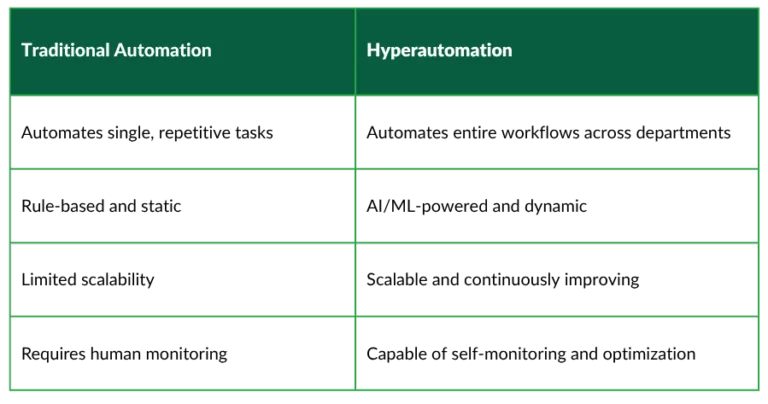
Example:
While automation might send a follow-up email after a sales call, hyperautomation could evaluate customer behavior, score the lead using AI, generate a dynamic quote, and route it for approval—all with minimal human intervention.
Automate Smarter. Scale Faster. Win with servicePath™
Common applications:
Organizations are deploying hyperautomation to drive efficiency, reduce costs, and accelerate digital transformation across multiple business functions. The most common applications include:
- Sales & Revenue Operations
- Automating CPQ (Configure, Price, Quote) workflows
- Generating instant, error-free proposals
- Streamlining approvals, renewals, and contract management
- Customer Experience & Support
- AI-powered chatbots and self-service portals
- Intelligent call routing and ticket resolution
- Predictive service interventions using IoT data
- Finance & Compliance
- Automated invoicing, billing, and collections
- Continuous compliance monitoring and audit trails
- Fraud detection and risk management powered by AI
- IT & Infrastructure
- Automated provisioning of cloud services
- Self-healing IT operations (AIOps)
- Security orchestration and threat detection
- Field Service & Operations
- Dynamic scheduling and dispatch optimization
- Robotics integration for repetitive tasks
- Predictive maintenance based on sensor data
- HR & Workforce Management
- Intelligent resume screening and onboarding workflows
- Automated payroll and benefits administration
- AI-driven workforce analytics for planning and retention
Key Benefits of Hyperautomation
- Faster Time-to-Value
Automates complex, multi-step processes across departments, reducing cycle times from weeks to days. - Cost Optimization
Cuts operational overhead by eliminating manual work, minimizing errors, and lowering compliance costs. - Improved Accuracy & Compliance
Reduces human error in quoting, billing, and reporting while ensuring continuous compliance with regulatory standards. - Scalability & Flexibility
Allows organizations to scale operations quickly without proportionally increasing headcount, adapting to growth and market shifts seamlessly. - Enhanced Customer Experience
Supports 24/7 self-service, faster resolutions, and personalized engagement powered by AI-driven insights. - Workforce Empowerment
Frees employees from repetitive tasks, allowing them to focus on higher-value strategic work and innovation. - Revenue Growth Acceleration
Enables faster quoting, pricing, and deal execution — turning market opportunities into booked revenue before competitors can react.
Hyperautomation vs. Other Approaches
Real-World Examples of Hyperautomation
- Financial Services – Banks use hyperautomation to streamline KYC (Know Your Customer) processes, combining RPA for data collection with AI-driven risk scoring.
- Healthcare – Hospitals automate patient intake, claims processing, and predictive diagnostics using AI-enhanced workflows.
- Manufacturing – Robotics, IoT sensors, and AI collaborate to enable predictive maintenance, automated supply chains, and self-correcting production lines.
- Telecommunications – Service providers deploy hyperautomation for customer onboarding, billing, and intelligent network optimization.
- Technology Sales – Enterprises use hyperautomation in CPQ processes: configuring complex AI/robotics bundles, generating instant pricing, automating approvals, and accelerating contract closure.
Frequently Asked Questions (FAQs)
1. How is hyperautomation different from RPA?
RPA automates individual tasks, while hyperautomation combines RPA, AI, and orchestration to automate entire business processes across departments.
2. Is hyperautomation only for large enterprises?
No — while early adopters have been Fortune 500 firms, SMBs are increasingly adopting hyperautomation tools to compete on agility and efficiency.
3. What are the main risks of hyperautomation?
4. Can hyperautomation improve customer experience?
5. Where should companies start with hyperautomation?
Turning Hyperautomation Into Competitive Advantage
Hyperautomation isn’t just a technology trend — it’s the execution engine of digital transformation. By orchestrating AI, RPA, and advanced workflows, organizations move faster, scale smarter, and deliver measurable business outcomes.
For executives, the choice isn’t whether to adopt hyperautomation but how quickly to align it with revenue-critical processes. Companies leveraging platforms like servicePath™ CPQ+ are already closing deals faster, scaling complex service portfolios, and capturing high-DOC opportunities before competitors.