Enterprise-Led Growth (ELG)
Synonyms
- Sales-Led Growth (SLG)
- Enterprise Sales Model
- Key Account Growth
What is Enterprise-Led Growth (ELG)?
Enterprise-Led Growth (ELG) is a go-to-market (GTM) strategy where growth is primarily driven by direct sales and strategic initiatives targeting large enterprise accounts, rather than relying solely on product-led or marketing-led tactics.
In ELG models, organizations focus on high-value, long-cycle deals with complex procurement processes, tailoring solutions to meet the unique needs of enterprise customers. This often requires specialized sales teams, deep industry knowledge, and advanced configuration, pricing, and quoting (CPQ) capabilities.
Key Characteristics of Enterprise-Led Growth
- Account-based focus – Prioritizes fewer, high-value enterprise customers rather than mass-market acquisition.
- Solution customization – Adapts offerings to fit unique enterprise needs and compliance requirements.
- Executive engagement – Involves C-level relationships and multi-stakeholder buy-in.
- Long sales cycles – Deals can take months or even years to close, requiring structured deal orchestration.
- Complex deal structures – Often includes multi-year contracts, custom pricing models, and service-level agreements (SLAs).
The CPQ Engine for Enterprise-Led Growth—servicePath™
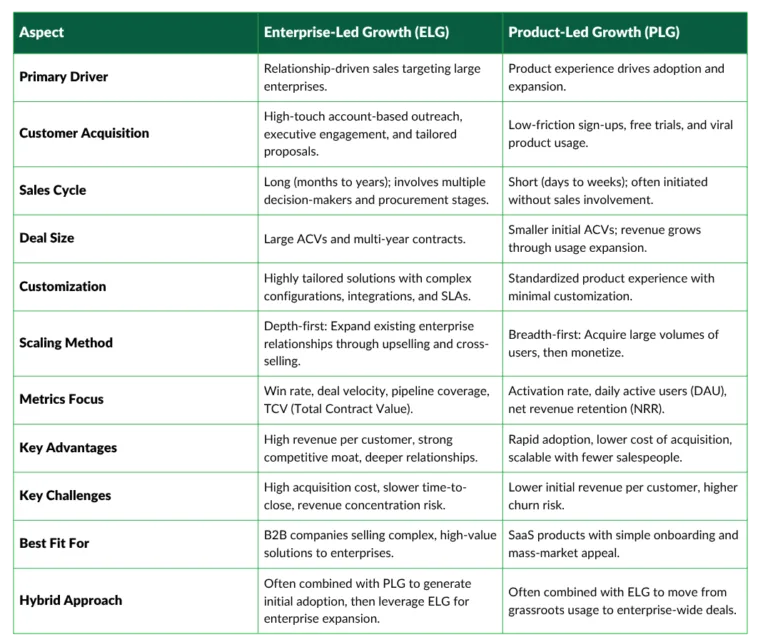
Enterprise-Led Growth (ELG) vs. Product-Led Growth (PLG)
Benefits of Enterprise-Led Growth (ELG)
- Unlock Higher Annual Contract Values (ACVs) – ELG targets fewer, larger deals, often in the six- to seven-figure range, delivering a predictable, high-margin revenue stream.
- Forge Strategic, Long-Term Partnerships – Deep engagement with enterprise stakeholders builds trust, loyalty, and multi-year commitments that competitors struggle to disrupt.
- Create a Defensible Competitive Moat – Custom integrations, tailored workflows, and contractual lock-ins make it harder for rivals to replace your solution.
- Align Seamlessly with Enterprise Buying Cycles – ELG adapts to procurement processes, compliance requirements, and governance standards, accelerating deal approval while reducing legal friction.
- Maximize Expansion and Cross-Sell Potential – Once inside the enterprise, account teams can grow deal size through add-on modules, global rollouts, and service upsells.
- Drive Executive-Level Influence – C-suite relationships enable strategic co-planning, unlocking budget and aligning your solution with enterprise transformation goals.
Challenges of Enterprise-Led Growth (ELG)
- Higher Cost of Sales – Specialized enterprise sales teams, solution engineers, and bid managers require significant upfront investment before revenue is realized.
- Longer Sales Cycles – Multi-stakeholder approvals, legal reviews, and procurement processes can extend timelines from months to over a year, impacting cash flow.
- Complex Delivery and Implementation – Enterprise rollouts often demand custom integrations, data migration, security compliance, and multi-phase deployments, requiring robust project management.
- Revenue Concentration Risk – Heavy reliance on a handful of enterprise accounts means that losing one major contract can create a material revenue gap.
- Competitive, High-Stakes Deal Environment – ELG opportunities often attract multiple established vendors, meaning margins and win rates depend heavily on differentiation.
Real-World Example
Oracle’s Intelligent Cloud and Enterprise Sales Strategy
Oracle effectively embodies ELG by leveraging its “intelligent cloud” portfolio in conjunction with a high-touch enterprise sales approach. Their go-to-market playbook includes tailored solutions for large enterprises, such as autonomous database platforms and industry-specific cloud stacks, bundled with strategic, consultative selling and multiyear licensing agreements.
- Oracle’s enterprise motion often begins with detailed discovery and architecture workshops, custom integration blueprints, and compliance-driven value propositions—especially for regulated sectors like finance and healthcare.
- They then engage executive stakeholders in both product and IT leadership with a value-aligned roadmap – all aiming to build long-term, high-value contracts that integrate deeply across the customer’s infrastructure and business operations
Why Enterprise-Led Growth (ELG) Matters to Enterprise Businesses Today
1. Delivers Strategic Revenue Stability
- In a business climate marked by volatility and digital transformation, enterprise-led strategies provide high-value, predictable revenue streams from large accounts. This steadiness is a key growth lever for resilient enterprises.
- For example, as businesses prioritize digital reinvention, cash flow predictability becomes essential—and ELG is a proven way to deliver it.
2. Enables Tailored, Secure, and Compliant Scaling
- ELG empowers enterprises to pitch customized, secure solutions—with flexible pricing, specialized SLAs, and infrastructure optimized for performance, cost, and governance.
- That level of precision and control is crucial when deploying enterprise-wide platforms like AI-enabled or cloud-native systems.
3. Supports Strategic Technology Leadership
- With agentic AI and integrated enterprise tools on the rise, companies adopting ELG can lead high-stakes transformation, aligning tailored solutions with long-term business goals.
- Firms that integrate advanced tech via ELG motions—rather than off-the-shelf offerings—achieve stronger differentiation and operational impact.
4. Bridges Bottom-Up Adoption to Top-Down Sales
- Leading software companies are increasingly blending PLG with ELG—initiating with product-led adoption, then expanding through enterprise sales. ELG unlocks strategic cross-sell, upsell, and expansion pathways for in‑market customers.
- This hybrid strategy amplifies scale while maintaining enterprise-level contract sophistication.
Related Terms
- Account-Based Marketing (ABM)
- Product-Led Growth (PLG)
- Customer-Led Growth (CLG)
- Sales-Led Growth (SLG)
- Key Account Management (KAM)
Frequently Asked Questions (FAQs)
1. What is Enterprise‑Led Growth (ELG)?
A go‑to‑market motion where growth is driven by high‑touch enterprise sales—custom solutions, complex pricing, and multi‑stakeholder buy‑in—often supported by CPQ and deal‑desk processes.
2. How is ELG different from PLG or Sales‑Led Growth?
PLG relies on self‑serve product adoption; ELG leans on human‑led enterprise selling. Most modern GTM blends both (product‑led for entry, enterprise‑led for expansion).
3. How long do enterprise sales cycles take?
Benchmarks vary by product and deal size, but enterprise cycles commonly span 6+ months, with many teams reporting lengthening cycles post‑2022.
4. What is CPQ and why does it matter in ELG?
CPQ (Configure‑Price‑Quote) automates complex configuration, pricing, and proposal generation—reducing errors and speeding approvals in enterprise deals.
Turning ELG Strategy into Measurable Wins
In today’s competitive B2B landscape, Enterprise-Led Growth isn’t just a sales methodology—it’s a disciplined approach to building deep, profitable, and defensible relationships with your most valuable customers.
It delivers predictable high-margin revenue, strengthens your competitive position through tailored solutions, and positions your business as a long-term strategic partner.
But executing ELG at scale requires precision: accurate configurations, transparent pricing, fast approvals, and seamless contract generation.
Ready to take the Next Step?
This is where servicePath™ gives you the edge—eliminating friction in even the most complex deals so your sales, finance, and delivery teams can operate in lockstep.
📞 Contact us for a demo | 📚 Explore success stories | 🎧 Listen to our CEO’s podcast with Frank Sohn