Clawback
Synonyms
- Compensation Recovery
- Bonus Recoupment
- Pay Reversal
- Commission Reclaim
- Earnings Reimbursement
- Incentive Reversal
- Retroactive Pay Adjustment
- Post-Payout Recovery
- Remuneration Reclaim
- Financial Restitution
- Reimbursement Clause
- Earnings Recapture
- Award Forfeiture (when funds are not yet disbursed)
- Deferred Compensation Reversal
What is Clawback?
A clawback is a contractual provision that enables an organization to recover previously paid compensation, commissions, or bonuses under specific conditions. Typically triggered by misconduct, policy violations, or unmet performance criteria, clawback clauses are commonly used in executive compensation, employee incentive plans, and B2B sales agreements to ensure fairness, compliance, and accountability.
Clawbacks function as a safeguard mechanism, allowing companies to retrieve payments or benefits if it’s later determined that they were awarded inappropriately or under false pretenses. This provision can apply to:
- Executive bonuses
- Sales commissions
- Stock options or RSUs
- Severance packages
Why Do Businesses Use Clawbacks?
Clawback clauses are essential in protecting an organization from:
- Unjust enrichment: Reclaim bonuses tied to false reporting or unearned performance.
- Regulatory scrutiny: Align with financial compliance mandates (e.g., Dodd-Frank Act).
- Reputation risk: Demonstrate proactive risk mitigation to stakeholders.
- Operational fairness: Ensure incentives reflect actual value creation and behavior.
Smarter Commissions. Built-In Clawback Controls—With servicePath™
Common Triggers for Clawbacks
Clawbacks are typically activated when:
- A customer cancels a deal or subscription shortly after a sales commission is paid
- An executive is found guilty of fraud, misconduct, or ethics violations
- A company restates financials due to errors or misreporting
- An employee fails to meet post-termination obligations
- A product or service fails to meet defined milestones or terms in the contract
Types of Clawbacks
- Sales Commission Clawbacks : Reclaim commission payouts if the customer churns, returns a product, or fails to pay within a set timeframe.
- Executive Compensation Clawbacks : Recover bonuses, equity grants, or long-term incentive payouts if tied to metrics later proven inaccurate.
- Equity Clawbacks : Used in startups and public companies to retract stock options or RSUs under breach-of-contract conditions.
- Severance Clawbacks : Triggered when a terminated employee violates post-employment restrictions (e.g., non-compete, NDA).
Benefits of Clawback Provisions
- Ensures Financial Fairness – Aligns rewards with long-term results and integrity.
- Strengthens Risk Management – Minimizes exposure to fraud and unethical behavior.
- Boosts Investor Confidence – Shows accountability and governance in executive pay.
- Protects Revenue – Sales clawbacks deter frontloading of commissions on unstable deals.
- Regulatory Alignment – Satisfies legal requirements in industries like finance and healthcare.
Potential Challenges
- Employee Pushback – Perceived as punitive if not communicated transparently.
- Legal Complexity – Must comply with employment law and contract law in various jurisdictions.
- Dispute Risk – Improperly drafted clauses can result in litigation.
- Enforcement Difficulty – Especially when trying to claw back funds from former employees.
Best Practices for Implementing Clawback Policies
- Be Transparent – Clearly outline clawback conditions in compensation or employment contracts.
- Define Scope – Specify exact triggers, amounts, and timeframes for recoupment.
- Review Periodically – Update clauses in response to legal, financial, or business changes.
- Integrate with HR & Finance – Ensure cross-functional visibility for enforcement and tracking.
- Balance with Culture – Avoid eroding trust; position clawbacks as risk controls, not punishments.
Clause Example (Sample)
“In the event of client cancellation within 120 days of initial contract signing, the employee agrees to repay any commission amounts previously disbursed for said deal. This clawback applies to contracts canceled due to non-payment, early termination, or breach of service terms.”
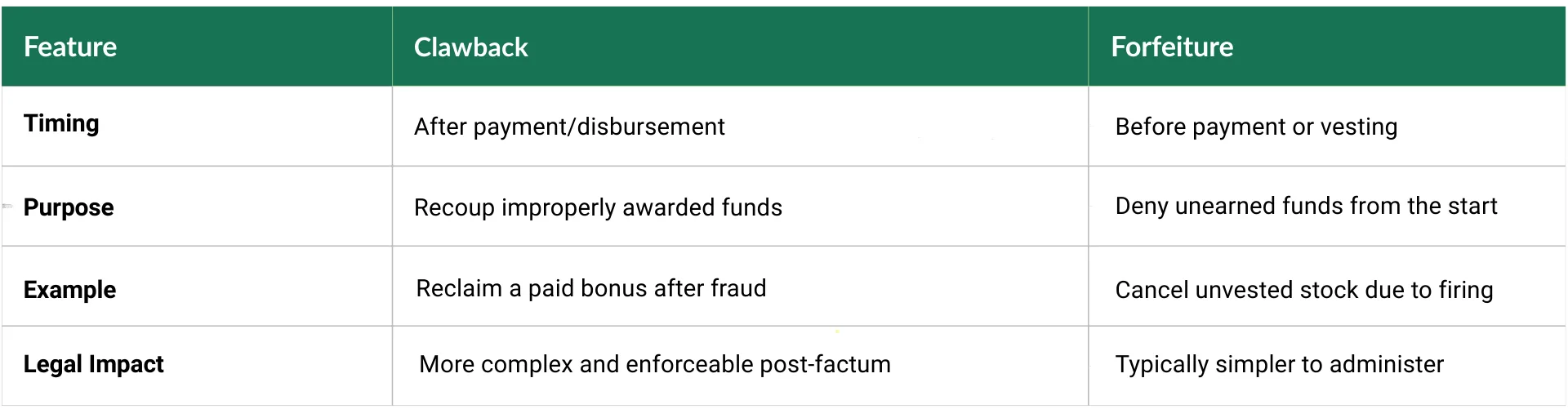
Clawback vs. Forfeiture
Industry Use Cases
Industry Use Cases
- SaaS: Recover commissions from churned customers within defined windows.
- Banking/Finance: Reclaim bonuses tied to misstated earnings or failed compliance audits.
- Healthcare: Reverse incentive payouts tied to metrics later deemed manipulated.
- Technology Startups: Apply equity clawbacks when founders violate IP or confidentiality terms.
Real-World Example
Related Terms
- Chargeback
- Withholding
- Incentive reversal
- Bonus repayment
- Earn-out adjustment
- Penalty provision
- Compensation recovery
- Deferred compensation
- Performance-based payout
- Contractual adjustment
- Vesting reversal
- Adjustment clause
- Compliance penalty
- Financial restitution
- Escrow arrangement
Frequently Asked Questions (FAQs)
1. Are clawback clauses enforceable in all jurisdictions?
Not always. Enforcement depends on local labor laws and the specific language in the contract.
2. Who typically writes clawback policies?
3. Can clawbacks apply to stock options?
4. How long can a clawback period be?
Typically ranges from 6 months to 2 years, depending on deal cycle or performance criteria.
5. Do clawbacks apply to terminated employees?
Turn Clawback Risk into Revenue Certainty
With servicePath™’s advanced CPQ and revenue operations tools, you can seamlessly automate complex commission logic, precisely track clawback eligibility timelines, and effortlessly embed clawback enforcement directly into your contract workflows. Achieve greater revenue predictability, protect margins, and confidently uphold regulatory compliance.
Ready to take the Next Step?
📞 Contact us for a demo | 📚 Explore success stories | 🎧 Listen to our CEO’s podcast with Frank Sohn