
Balance Sheet
Synonyms
- Statement of Financial Position
- Financial Position Statement
What Is a Balance Sheet?
A Balance Sheet is a fundamental financial statement that provides a snapshot of a company’s financial position at a specific point in time. It outlines the company’s assets, liabilities, and shareholder equity, illustrating how resources are financed—either through debt or owner investment.
The balance sheet, also known as the statement of financial position, summarizes what a company owns and owes. It adheres to the core accounting equation:
Assets = Liabilities + Shareholders’ Equity
This equation ensures that the sheet is always “balanced,” reflecting a company’s solvency and financial structure. It’s a critical tool for internal stakeholders, investors, lenders, and auditors to evaluate a business’s financial health, liquidity, and risk exposure.
Components of a Balance Sheet
A standard balance sheet includes three primary sections:
Assets
Resources owned or controlled by the company that have future economic value.
- Current Assets: Cash, accounts receivable, inventory, short-term investments
- Non-Current Assets: Property, equipment, long-term investments, intellectual property
Liabilities
Obligations the company owes to others.
- Current Liabilities: Accounts payable, short-term debt, accrued expenses
- Long-Term Liabilities: Loans, bonds payable, lease obligations
Shareholders’ Equity
The residual interest in the company after liabilities are deducted from assets. Includes:
- Common stock
- Retained earnings
- Treasury stock
- Additional paid-in capital
One Platform. Total Financial Clarity—servicePath™
Importance of a Balance Sheet
- Financial Transparency: Offers a clear view of what the company owns and owes at a specific moment.
- Performance Tracking: Compares financial health over time to track growth or risk.
- Stakeholder Confidence: Investors, analysts, and creditors rely on balance sheets to assess creditworthiness and strategic direction.
- Regulatory Compliance: Required for reporting under accounting standards (GAAP, IFRS) and public disclosure.
- Business Planning: Assists executives in making data-driven decisions related to expansion, cost control, or M&A.
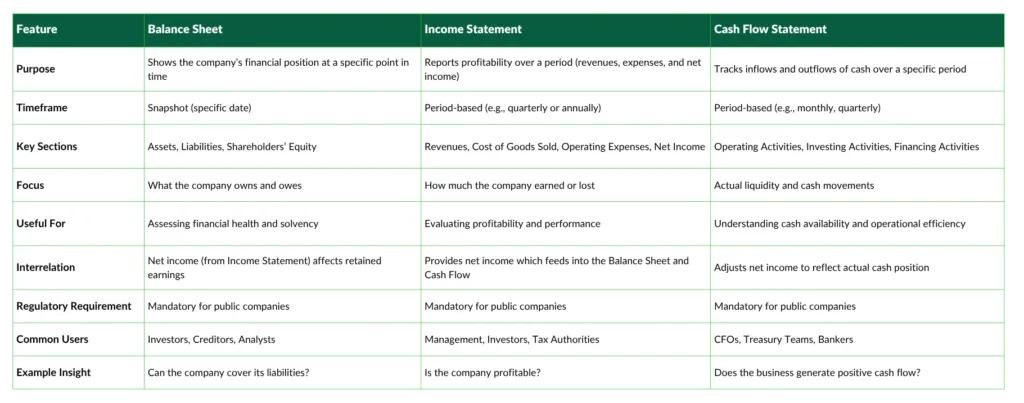
Balance Sheet vs. Income Statement vs. Cash Flow Statement
Balance Sheets in SaaS and B2B Contexts
- Deferred Revenue (a liability) represents unearned income from prepaid contracts.
- Recurring Revenue Assets reflect stable customer value and can impact valuation.
- Capitalized Costs of Customer Acquisition (CAC) appear under non-current assets.
For organizations leveraging CPQ platforms like servicePath™, automated integrations with ERP or finance tools ensure balance sheet updates remain accurate and real-time—especially as contract values and billing terms change dynamically.
Use Cases of Balance Sheet Analysis
Banks and investors evaluate liabilities and working capital to assess borrowing risk.
Investment Evaluation
Balance sheet strength influences valuation, investor confidence, and acquisition potential.
Performance Monitoring
Compare current and historical balance sheets to identify trends in liquidity, solvency, or leverage.
Operational Decisions
Use asset-to-liability ratios to inform hiring, budgeting, and capital investment strategies.
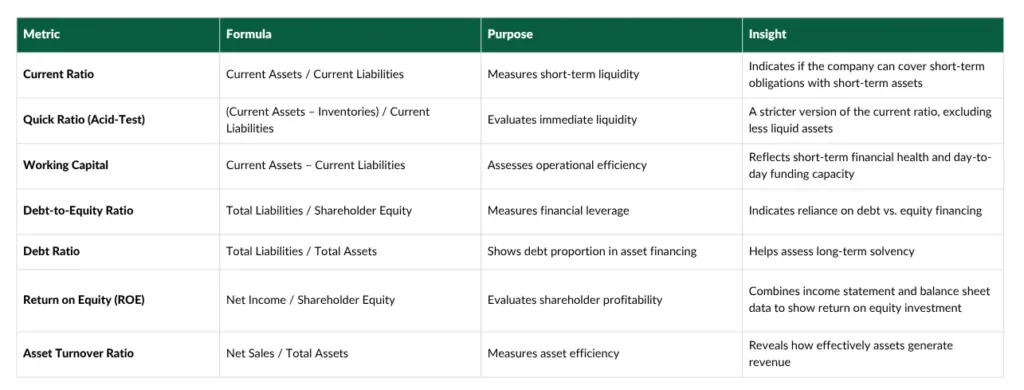
Common Balance Sheet Metrics
Challenges in Balance Sheet Management
- Valuation Complexity: Assets like goodwill or IP may lack clear market value.
- Timing Issues: A balance sheet only captures a single point in time—limiting visibility into day-to-day operations.
- Data Integrity: Manual updates or delayed reporting can introduce inaccuracies.
- Cross-Department Disconnect: Finance may not have real-time visibility into changes triggered by Sales, RevOps, or CPQ tools.
A modern financial stack integrated with quoting and revenue systems like servicePath™ CPQ+ ensures real-time balance sheet alignment.
Best Practices for Effective Balance Sheet Management
✅ Automate Data Capture
Leverage integrations with CPQ, CRM, and ERP tools to streamline balance sheet reporting.
✅ Standardize Accounting Practices
Align with GAAP or IFRS frameworks to ensure regulatory compliance and consistency.
✅ Monitor Liquidity & Solvency
Track current ratios, debt levels, and cash reserves to support financial agility.
✅ Align With Strategic Planning
Use balance sheet insights to guide expansion, hiring, M&A, and capital allocation decisions.
✅ Ensure Audit Readiness
Maintain detailed audit trails and reconciliation reports across revenue-related tools.
Related Terms
- Income Statement
- Cash Flow Statement
- Assets
- Liabilities
- Equity
- Current Assets
- Current Liabilities
- Retained Earnings
- Financial Statement
- Chart of Accounts
- Double-Entry Accounting
- Liquidity
- Solvency
- GAAP
- IFRS
Frequently Asked Questions (FAQs)
1. What is a balance sheet?
A balance sheet is a financial statement offering a snapshot of a company’s assets, liabilities, and shareholders’ equity at a specific point in time, following the formula Assets = Liabilities + Equity.
2. Why is the balance sheet important?
It helps assess a company’s financial health—liquidity, solvency, capital structure—and is essential for investors, creditors, and internal decision-making.
3. What are the key components of a balance sheet?
It includes: Assets (current and noncurrent), Liabilities (current and long-term), and Shareholders’ Equity—including retained earnings and paid-in capital.
4. How often should a balance sheet be prepared?
It’s commonly prepared monthly for smaller businesses, and quarterly or annually for larger organizations, aligning with reporting cycles and financial oversight needs.
5. How does the balance sheet differ from the income and cash flow statements?
The balance sheet offers a static snapshot of financial position; the income statement shows performance over time, and the cash flow statement details the movement of cash in three categories—operating, investing, and financing.
6. What are common mistakes when preparing a balance sheet?
Errors often include data entry mistakes, omissions, misclassification of items, or inconsistent valuation methods across periods. Consistent review and reconciliation are vital.
7. What critical ratios can be derived from a balance sheet?
Key financial ratios include working capital, debt-to-equity, current ratio, and quick ratio—helpful for assessing liquidity and capital structure.
8. Why do balance sheets sometimes not “balance”?
Discrepancies usually stem from missing entries, recording errors, or calculation mistakes. Ensuring double-entry accounting and reconciliations helps maintain accuracy.
The Balance Sheet’s Enduring Value
In a business world where speed and adaptability are critical, the balance sheet serves as a reliable anchor. By regularly reviewing and understanding this statement, organizations can spot potential problems early, identify opportunities for improvement, and build a foundation for sustainable success.
Ready to take the Next Step?
📞 Contact us for a demo | 📚 Explore success stories | 🎧 Listen to our CEO’s podcast with Frank Sohn