From Rules to Revenue: Edward Golod on AI’s CPQ Transformation for High-Velocity RevOps & Sales Success
servicePath™ presents Ed Golod’s insights on AI transforming CPQ. Learn how to drive revenue and RevOps success with deterministic AI. Your 2025+ playbook.
Success in 2025 & Beyond
In a business world changing at lightning speed, Artificial Intelligence isn’t just a buzzword—it’s the engine driving the next wave of sales transformation. For leaders and senior executives, understanding and strategically using AI within Configure-Price-Quote (CPQ) systems is no longer optional; it’s critical for growth, efficiency, and staying ahead. This guide cuts through the noise, offering a practical playbook based on 2025 insights and future projections, designed to help you turn AI potential into real-world results for your enterprise.
As seasoned business leader Edward Golod starkly puts it, the impact of AI could be “10,000 times” that of previous technological shifts. This isn’t about hype; it’s about a fundamental change in how deals are won and revenue is generated. With 78% of companies already using AI in 2024 (Stanford HAI AI Index Report 2025), the challenge now is smart, strategic integration, especially in core revenue operations like CPQ. This playbook will help you navigate this new landscape, focusing on actionable strategies to make your CPQ an AI-powered engine for success, subtly positioning your organization, like servicePath™, as a leader in this evolution.
1. The AI Wake-Up Call: Are You Leading or Being Led?
Leadership Pain Point: AI is evolving at breakneck speed. Without a firm grasp, leaders risk flawed strategies, missed opportunities, and ceding control to the technology itself. How can you effectively command AI without becoming a technical expert?
“AI is a fast-moving weapon of control—master it, or it masters you.” – Edward Golod
This stark warning from enterprise veteran Edward Golod cuts to the heart of a critical challenge for leaders in 2025: achieving strategic mastery over Artificial Intelligence. It’s not about coding; it’s about understanding AI’s capabilities, limits, and strategic implications to steer your organization effectively.
In the high-stakes world of B2B sales and CPQ, where AI-driven decisions directly impact revenue, this literacy means asking tough questions and demanding verifiable data, not opaque assurances. The Stanford HAI AI Index Report 2025 highlights that while AI adoption is widespread, true market leadership lies in informed, strategic application.
Many executives grapple with AI’s pace. The fear of missing out (FOMO) can drive hasty adoption, while uncertainty can lead to paralysis. The solution? Foster strategic AI literacy. This means understanding AI fundamentals in business terms and learning from pathfinders like Golod, who ensured AI models “spoke his dialect” to avoid costly errors.
For CPQ, this translates to knowing how AI can enhance pricing, optimize configurations, and streamline proposals, but also recognizing where human oversight is non-negotiable. As Golod notes, AI can transform business processes in “quarters, not decades,” demanding executive engagement to ensure technology serves strategy, not the other way around.
Three Urgent AI Questions Every Leader Should Ask Their CPQ Team
- How are we ensuring our AI-CPQ decisions are transparent and explainable, especially for pricing and configurations? (Avoid black-box solutions.)
- What is our governance framework for AI in CPQ, including data quality, ethical guidelines, and human oversight for critical outputs? (The “hallucination gate” is crucial.)
- How agile is our AI-CPQ roadmap to adapt to rapid AI advancements and integrate new, value-driven capabilities quickly? (Are we built for quarters, not decades?)
2. Why Your CPQ Can’t Ignore AI Anymore: Adapt or Become a Dinosaur
Leadership Pain Point: Existing CPQ systems, often rigid and outdated, are becoming significant bottlenecks, hindering sales agility and failing to leverage modern AI. How can leaders justify the shift from a familiar (albeit flawed) system to a truly AI-native CPQ solution in a rapidly evolving market?
“If you don’t have technology today that’s made for corporations you’re a dinosaur.” – Edward Golod
Edward Golod’s analogy of a finely-tuned sports car versus a dinosaur perfectly captures the predicament many enterprises face with their existing CPQ systems. While once serviceable, many legacy platforms are now struggling to keep pace with a 2025 sales environment increasingly shaped by AI. The market is moving incredibly fast.
The Stanford HAI AI Index Report 2025 reveals that 78% of organizations globally were already using AI in 2024, with inference costs for high-level AI dropping over 280-fold between late 2022 and late 2024, making powerful AI more accessible. By 2026, Gartner projects that 75% of businesses will use generative AI for synthetic customer data creation, profoundly impacting CPQ personalization.
This rapid evolution directly impacts how enterprises approach sales. Buyers are often “85% of the way there” in their decision-making before engaging sales. An AI-powered CPQ is the critical enabler for sales teams to engage these sophisticated, well-informed buyers. Yet, many legacy CPQs are slow, clunky, and lack the architecture to harness AI for dynamic pricing, intelligent configuration, or predictive insights. Golod’s comparison of using outdated CPQ to “streaming Netflix on a flip phone” highlights the inefficiency these systems impose, potentially costing sales reps up to 25% of their valuable time.
5 Signs Your CPQ is an AI Dinosaur

3. AI Superpowers Your CPQ Needs Now: Beyond the Buzzwords
Leadership Pain Point: The term “AI-powered CPQ” is ubiquitous, but often vague. What specific, tangible AI capabilities should leaders demand from their CPQ systems to drive real business value, not just invest in hype?
“You must be current with what’s hot in sales, what’s hot in product, and what corporations are hot in acquiring and fitting into their stack.” – Edward Golod
Edward Golod’s career-long emphasis on leveraging cutting-edge, effective technology is a crucial lesson for leaders evaluating AI in Configure-Price-Quote systems. It’s not about adopting AI for novelty’s sake; it’s about demanding specific, high-value capabilities that align with strategic business objectives. In 2025, an “AI-powered CPQ” must transcend mere automation of legacy tasks. It must deliver tangible “superpowers” that enhance decision-making, accelerate sales cycles, and unlock new revenue opportunities. The challenge for leaders is to see past vendor rhetoric and identify the AI functionalities that truly move the needle.
Drawing from current AI advancements and enterprise sales needs, here are five essential AI-driven capabilities your CPQ system must deliver in 2025 and be architected to enhance through 2026:

Five Core AI Superpowers for an Optimized CPQ System in 2025, illustrating how capabilities like intelligent pricing, predictive configuration, AI-assisted proposals, risk warnings, and continuous learning converge to enhance CPQ performance.
Five AI Superpowers for Your CPQ in 2025
1.Intelligent Pricing Guidance & Deal Optimization:
What it does: AI analyzes historical sales data, customer segmentation, competitive pricing, and current market conditions to recommend optimal pricing and discount structures for each specific deal. It should provide sales reps with data-backed negotiation leverage, maximizing margin while improving win rates. This is a leap beyond static price lists to dynamic, context-aware pricing.
Value for Leaders: Increased profitability, consistent pricing strategies, and empowered sales negotiations.
2.Predictive Configuration & Personalized Bundling:
What it does: AI learns from successful historical configurations and customer preferences to guide sales reps (and even customers in self-service scenarios) toward optimal product and service bundles. It should proactively suggest compatible add-ons or alternatives tailored to the customer’s unique needs, sometimes uncovering unstated requirements. This is critical as buyers, often 85% through their research journey before sales engagement (as Golod notes, referencing Gartner), expect highly personalized solutions.
Value for Leaders: Increased average deal sizes, enhanced customer satisfaction through tailored solutions, and reduced configuration errors.
3.AI-Assisted Proposal Generation & Content Personalization:
What it does:Generative AI, when properly governed and connected to reliable data sources, can significantly accelerate the creation of customized sales proposals. It can auto-populate proposals with accurate product information, pricing, and terms, and even suggest relevant value propositions or case studies tailored to the specific client and industry. This frees sales reps from tedious administrative work to focus on strategic selling.
Value for Leaders: Reduced sales cycle times, improved proposal quality and consistency, and increased sales productivity.
4.Proactive Deal Risk Warnings & Enhanced Forecasting:
What it does: By analyzing patterns in deal progression, sales activities, and customer engagement (leveraging data from CPQ and CRM), AI can generate more accurate sales forecasts. Crucially, it can also identify at-risk deals earlier. It can flag potential issues (e.g., declining customer engagement, unfavorable terms, competitive threats) allowing sales managers to intervene proactively.
Value for Leaders: More reliable revenue predictability, reduced deal slippage, and improved sales pipeline management.
5.Continuous Learning & Process Optimization:
What it does: A truly intelligent CPQ system should feature AI models that continuously learn from new data and sales outcomes. This feedback loop allows the system to refine its recommendations, improve its predictive accuracy, and adapt its processes over time, ensuring the CPQ solution co-evolves with the business. This mirrors Golod’s own ethos of continuous learning and adaptation to new technologies.
Value for Leaders: Ongoing performance improvement from the CPQ system, better alignment with changing market dynamics, and a future-proofed sales technology stack.
4. Humans + AI: The Winning Sales Formula for 2025
Leadership Pain Point: As AI automates tasks, there’s a concern that sales professionals might see their skills diminish or that organizations won’t cultivate the uniquely human talents AI cannot replicate. How can leaders ensure AI augments, rather than atrophies, their sales teams’ capabilities for sustained competitive advantage?
“It’s the same stuff today… shareholder value, business impact, how does it fit our company strategically.” – Edward Golod (on the enduring fundamentals of enterprise sales)
AI can handle the grunt work, but lasting competitive advantage lies in human judgment, strategic insight, and relationship-building. In 2025, your aim is an AI-augmented Salesforce where technology frees reps to focus on high-value activities.
Top performers will be those who:
- Think Strategically: Interpret AI analytics to craft creative, customer-centric solutions.
- Consult Expertly: Translate data into tailored recommendations that align with business goals.
- Build Trust: Spend time listening, empathizing, and guiding customers through complex decisions.
- Adapt Quickly: Use AI feedback loops to continuously refine their approach.
4 Ways AI Frees Up Your Sales Team for High-Value Work
- Automates Tedious Research & Data Entry: AI can handle the time-consuming tasks of gathering prospect information and updating CRM/CPQ records, allowing reps to focus on strategy and client interaction.
- Provides Instant Access to Product & Pricing Knowledge: AI-powered CPQ can serve as an intelligent assistant, quickly providing accurate product details, configurations, and pricing, enabling reps to answer complex customer queries confidently.
- Drafts Initial Proposals & Communications: Generative AI can create first drafts of emails, presentations, and proposals (for human review and refinement), significantly reducing administrative burden.
- Identifies Prime Opportunities & Next Best Actions: AI can analyze data to highlight the most promising leads or suggest the most effective next steps in a sales cycle, guiding reps to focus their efforts where they’ll have the most impact.
5. The Deterministic Difference: Why Predictability is King in CPQ AI
Leadership Pain Point: With the rise of creative generative AI, it’s easy to get confused about which AI type is suitable for mission-critical systems like CPQ. How can leaders ensure they’re choosing AI approaches that offer reliability and predictability, not just novelty?
“Know how AI is coded to know how to talk to it.” – Edward Golod
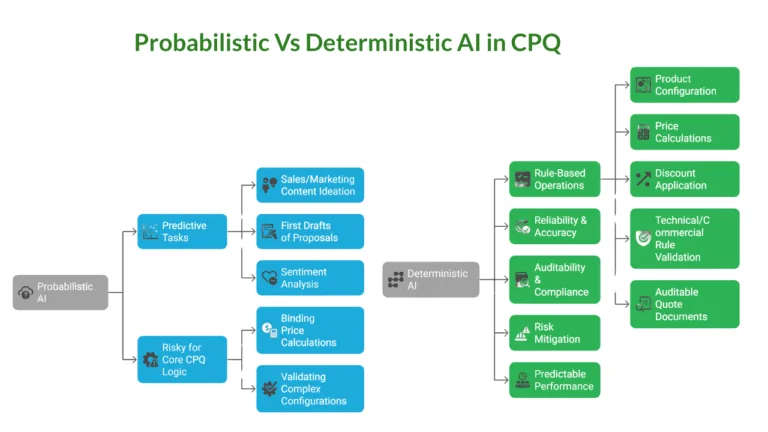
As Artificial Intelligence becomes increasingly embedded in business applications, a critical distinction often gets lost in the excitement: the difference between probabilistic AI (the guessers) and deterministic AI (the rule-followers). For leaders, especially when considering AI’s role in vital functions like Configure-Price-Quote, understanding this isn’t just a technical detail; it’s fundamental to managing risk, ensuring operational reliability, and achieving predictable business outcomes. While the creative prowess of probabilistic AI (powering many Large Language Models) is making headlines in 2025, for the core mechanics of CPQ—pricing, product rules, quote generation—a deterministic approach provides the stability and trustworthiness enterprises demand. Edward Golod’s insight about understanding AI’s nature to control it is paramount here.
Probabilistic AI – The Realm of “Most Likely” & Creativity
Probabilistic models—large language models, diffusion image generators, and other deep-learning systems—work by estimating likelihoods. Trained on massive corpora, they predict the next word, pixel, or data point, enabling them to draft natural-sounding text, generate visuals, or surface subtle patterns in unstructured data (Stanford HAI AI Index Report 2025). Their strength is-inventiveness: they fill gaps, extrapolate trends, and spin up first-pass content in seconds.
Best suited for
- Sales or marketing ideation (social posts, thought-leadership hooks, ad copy)
- First-draft proposals and presentations that humans will refine
- Sentiment and intent analysis to prioritize outreach
Use-with-caution in CPQ
- Binding price calculations or complex product-rule validation—“likely correct” can still break margin or compliance
Take-away: Probabilistic AI is a brilliant creative partner, but you need guardrails and human review before its output becomes contractual.
Deterministic AI – The Bedrock of Rules, Logic & Certainty
Deterministic systems encode explicit rules: given the same inputs, they always return the same outputs. In CPQ, that means every configuration is validated, every discount calculated, every quote generated with audit-ready precision. When stakes involve revenue recognition, compliance, or contractual obligations, predictability is non-negotiable.
Mission-critical in CPQ
- Rule-based product configuration
- Granular, auditable price calculations
- Consistent discount governance
- Enforcement of technical / commercial rules
- Automatic generation of compliant quote documents
Key strengths for revenue operations
- Reliability & Accuracy — eliminates pricing or configuration errors
- Auditability & Compliance — logic is transparent and traceable
- Risk Mitigation — removes probabilistic guesswork from core calculations
- Predictable Performance — ensures repeatable results that finance and legal teams trust
Take-away: Deterministic AI is the control system that keeps revenue processes safe, compliant, and scalable.
Putting It Together
For modern CPQ, the sweet spot is a hybrid approach:
- Use probabilistic AI at the front end to accelerate content creation, guide reps, and surface insights.
- Rely on deterministic AI for all binding decisions—pricing, configuration, and contract generation—where “exactly right” beats “probably right” every time.
This blend delivers both speed and certainty, creativity and compliance—exactly what enterprise sales needs to thrive in 2025 and beyond. (Source: Stanford HAI AI Index Report 2025).
6. Making AI Work: Smart Governance & Strategic Rollout for CPQ Success
Leadership Pain Point: Implementing AI in CPQ isn’t just about technology; it’s about managing change, ensuring ethical use, and getting real business value. How can leaders implement AI safely and strategically, avoiding ad-hoc efforts that yield poor results?
“Know how AI is coded to know how to talk to it.” – Edward Golod (implying understanding is key to control and effective use)
Successfully integrating Artificial Intelligence into your Configure-Price-Quote system requires more than just good intentions; it demands a disciplined, strategic approach to both governance and implementation. Edward Golod’s insight about understanding AI to control it extends to how you roll it out and manage it. Without a clear framework, AI initiatives can become fragmented, miss strategic goals, or introduce unintended risks related to data privacy, bias, or security. In 2025, a proactive, well-governed AI strategy is essential for turning CPQ technology investments into sustained business advantages.
This means moving beyond simply trying out AI features to establishing a structured “training camp” for AI adoption—a methodical process to build internal capabilities, manage risks, and ensure AI aligns with core business objectives. The Stanford HAI AI Index Report 2025 underscores the rapid advancements in AI, making a reactive approach untenable. A well-defined governance structure provides the necessary guardrails, while a phased implementation allows for learning and refinement, ensuring your AI-CPQ solution is both powerful and reliable.
3 Essential AI Governance Steps for Your CPQ
- Establish a Cross-Functional AI-CPQ Oversight Team: Assemble a dedicated group with representatives from Sales Ops, IT/Security, Legal/Compliance, Finance, and business leadership. This team will define AI policies for CPQ, oversee ethical guidelines, manage data governance, and ensure AI initiatives align with overall business strategy.
- Implement a “Human-in-the-Loop” for Critical Decisions: For high-stakes CPQ outputs (e.g., final pricing on major deals, complex configurations with significant implications, contractual terms suggested by AI), mandate human expert review and approval. This acts as a crucial “hallucination gate” and ensures accountability.
- Mandate Regular Audits for Bias, Performance & Security: Continuously monitor your AI-CPQ models for accuracy, potential biases (which can creep in, especially with self-learning systems), and security vulnerabilities. Ensure your vendor provides transparency and tools for these ongoing assessments.
Strategic Implementation: A Phased Approach
- Start with Pilot Programs: Don’t attempt a full-scale AI rollout in CPQ at once. Begin with controlled pilot projects in specific areas to test AI functionalities, gather user feedback, and identify any operational challenges or AI “quirks” (as Golod did when testing models).
- Prioritize Data Readiness: AI is only as good as its data. Ensure your product catalogs, pricing rules, customer information, and historical sales data are accurate, clean, and well-structured before deploying advanced AI capabilities in CPQ.
- Integrate AI-CPQ with Broader Sales Strategy: Clearly define how AI-driven insights from CPQ will support overarching sales objectives, such as key account planning, cross-sell/upsell initiatives, or new market entry.
Conclusion: Your Next Move in Mastering Enterprise CPQ – Partner with servicePath™
Navigating the complexities of modern B2B sales and the rapid evolution of CPQ technology demands more than just a software vendor; it requires a strategic partner. The insights from industry veterans like Edward Golod and the undeniable trends highlighted in reports like the Stanford HAI AI Index 2025 underscore a critical reality: the future of sales success lies in intelligent, agile, and reliable CPQ systems that empower, not overwhelm, your teams.
For leaders and senior executives, the core challenges are clear:
-
Taming Complexity: Are your current systems struggling to handle intricate product configurations, dynamic pricing, and complex deal structures, leading to errors and delays?
-
Boosting Sales Agility: Is your sales team bogged down by manual processes and clunky tools, preventing them from responding quickly to customer needs and market changes?
-
Ensuring Profitability: Are you confident that every quote accurately reflects optimal pricing and protects your margins, especially in high-stakes enterprise deals?
-
Future-Proofing Your Revenue Operations: Is your CPQ solution built to adapt and scale, ready to leverage advancements that enhance decision-making and operational efficiency, without succumbing to unreliable guesswork?
servicePath™ was built to tackle CPQ’s toughest challenges. Our enterprise-grade platform simplifies quote-to-cash by automating complex configurations, enforcing pricing rules, and delivering real-time insights—so your sales team spends less time on admin and more time closing high-value deals.
Under the hood, servicePath™ combines rock-solid reliability, intuitive design, and strategic flexibility. Whether you’re rolling out new products, refining discount strategies, or scaling into new markets, our solution adapts to your business needs without sacrificing control or transparency.
Ready to elevate your CPQ game? Let’s explore how servicePath™ can help you master complexity, protect margins, and accelerate growth—empowering your team to sell smarter and win more, every time.
Ready to Take the Next Step?
- Listen to the entire podcast now
-
Read More: Explore additional blogs and insights on CPQ, quoting transformation, and digital sales enablement.
-
Download Our Case Studies: See how leading enterprises have transformed revenue operations with servicePath™.
-
Check Out Our G2 Reviews: Discover what real users love about servicePath™.
-
Recognized by Gartner: Find out why we’ve been named a Visionary in the Gartner Magic Quadrant for CPQ Application Suites three years in a row.
-
Book a Virtual Coffee ☕ : Let’s chat about your challenges and explore how servicePath™ can help. No pressure—just insights.
Let’s grow revenue together—one smart quote at a time.
Sources
- Stanford Institute for Human-Centered Artificial Intelligence (HAI). (2025). Artificial Intelligence Index Report 2025. https://hai.stanford.edu/ai-index/2025-ai-index-report (Main report page)
- (2025, March 31). Gartner Forecasts Worldwide GenAI Spending to Reach $644 Billion in 2025. https://www.gartner.com/en/newsroom/press-releases/2025-03-31-gartner-forecasts-worldwide-genai-spending-to-reach-644-billion-in-2025
- Generative AI. https://www.gartner.com/en/topics/generative-ai .
- https://www.gartner.com/en/insights/generative-ai-for-business
- https://www.gartner.com/en/articles/3-bold-and-actionable-predictions-for-the-future-of-genai)
- Gartner Magic Quadrant CPQ 2025″ https://pros.com/gartner-magic-quadrant-2025/ or https://www.infor.com/news/infor-leader-gartner-magic-quadrant-cpq-2025).