

One strong read a month on revenue, pricing and AI. Get the next edition in your inbox.
We built our FY27 plan in March. By September the targets were still on the page, but what held them up had moved: how our engineers work, what marketing spends its day on, which roles we needed and which we did not. The plan had not failed. The ground under it had.
I started calling it the shifting strategy floor. It is now the introduction to a book I am writing, and it is this month’s main read. If your plan still looks right on paper and feels wrong underneath, start there. There is a question from me at the bottom.
Daniel Kube
CEO, servicePath™

The shifting strategy floor
One doubling between two board meetings.
METR’s January 2026 update puts the doubling time for the length of tasks AI agents can complete at about four months. A plan signed in January assumes January’s tools, and by December your teams are using different ones. The floor does not move evenly either: engineering, support and marketing shift first, finance close and procurement later, so one team stands on new ground while the team beside it is still on the old floor.
The answer is not a better plan. Review strategy as often as the floor demands, and keep one thing fixed: the governed product, pricing and approval rules that every person, partner and AI agent quotes through. Inside: four public wrecks and what each was missing, a five-area score for your own floor, and six questions for any vendor whose AI touches your revenue.
The logic that governs your revenue is the one thing that must not move.
Also in this edition
- 01Best Salesforce Revenue Cloud alternatives for 2027
- 02AI builds the offer. Someone still has to price it.
- 03Speed lives three levels below the quote
- 04Executive Conversations with Omar Rick Kazi
- 05Six questions a CFO should ask before an AI agent quotes
Best Salesforce Revenue Cloud alternatives for 2027
Salesforce has set no end-of-life date and forces no migration. Your 2027 budget has a date, and it is closer. For technology service providers, telcos and systems integrators, seven platforms compared on five criteria, on what each vendor publishes about itself, checked 28 October to 4 November.
Plus the six questions to put to every vendor and a six-week path to a December decision.
Your hardest deal is the only fair test.
AI builds the offer. Someone still has to price it.
The first time the team connected AI to quoting in a sandbox, it created a quote, created an order, and pushed it through without any approvals.
Our Product Director Ben Buck came to the Birmingham stage with his own count: of about 5,000 AI interactions over six months, roughly one in seven needed a correction, and the rate barely moved as the models improved. Then the four deterministic models the AI now has to quote on top of.
Brilliant, but confidently wrong.
Speed lives three levels below the quote
If the fix on your roadmap is a faster quoting screen, read this before you fund it. The slowness in a complex deal sits three levels below the screen: in the product, the contract and the economics.
One deal, followed through all three, to show where the speed is hiding.
Complex deals are slow because they are uncertain, not because they are governed.
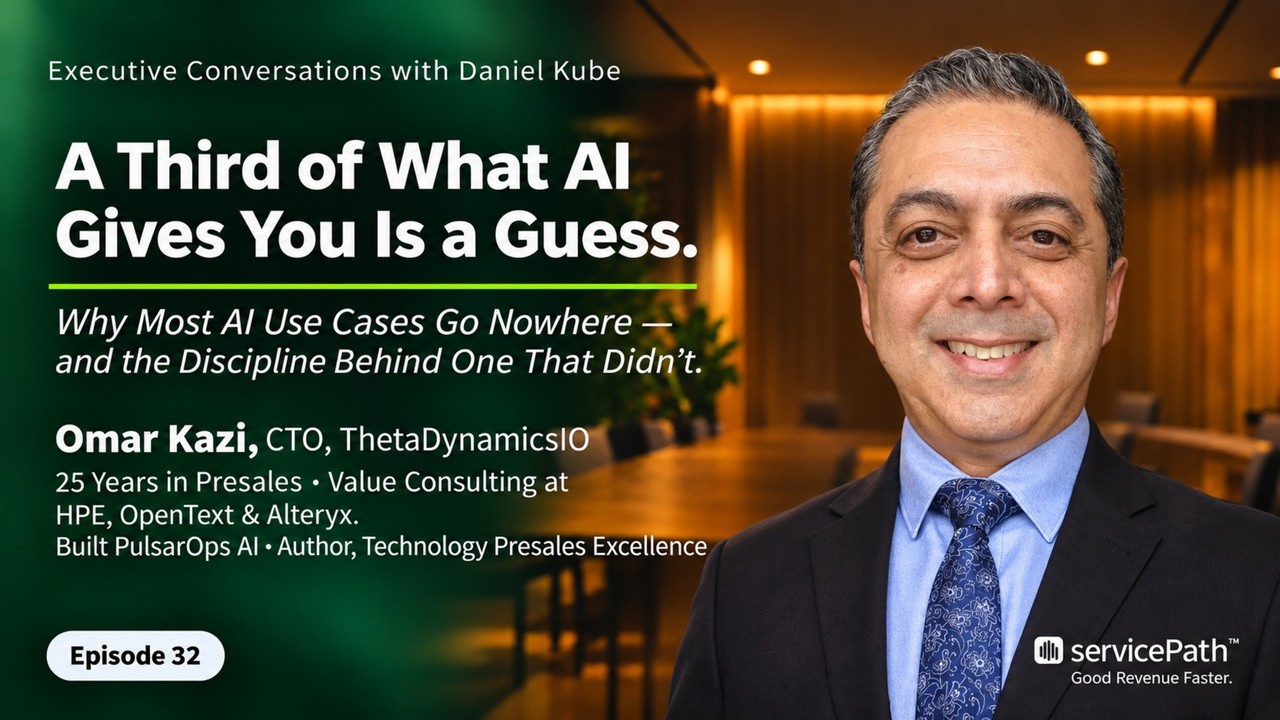
A Third of What AI Gives You Is a Guess, with Omar Rick Kazi
Omar’s team handed him a document written by AI. His note back: “that document was 9 pages, it could have been one.” He builds AI for a living, leading the team behind PulsarOps AI, so his warning about public chatbots carries weight.
Why the newest model is not always the right one, what a single SEV1 outage call really costs, and where the human has to stay in the loop.
About a third of the data is approximate or guesses.
Six questions a CFO should ask before an AI agent quotes
An AI agent can apply every rule it was given and still commit the business to a deal it should not accept. Six questions for any vendor on the shortlist, servicePath™ included, each with the answer that should satisfy finance and the one that should not, plus a six-number readiness scorecard to take to the board.
The investment goes to the speed. The control goes unfunded.
Shifting strategy floor
The set of assumptions a strategy stands on, from how work gets done to what customers buy. Those assumptions now move faster than the planning cycle above them, and in Daniel Kube’s view the floor moves every quarter. He coined the term for his forthcoming book.
If an AI agent quoted your largest customer tomorrow, which rule would catch the mistake?
Name the rule, or tell us there isn’t one. Subscribers can reply to any edition, and Daniel reads every answer.
If your answer was “there isn’t one,” bring your most complex deal, the one a seller, a partner and an AI agent can all quote, and watch one set of rules price it, route the approval and hold the margin. You will be working with a CPQ architect on your deal, not a salesperson on a demo script.
P.S. If a Salesforce CPQ renewal lands before your 2027 budget locks, forward the Revenue Cloud comparison to whoever owns it. The six questions in it work on every vendor, Salesforce included.
Want December in your inbox? One strong read a month, unsubscribe any time.